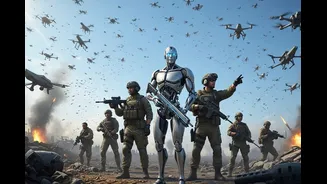










When The Terminator introduced audiences to autonomous killing machines in 1984, the idea seemed like a distant dystopian fantasy. Four decades later, militaries around the world are investing billions
of dollars in artificial intelligence, autonomous systems and humanoid robots, bringing elements of that once-fictional future closer to reality.
The latest example comes from Foundation Robotics, a San Francisco-based start-up that says it is developing autonomous humanoid robots for both industrial and military applications. It is part of a growing global push by robotics companies to build machines capable of performing tasks far beyond household chores, from manufacturing and healthcare to logistics and defence.
The war in Ukraine has already shown how quickly military technology can evolve. Cheap drones that were once viewed as niche tools are now being used for surveillance, targeting, logistics and direct attacks, fundamentally changing the way wars are fought.
While fully autonomous “robot soldiers” remain some distance away, the race to develop military robotics is accelerating, driven by advances in AI, growing geopolitical competition and the desire to reduce battlefield casualties. The question now is no longer whether robots will play a bigger role in warfare, but how far that role could eventually extend. Could humanoid robots one day fight alongside human soldiers on the battlefield?
Why Is The World Talking About Robot Soldiers?
Interest in military robots has surged because the underlying technology has improved dramatically in recent years. Unlike traditional industrial robots, which typically operate in factories and perform repetitive tasks, humanoid robots are designed to move through environments built for humans. They can climb stairs, navigate rough terrain, carry equipment and potentially work alongside soldiers without requiring major infrastructure changes.
Around 229,000 robotic systems were sold for industrial, with 70% of global sales coming from just five countries: Japan, China, the US, Germany, and the Republic of Korea, according to the International Federation of Robotics (IFR). These countries have a number of government programmes aimed at supporting and developing robotics industry strategies, although the US relies more on private capital than federal funding.
They also differ from drones. Drones dominate the skies and provide aerial intelligence, but humanoid robots are being designed to operate on the ground, where many military missions still require physical presence.
Ukraine alone produced around 4 million drones in 2025, most of them low-cost FPV (first-person view) strike drones that have become central to modern battlefield tactics. Alongside aerial systems, Kyiv has increasingly deployed ground-based robots for dangerous frontline tasks such as mine-clearing, casualty evacuation and logistics support.
The US has also accelerated investment in autonomous warfare technologies. Through initiatives aimed at rapidly fielding low-cost, expendable systems, the Pentagon has increased procurement of drones, unmanned ground vehicles (UGVs) and autonomous surface vessels (USVs). Industry estimates suggest the global military robotics market is now worth more than $20 billion and is expected to grow rapidly over the coming decade.
India, meanwhile, is strengthening its indigenous drone ecosystem under the government’s ‘Make in India’ initiative. Along with boosting domestic production capabilities, New Delhi has approved several major defence modernisation programmes, including the acquisition of 31 MQ-9B Predator drones. The armed forces are increasingly exploring the use of drones, AI-enabled surveillance systems and autonomous platforms for border security and military operations.
China remains one of the world’s most aggressive investors in military AI and robotics. The country has showcased autonomous robot dogs, AI-guided drone swarms and unmanned surface vessels capable of operating in coordinated formations. Beijing’s strategy increasingly focuses on integrating advances in commercial artificial intelligence and robotics with military applications, reflecting the growing convergence between civilian technology and modern warfare.
What Can Humanoid Robots Actually Do Today?
Despite the excitement surrounding military robotics, today’s humanoid robots are still far from replacing soldiers. Most of the current focus is on support roles rather than combat.
Military planners see immediate potential in using robots to carry heavy supplies, transport ammunition, deliver food and water, and reduce the physical burden on troops. Soldiers often carry equipment weighing more than 30 kg during operations, making robotic assistance attractive.
Humanoid robots are also being tested for reconnaissance missions. They can potentially enter dangerous areas, inspect buildings, monitor enemy positions and collect intelligence without putting soldiers directly at risk.
Another promising application is casualty evacuation. In conflict zones, retrieving wounded soldiers can be one of the most dangerous tasks. Robots capable of moving through hostile environments could help rescue casualties while reducing risks to medical personnel.
Logistics support is another area attracting significant investment. Robots could operate in contaminated environments, underground tunnels, disaster zones or high-risk military areas where human access is difficult.
However, experts caution that fully autonomous combat remains highly limited. Modern robots still struggle with unpredictable environments, complex decision-making and rapidly changing battlefield conditions. Most current systems require significant human oversight.
The Lessons From Ukraine And Modern Warfare
If Ukraine has taught militaries one lesson, it is that technology can transform warfare much faster than expected. Ukraine, which launches 9,000 drones every day, has become the world’s premier testing ground for arms manufacturers, including Western start-ups.
The conflict has demonstrated the value of systems that reduce human exposure to danger while maintaining operational effectiveness.
According to Mike LeBlanc, a former US Marine who served multiple combat tours in Iraq and Afghanistan, the experience was eye-opening. As quoted by TIME, LeBlanc said after taking Foundation Robotics’ Phantom robot to Ukraine, the battlefield looked fundamentally different from the wars he fought. In Iraq and Afghanistan, soldiers carried out most combat operations while technology played a supporting role. In Ukraine, he argues, that equation is increasingly being reversed, with drones and robotic systems taking centre stage and humans often supporting the machines.
Moreover, LeBlanc believes that large armies of humanoid robots will “eventually nullify each side’s tactical advantage in any conflict much like nuclear deterrents— exponentially decreasing escalation risks”.
Military strategists increasingly view autonomous and semi-autonomous systems as force multipliers. Rather than replacing soldiers, they can help armies achieve more with fewer personnel.
Uncrewed Ground Vehicles (UGVs) are already being used on the frontlines in Ukraine, with some reportedly holding defensive positions for weeks at a time. However, their size and shape make them relatively easy to detect, leaving them vulnerable to drone attacks. Humanoid robots, proponents argue, could offer a tactical advantage. Because they resemble humans in form and movement, they can take cover in trenches and bunkers, move through terrain designed for soldiers, and conceal themselves more effectively before engaging in combat, according to Popular Mechanics.
Another advantage is endurance. Human soldiers defending a position can eventually become combat ineffective after suffering significant casualties, forcing them to retreat or surrender. Robots, by contrast, do not face fatigue, fear or morale issues. Military analysts argue that an autonomous defensive force could continue operating until every machine is disabled, potentially making such positions much harder to capture than those defended solely by human troops.
Meanwhile, Ukraine aims to build some 50,000 military robots this year, according to Popular Mechanics.
Where India Stands In The Race
India is not among the global leaders in military robotics yet, but it is actively building capabilities.
The Ministry of Defence has identified AI, autonomous systems and robotics as strategic priorities under several modernisation initiatives. The armed forces have already experimented with robotic surveillance platforms, autonomous vehicles and AI-powered systems.
Indian start-ups and defence technology firms are increasingly entering the sector. Listed drone-maker IdeaForge Technology already supplies surveillance drones to the Indian armed forces, including systems designed for operations in high-altitude and difficult terrain.
At the same time, a new wave of defence-tech start-ups is pushing the boundaries of autonomous warfare. Companies such as Flying Wedge are developing drone-swarm technologies for counter-drone operations, while Vayudh is working on autonomous reconnaissance and surveillance platforms. Together, they reflect India’s growing ambition to build indigenous capabilities in military AI, robotics and autonomous systems.
Torus Robotics is developing autonomous platforms that can assist troops with logistics, transport heavy loads and navigate challenging terrain along India’s border regions, potentially reducing the physical burden on soldiers operating in harsh conditions.
Humanoid robots could potentially assist with surveillance, supply transport and infrastructure maintenance in these environments, reducing risks to personnel.
India reached a record 9,120 robot installations in 2024, a 7% increase year-on-year, making it the sixth-largest installer worldwide. Automotive led with installations surging 15% to 4,070 units, plastics and chemicals grew 33% to 600 units, and the metal industry grew 30% to 420 units. With GDP growth projected at 6.5% in 2024-2025 and continued EV investments, India’s robotics market is set to expand further.
Ethical Question: Should A Machine Ever Be Allowed To Fight A War?
Supporters argue that autonomous systems could eventually reduce mistakes, improve precision and lower civilian casualties. Critics counter that delegating lethal decisions to algorithms raises serious moral and legal concerns.
Unlike nuclear weapons or chemical weapons, there is currently no comprehensive international treaty governing autonomous weapons systems. The United Nations leadership has urged member states to negotiate and conclude a legally binding treaty to prohibit fully autonomous weapons that operate without human oversight.
Human rights organisations and many AI researchers have repeatedly called for strict regulations to ensure meaningful human control over any system capable of using lethal force.
For now, robot soldiers remain an emerging technology rather than a battlefield reality. But as AI becomes more powerful and robotics more capable, the line between science fiction and military strategy is beginning to blur. The countries that master this technology first may gain a significant advantage in the wars of the future.