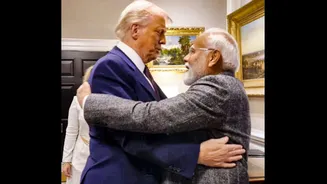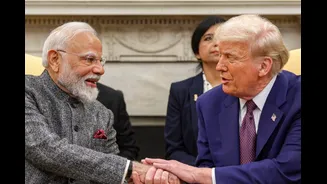




US President Donald Trump on Monday announced that he had finalised a trade deal with India that lowers US reciprocal tariffs on Indian commodities to 18 per cent from 25 per cent.
In a post on Truth Social,
Trump described Prime Minister Narendra Modi as a ‘great friend’, saying he spoke to him on a range of issues, including the ongoing Russia-Ukraine war.
Echoing the sentiment, Prime Minister Modi thanked the US President for the “wonderful announcement”. In a post on ‘X’, Modi wrote, “Wonderful to speak with my dear friend President Trump today. Delighted that Made in India products will now have a reduced tariff of 18%. Big thanks to President Trump on behalf of the 1.4 billion people of India for this wonderful announcement.”
Wonderful to speak with my dear friend President Trump today. Delighted that Made in India products will now have a reduced tariff of 18%. Big thanks to President Trump on behalf of the 1.4 billion people of India for this wonderful announcement.
When two large economies and the…
— Narendra Modi (@narendramodi) February 2, 2026
The Prime Minister described President Trump’s leadership as “vital for global peace, stability, and prosperity”, asserting the nation’s support for his peace efforts.
“When two large economies and the world’s largest democracies work together, it benefits our people and unlocks immense opportunities for mutually beneficial cooperation. President Trump’s leadership is vital for global peace, stability, and prosperity. India fully supports his efforts for peace. I look forward to working closely with him to take our partnership to unprecedented heights”.
Industrialists Hail India-US Trade Deal
The India-US trade deal, announced late Monday evening, prompted reactions from industry veterans as they welcomed the development and expressed hope that the deal would strengthen the bilateral ties between the two countries.
Anand Mahindra, Chairman of Mahindra Group, wrote in a post on ‘X’, “More evidence of the benefits of ‘Making haste slowly.’ When the noise subsides, two natural partners will come together…”
More evidence of the benefits of “Making haste slowly.”
When the noise subsides, two natural partners will come together… https://t.co/9YjjMFBDMS
— anand mahindra (@anandmahindra) February 2, 2026
Kumar Mangalam Birla, Chairman of Aditya Birla Group, congratulated Prime Minister Modi and President Trump for agreeing to the India-US trade deal.
“I applaud Prime Minister Modi and President Trump for today’s trade announcement. The reduced tariffs will help strengthen the strategic and economic ties between our two great countries and provide additional opportunity for investment and collaboration. The Aditya Birla Group is the largest Indian investor in the U.S., and we see this agreement help shape more resilient supply chains, unlock manufacturing opportunities and drive long-term economic competitiveness in both the U.S. and India. We are committed to expanding our presence and investments in the U.S., where we see substantial opportunities for innovation, growth and enduring partnerships”, he said.
Ashish Chauhan, Managing Director and CEO of the National Stock Exchange, welcomed the India-US trade deal, describing it as a “big win for businesses, supply chains and partnership between the two nations”.
“Welcome move for global trade! Congratulations! After today evening’s talks between the US President Mr @realDonaldTrump and the Indian Prime Minister Shri @narendramodi, tariffs on Indian goods coming down sharply from 50% to 18% with immediate effect. A big win for businesses, supply chains, and the India–US partnership. Kudos to the teams involved in bringing this historic deal to a close”, he said.
Sujan Hajra, Chief Economist & Executive Director at Anand Rathi Group, acknowledged that the imposition of a steep 50 per cent tariffs disrupted a “wide swathe of Indian exports”.
“While the imposition of a 50% US tariff disrupted a wide swathe of Indian exports, its direct impact on the earnings of India’s listed corporates was limited. India’s tariff impacted parts of goods export exposure to the US is skewed toward privately held MSMEs and low-margin manufacturing rather than large, listed firms. Consequently, the subsequent rollback in tariff rates is unlikely, by itself, to materially alter the earnings trajectory of Indian equities.”