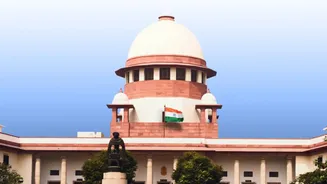







The Centre informed the Supreme Court on Thursday that it is reconsidering the University Grants Commission (UGC) regulations, 2026. These regulations were aimed at preventing caste discrimination in higher
education institutions.
The UGC (Promotion of Equity in Higher Education Institutions) Regulations, 2026 were notified on January 13 but stayed by the Supreme Court on January 29. The rules have since become a political issue, with sections of dominant-caste groups opposing provisions they say exclude general category students and Dalit and OBC groups demanding that the regulations be implemented.
“It is being reconsidered,” Solicitor General Tushar Mehta told a three-judge bench headed by Chief Justice of India Surya Kant. The bench was hearing petitions challenging parts of the regulations, particularly the definition of caste-based discrimination.
The main point of contention is Regulation 3(1)(c), which defines caste-based discrimination as discrimination against members of the Scheduled Castes, Scheduled Tribes and Other Backward Classes on the basis of caste or tribe.
The petitioners have argued that this wording does not give general category students and faculty specific protection against caste-based discrimination. The regulations, however, separately define discrimination more broadly and cover unfair or differential treatment based on caste against any stakeholder.
Moreover, the caste system is not one where unequal treatment and oppression were directed against all communities uniformly. It is a system designed by particular privileged and socially dominant groups to suppress and systematically disadvantage a very particular set of communities.
The issue has also acquired a political dimension in Bihar and Uttar Pradesh. Sections of dominant-caste groups protested after the rules were notified, arguing that the specific reference to SCs, STs and OBCs amounted to exclusion of general category students.
The Supreme Court stayed the regulations on January 29 and restored the 2012 framework until further orders.
What The Supreme Court Questioned
The regulations followed a 2019 petition filed by the mothers of Payal Tadvi and Rohith Vemula, who had died by suicide after facing caste-based discrimination in their universities. Their mothers had sought stronger safeguards against discrimination in higher education.
The court has raised several questions about the new rules. One concerns whether the special definition of caste-based discrimination is needed when the regulations already have a wider definition of discrimination.
The bench also wants to examine whether the rules adequately protect particularly disadvantaged groups within the SC, ST and OBC categories.
Another concern relates to the word “segregation”. The court questioned whether separating students in hostels, classrooms or mentorship groups, even when done on apparently neutral grounds, could violate constitutional guarantees of equality.
The petitions have mainly been filed by Mritunjay Tiwari, advocate Vineet Jindal and Rahul Dewan. Their main thrust is against Regulation 3(1)(c).
Rules Had Triggered Student Mobilisation
The controversy had mainly manifested itself beginning in higher education institutions. After initial protests by sections of dominant-caste groups, students from marginalised backgrounds and progressive student organisations began mobilising against the Supreme Court stay and demanding implementation of the regulations.
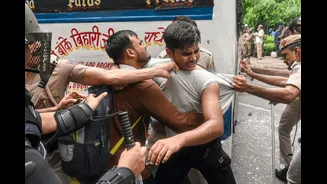
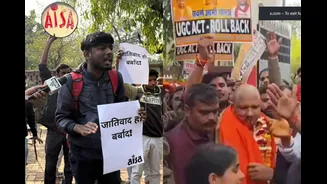
Student groups, like the All India Students’ Association (AISA), organised marches at Delhi University. Hundreds of students took part in an “Equity March” at North Campus on February 3, demanding that the rules be implemented.
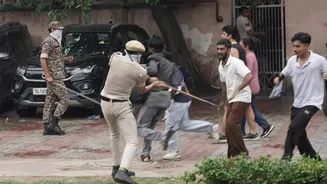
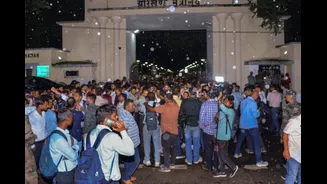
The protests later turned confrontational. A demonstration in support of the regulations at Delhi University’s North Campus in February saw clashes between student groups, with allegations of assault and counter-allegations of violence. Cross FIRs were registered and police began examining CCTV footage.
The student mobilisation has added another layer to the political dispute over the regulations. While critics have focused on what they describe as ambiguities and the exclusion of general category students, supporters argue that the rules are necessary to address caste discrimination and institutional barriers faced by marginalised students in higher education.