




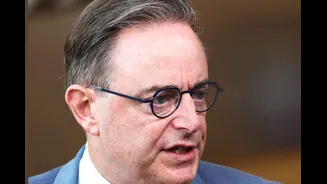
Belgian Prime Minister Bart De Wever said Europe underwent a “rude awakening” over the risks of trade and industrial dependencies, acknowledging that India had warned European countries about the issue
earlier but that the warnings were ignored.
Speaking at a CII event, Bart De Wever said India and Europe faced similar challenges as economic dependencies were increasingly being used as leverage in global trade and geopolitics.
“We face the same challenges. We are confronted with the same power blocks that are going in a certain direction, a direction that we maybe do not like and we do not like to be pushed around. We do not like dependencies becoming weaponized against us,” he said.
Bart De Wever said India had recognised the risks of excessive economic dependence on other countries much earlier, while Europe was now confronting the consequences.
“You have lived this history. Your prime minister warned Europe about this long time ago already, but he was ignored. He wasn’t listened to. We are listening now. It’s a bit late maybe in Europe this awakening, but it is happening,” he said.
Bart De Wever described Europe’s experience with trade and industrial dependencies as a “rude awakening”, saying the continent had allowed foreign overcapacity to be dumped below cost on its markets while its industrial base was weakened.
“The country that has profited most from that practice does not lie very far from here. It’s a neighbor you all know. And India saw this earlier than we did and they warned us and we didn’t listen,” he said, in a veiled reference to China.
Responding to a question on why India and Europe could build a durable strategic partnership amid increasing global economic fragmentation, Bart De Wever said Europe was looking for partners committed to multilateralism and cooperation based on “respect and not force”.
“If India is not on that list then you have missed something very fundamental. India is on that list. It’s number one,” he said.
Bart De Wever described India as the world’s largest and fastest-growing economy, with a large talent pool and significant scope for cooperation in trade, investment, technology and supply-chain resilience. He said India’s growth prospects offered opportunities that were different from those of more mature economies such as Japan.
Bart De Wever said Europe and India should work towards more diversified trade with partners that honour their commitments, while recognising that openness to global markets could not mean ignoring strategic dependencies.
“Defending our national interests is essential to maintaining the trust required for free trade,” he said.
He acknowledged that India and Europe had different histories, institutions and strategic outlooks, but argued that their interests converged in several important areas.
“India is a major democratic power, a leader in innovation, a voice that cannot be missing when a free and prosperous world is shaped,” Bart De Wever said.
He said Europe could contribute its single market, industrial and technological capabilities and commitment to predictable, rules-based cooperation.
“In a world where too many countries are being asked to choose a camp, India and Europe choose partnership decisively,” he said.