
A day after the Brihanmumbai Municipal Corporation (BMC) election results were announced, the Maharashtra cabinet gave a key toll relief to motorists travelling on the Atal Setu. Moreover, the City And
Industrial Development Corporation Of Maharashtra Ltd (CIDCO) has plans to directly link this bridge to the Coastal Road and the Navi Mumbai International Airport (NMIA). What is the toll relief? How much is the discount? Which vehicles can avail of it? What is the plan for the link? All you need to know.
Atal Setu or Mumbai Trans Harbour Link
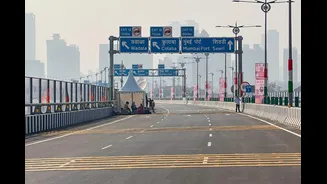
The Mumbai Trans Harbour Link, officially named as Atal Bihari Vajpayee Sewri-Nhava Sheva Atal Setu and colloquially known as Atal Setu, is a 18.2-km, six-lane grade separated expressway bridge, which connects Mumbai with Navi Mumbai, its satellite city. It is the longest sea bridge in India, and the world’s 12th longest sea bridge.
The bridge begins in Sewri, South Mumbai, crosses Thane Creek north of Elephanta Island, and terminates at Chirle near Nhava Sheva in Uran taluka, Navi Mumbai. The road is linked to NH348 in the east and to the Eastern Freeway in the west.
Prime Minister Narendra Modi inaugurated the bridge on January 12, 2024, and it was opened to the public a day later. The Atal Setu has transformed how people move between South Mumbai and key locations such as Panvel, Pune, and Navi Mumbai.
By cutting travel time by at least an hour, it has made daily commute significantly smoother. Currently, around 60,000 vehicles use this bridge every day.
Atal Setu toll relief
Earlier, on January 4, 2024, the cabinet decided to give a 50 per cent toll discount on Atal Setu. The Maharashtra cabinet on Saturday approved extending the toll discount on Atal Setu for another year, till December 31, 2026. This means, the 50 per cent toll discount on the bridge connecting Mumbai and Navi Mumbai will continue.
Different rates have been fixed for cars, jeeps, vans, light and heavy vehicles, buses, trucks, and heavy construction machinery, and toll will be charged according to the type of vehicle.
What are Atal Setu toll rates?
The Atal Setu has a standard Rs 250 toll for cars/SUVs with the ongoing 50% discount. This means the initial proposed rates (like Rs 375 for a single car journey) have not been fully implemented, with the concessional Rs 250 rate for four-wheelers continuing, plus a full exemption for electric cars and buses.
Current Rates (with 50% concession)
- Cars/SUVs (Four-Wheelers): Rs 250 (single journey)
- Electric Vehicles (EVs) & Buses: Complete toll exemption
Atal Setu-NMIA link: What is the plan?
CIDCO plans to directly link Atal Setu to the Coastal Road and the Navi Mumbai International Airport. This decision will make travel between Uran, Panvel, JNPT, Navi Mumbai Airport, and Mumbai faster and smoother.
As part of this project, six ramps will be built at the Shivajinagar Interchange near Gavhan village in Uran taluka. Earlier, this connection was not possible because the Coastal Road work had not started when Atal Setu was being planned.
But now, with CIDCO speeding up the Coastal Road work, the necessary linkage through the Shivajinagar connector can be completed.
The Coastal Regulation Zone (CRZ) authority has approved the construction of these six ramps with certain conditions, and the proposal has been sent to the Ministry of Environment, Forest and Climate Change for further approval. Work will begin once approval is received. This project will not only improve road traffic but also strengthen railway connectivity. The area is already connected by Nhava Road and Uran Road, and the new ramps will make Kharkopar railway station even more accessible. As a result, transportation between JNPT, Chirle, Mumbai, and Navi Mumbai Airport will greatly improve.
Although about 936 mangrove trees will be affected by this project, the Environmental Impact Assessment (EIA) report says that necessary measures will be taken to minimize the damage. The project will cover about 3.5 hectares and include 32 structural modules. Each span will be 75 meters long and built on 1.0-meter diameter bored cast-in-situ piles, with enough rock socketing for long-term strength. Once completed, this project will make it easier, faster, and safer for people in Raigad district to reach Mumbai and Navi Mumbai, and it will give a new direction to the entire Mumbai Metropolitan Region’s transport system.