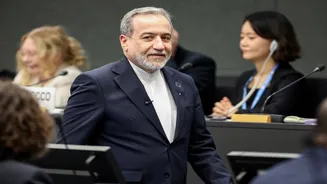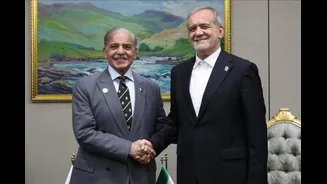








Acting on the invitation of Pakistan PM Shehbaz Sharif and Field Marshal Asim Munir, Iranian President Masoud Pezeshkian is set to visit Islamabad for strategic talks on Tuesday. The US-Iran peace deal
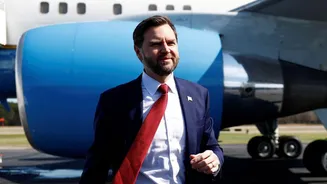
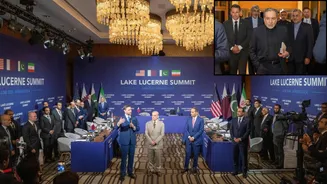
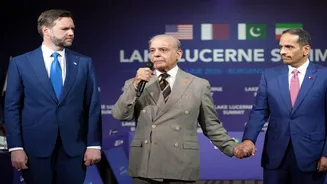
framework tops the agenda of Pezeshkian’s Pakistan visit. The Iranian President is set for Islamabad talks to exchange regional perspectives. Talks between Iran and the U.S. have concluded successfully in Switzerland, Pakistani Prime Minister Shehbaz Sharif said on Monday. “The discussions were held in a positive and constructive atmosphereand yielded encouraging progress, including agreement on a roadmap toward a final deal within 60 days, the establishment of a high-level committee to provide political oversight, and the commencement of further technical talks,” he said in a post on X. US Vice President JD Vance, Special Envoy Steve Witkoff, and President Donald Trump’s son-in-law Jared Kushner held a meeting with the Pakistani mediating team in Switzerland’s Burgenstock resort on Sunday ahead of negotiations with the Iranian delegation scheduled for later in the afternoon. The members of the American delegation were seen exchanging handshakes with Sharif and Munir.
This key meeting took place shortly after Sharif, accompanied by Munir and a high-level delegation, arrived in Switzerland on Sunday to participate in technical-level talks between the United States and Iran aimed at restoring peace in West Asia.
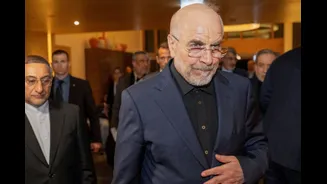
Iranian Parliament Speaker and chief negotiator Mohammad Bagher Ghalibaf met Sharif in Switzerland on the sidelines of the negotiations.
The diplomatic push gained momentum following the arrival of American and Iranian delegations in Switzerland for this upcoming round of negotiations. These talks are being held under a 14-point Memorandum of Understanding (MoU) finalised on June 17 by US President Donald Trump and Pezeshkian.
While the technical-level talkswere originally scheduled to commence on Friday, they faced sudden delays, primarily due to recent exchanges of fire between Israel and Lebanon, which threatened to derail the diplomatic timeline.
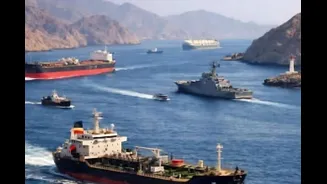
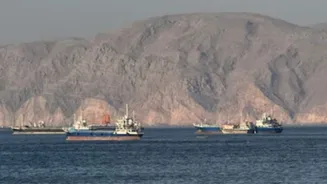
A primary objective behind these urgent negotiations is securing global energy corridors. The finalisation of the MoU had prompted the reopening of the crucial Strait of Hormuz maritime route, which handles nearly 20 per cent of global energy supplies under normal conditions. The waterway had been blocked since 28 February following joint military strikes by the US and Israel on Iran, which provoked retaliatory actions from Tehran. However, contradictory reports emerged on Saturday, as Iran claimed it had shut down the waterway again following an Israeli strike in Lebanon, whereas the United States maintained that the maritime route remained open.
With ANI inputs