





What was meant to be an attempt to enhance workers’ welfare has instead set off a chain reaction across India’s industrial belt. A wage hike in Haryana has travelled far beyond state borders, fueling violent
protests in Noida, and triggering unrest as far as Bhiwadi.
At the core of this growing churn is a simple question workers are now asking: if the work is the same, why are they being paid differently?
Follow LIVE updates on Noida Protests Here
What Haryana Announced On April 1
On April 1, 2026, Haryana announced a sharp 35 pee cent increase in minimum wages. For an unskilled worker, monthly pay jumped from about Rs 11,200 to over Rs 15,200. Those in semi-skilled and skilled categories saw similar gains.
On paper, it was a welfare move, aligned with labour codes and aimed at cushioning workers against rising costs. But in tightly connected industrial clusters where state borders blur into each other, the decision didn’t stay local. It quickly became a benchmark.
How Comparisons Turned Into Anger
In places like Noida and the Gurgaon–Manesar belt, factories often belong to the same companies, sometimes even operating similar production lines. Workers talk, compare, and increasingly, organise.
So when wages went up in Haryana, workers in Noida began noticing the gap. In some cases, employees doing identical work for the same employer were earning significantly different salaries simply because they were located across a state boundary.
That’s when the demand shifted, from a routine wage grievance to equal pay for equal work.
How Noida Protest turned Violent
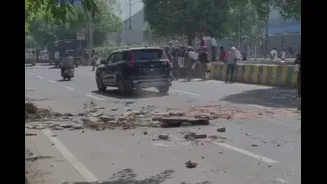
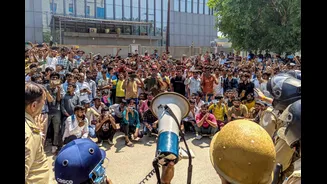
By April 13, the simmering anger spilled onto the streets. What began as factory-level protests in Noida’s industrial sectors soon escalated into widespread unrest. Workers blocked roads, clashed with police, and in several pockets, the situation turned violent, vehicles were set on fire, stones were thrown, and tear gas filled the air.
Key stretches connecting Noida to Delhi were choked for hours, turning an industrial protest into a full-blown public disruption.
Even a day later, on April 14, the tension refused to die down. Fresh protests broke out across sectors like 62, 70 and other industrial zones. Workers regrouped, roads were blocked again, and sporadic violence continued. What started as a wage dispute has now evolved into a serious law-and-order challenge.
According to reports, around 200 people were detained/arrested following incidents of stone-pelting, arson and clashes across industrial sectors on April 13. At the same time, authorities have suggested that the protests may not have been entirely organic. Police and the state government indicated that “external elements” could have infiltrated or hijacked the agitation, pointing to the possible role of organised networks spreading misinformation and amplifying unrest. Investigations are looking into suspicious activity, including bot-driven messaging and even potential foreign links, as officials try to determine whether the violence was deliberately escalated beyond the workers’ original demands.
What Are Workers Demanding?
While the wage gap triggered the protests, the anger runs deeper. Workers say they have been grappling with rising fuel costs, expensive essentials, and stagnant incomes for years. Fuelled by the recent hike in Haryana, they are now asking for more than just a pay hike:
- Fixed working hours
- Proper overtime compensation
- Weekly holidays
- Job security
The Fire Spreads To Bhiwadi
The unrest didn’t stop at Noida. In Rajasthan’s Bhiwadi, hundreds of workers gathered outside a factory unit on April 13, raising similar demands.
The protest began peacefully, with slogans and a sit-in, but tensions rose when police tried to clear the area. A blockade disrupted traffic for hours before authorities stepped in to disperse the crowd.
How Early Signs Of Unrest Were Seen In Surat
In many ways, Surat had already signalled what was coming. Weeks before Noida erupted, contract workers in the Hazira industrial belt had taken to the streets. Their complaints sound familiar now – low wages, long hours, and rising living costs. One protest even turned violent, with clashes, stone-pelting, and police action.
What happened in Surat didn’t stay there. It fed into a broader sense of frustration across industrial hubs like Panipat and Manesar, ultimately setting the stage for the explosion in Noida.
UP Steps In, Revises Wages
Faced with escalating violence, the Uttar Pradesh government moved quickly. Within a day of the Noida clashes, it announced a revision in minimum wages, effective retrospectively from April 1. The hike, around 20–21 per cent, pushed unskilled wages to about Rs 13,690 per month, with similar increases for semi-skilled and skilled workers.
It was a clear attempt to calm tempers and close the gap with Haryana. But the protests didn’t immediately fade. Stone pelting was reported in Noida’s Sector 80, even as police said they managed to calm the workers there. Tension continued in Sector 70, where stones were repeatedly thrown at police personnel. Authorities said efforts were ongoing to bring the crowd under control.
In Sector 121’s Cleo County, police vehicles were also targeted with stones as the unrest spread to residential areas. As the chaos unravelled, school children took shelter in nearby hotels.
With easy access to internet and information flowing rapidly on social media, the workers’ protests have gone beyond isolated pockets. According to fresh PTI reports, on Tuesday, the protests intensified further as domestic workers, including maids working in housing societies, also gathered in Cleo County, Sector 121, demanding higher wages and better working conditions.