


External Affairs Minister S Jaishankar on Thursday said the world is witnessing an “exceptionally volatile and uncertain phase” marked by major conflicts, economic security concerns and the recurring threat
of terrorism, while asserting that dialogue and diplomacy remain the only path to resolving disputes.
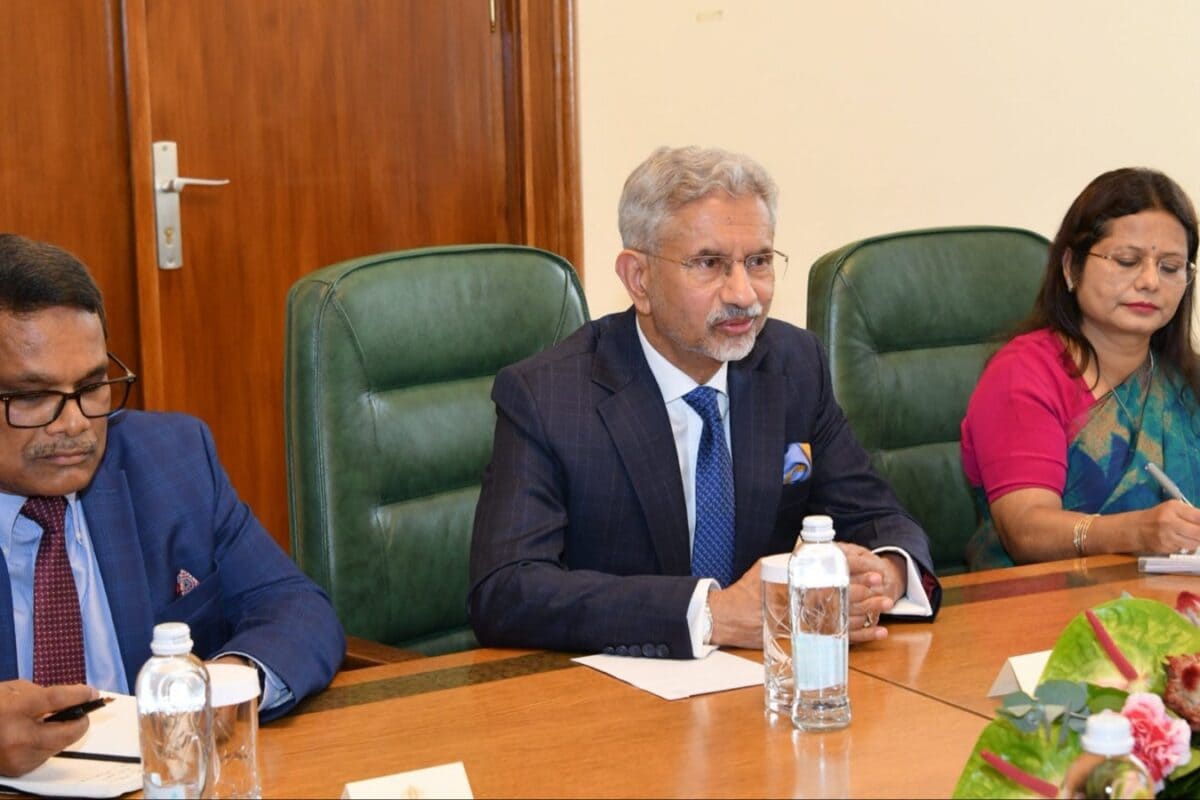
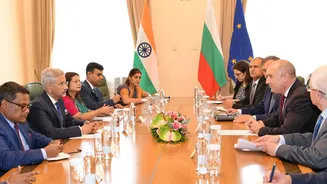
Speaking after meeting Bulgarian Foreign Minister Velislava Petrova-Chamova in Sofia, Jaishankar outlined India’s position on key global challenges and stressed that countries must adopt a firm approach against terrorism.
“We all recognise the world is passing through an exceptionally volatile and uncertain phase. This includes multiple major conflicts, concerns about economic security, and the recurring threat of terrorism,” Jaishankar said.
Highlighting India’s stance on ongoing conflicts around the world, he said, “We believe that this is not an era of war. The only solution is dialogue and diplomacy.”
The External Affairs Minister also spoke about the growing economic uncertainties facing nations and the need to build resilience against disruptions.
According to him, stronger and more diversified supply chains are critical in the current geopolitical environment.
“When it comes to economic risks, the answer is resilient supply chains and further diversification,” he said.
Jaishankar further underlined the importance of protecting global trade routes and ensuring the uninterrupted movement of goods across regions.
“It is particularly important that maritime trade is neither impeded nor endangered,” he said.
On terrorism, the minister delivered a clear message, calling for a unified global response against the menace.
“As for terrorism, the world must be clear on zero tolerance,” Jaishankar said.
#WATCH | After meeting with Foreign Minister Velislava Petrova-Chamova of Bulgaria, EAM Dr S Jaishankar says, “…We all recognise the world is passing through an exceptionally volatile and uncertain phase. This includes multiple major conflicts, concerns about economic security,… pic.twitter.com/viC3HBuCTe
— ANI (@ANI) June 11, 2026
The remarks came during a series of high-level engagements in Bulgaria, where Jaishankar met Prime Minister Rumen Radev and Foreign Minister Velislava Petrova-Chamova to discuss ways to deepen bilateral cooperation and strengthen ties between India, Bulgaria and the European Union.
According to the External Affairs Minister, his meeting with Prime Minister Radev focused on the growing opportunities created by the strengthening India-European Union Strategic Partnership and the need for closer India-Bulgaria cooperation in an increasingly uncertain world.
The two sides discussed expanding collaboration in trade and investment, pharmaceuticals, semiconductors, artificial intelligence, space, defence, mobility, tourism and the creative entertainment industry.
They also exchanged views on regional and global developments of mutual interest.
Jaishankar later held talks with Petrova-Chamova and reviewed the full spectrum of bilateral relations.
He said both countries explored new avenues of cooperation, particularly in the context of the proposed India-EU Free Trade Agreement, the Strategic and Defence Partnership and the Comprehensive Mobility Cooperation Framework.
The discussions also focused on strengthening cooperation in science and technology, AI, pharmaceuticals, defence, connectivity, education, culture and people-to-people exchanges, while increasing the frequency of political engagements.
Emphasising the future direction of ties, Jaishankar said India and Bulgaria are committed to transforming their longstanding friendship into a contemporary and forward-looking partnership.
Earlier in the day, the minister met with notable Bulgarian friends of India and discussed deepening economic, academic, cultural, and mobility partnerships between the two countries.
Jaishankar is currently on a multi-nation visit and will travel to Finland on June 11 to participate in the 14th edition of the Kultaranta Talks, where global and regional challenges are expected to be discussed under the theme ‘A World in Transition: Global, Regional and Local Perspectives’.