







Assam Assembly Elections 2026:
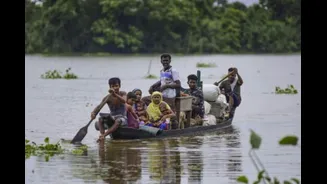
Every year, swollen rivers cut off villages, wash away embankments, destroy crops and force thousands into relief camps. And every year, politicians promise action. But for many
voters across flood- and erosion-hit districts, the question remains the same: why does Assam still drown every monsoon, despite decades of flood-control projects and changing governments?
The answer lies in both nature and politics.
A state shaped by the river
Assam sits in the floodplain of the Brahmaputra, one of the world’s largest and most unpredictable rivers. Fed by monsoon rains, Himalayan runoff and dozens of tributaries, the river carries huge volumes of water and silt into the state every year. Flooding, in that sense, is natural to Assam’s geography. But experts say the devastation has been made worse over decades by poor planning, weak flood management and short-term political fixes.
At the heart of the problem is the Brahmaputra itself. Unlike a stable river flowing in a fixed channel, it is constantly shifting, eroding banks and depositing sediment. That makes it not just a flood threat, but an erosion threat too. In districts like Dibrugarh, Dhemaji, Lakhimpur and Majuli, families are often not only flooded out — they also lose land permanently to the river.
The embankment trap
For decades, governments have tried to contain this with embankments. Thousands of kilometres of earthen barriers have been built across Assam since the 1950s. Politically, embankments are easy to showcase as action. But hydrologists and environmental historians have long warned that they often create new risks.
By trapping the river inside narrower channels, embankments can also trap sediment, raising the riverbed over time. That means when breaches happen, and they often do during heavy monsoon flows, the flooding can be even more destructive.
That is why Assam’s flood response has increasingly come to be seen as a cycle of repair, relief and repetition.
Why governments keep failing
Government audits have repeatedly pointed to delayed projects, incomplete works and poor execution in flood management. Despite repeated spending on embankment repairs, anti-erosion works and relief, Assam continues to suffer heavy losses every monsoon. Much of the state’s response remains focused on emergency rescue and rehabilitation rather than long-term resilience.
Another popular political talking point is dredging the Brahmaputra. The idea that deepening the river will reduce flooding has strong public appeal. But experts have warned that large-scale dredging is not a permanent fix for a river that carries enormous sediment loads. At best, it may help in selected stretches, but not solve Assam’s broader flood crisis on its own.
An election issue in 2026
Now, with elections approaching, floods are becoming a political test.
The ruling BJP has sought to project flood control as part of its governance and infrastructure agenda, with leaders making fresh promises on tackling the issue. But the opposition is also trying to turn the flood crisis into a question of accountability: if governments have known for decades that Assam is vulnerable, why do embankments still fail, why are floodplains still occupied, and why are relief camps still a seasonal reality?
The uncomfortable truth is that Assam cannot be made “flood-free” in the literal sense. Flooding is part of the Brahmaputra valley’s ecology. What can be changed is how destructive it becomes.
Beyond slogans
That would mean shifting away from annual emergency management and toward a more realistic long-term strategy: stronger floodplain zoning, better drainage, wetland restoration, erosion control, resilient housing and scientific river management.
As the 2026 campaign gathers pace, voters in Assam are likely to hear many more promises about taming the Brahmaputra. But for people living on its banks, the demand is much simpler: not another slogan, but a plan that finally lasts.