
Soaring above the clouds at 35,000 feet on a seat while casually snacking, listening to music, and having your favourite drink wasn’t a possibility a century ago. Today, millions of flights take off and land
every year without having to bother the safety inspectors. The technological advancements and decades of engineering have made aircraft safer than ever. Crew Resource Management (CRM), extensive simulator training, improved air traffic control and navigation systems, modern engineering allowing redundant systems, weather radars, and strict global guidelines, have only helped close the safety gaps.
Consider this: Humans can now take off from the New York John F. Kennedy International Airport aboard the Singapore Airlines’ Airbus A350 and land in Singapore Changi International Airport in roughly 18 hours. Fascinating, right?
In short, modern aviation is as sophisticated as it has ever been.
To better understand the complexities of aviation, curious people frequently turn to Google, searching for answers to uncover the ins and outs of flying. Buckle up, this ride will be smooth and turbulence-free, we promise.
Is Turbulence Dangerous?
No. Consider turbulence as bumps on a highway. Yes, they can feel uncomfortable, but modern-day jets are designed to withstand turbulence. You may see the wings flexing outside your window, but they are tested to take abuse to the extreme, invisible forces.
“Structurally, the wings are designed and tested to handle a load that is like 5x greater than the maximum performance expected from the plane, and then the pilots fly the plane at like, a fifth of that maximum performance. No turbulence is strong enough to shake a plane apart. If the weather ever got that bad, they’d see it well ahead of time and fly around it. Avoiding turbulence is 90% about keeping the flight pleasant for the passengers and 10% not putting a teeny tiny extra bit of wear and tear on the parts,” a Reddit user put it aptly.
Humans, on the other hand, aren’t as structurally gifted as the modern-day jets. So, please fasten your seatbelts!
What’s That Hole in My Window?
Paid extra for a plane’s window seat only to find a hole in your window? Don’t worry, it is there for a purpose.
Plane windows are made of three separate panes. The outer pane of the window handles air pressure difference, the middle pane, which consists of a bleed hole, balances air pressure, and then comes the inner pane, which helps protect the middle and outer pane from any damage caused by passengers. There’s a little gap between the outer pane and the middle pane.
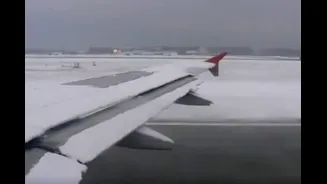
Also Read: Video of Plane Taking Off With Snowy Wings Causes Outrage: Why Is Deicing Critical For Aircraft?
The bleed hole, which is on the middle pane of the window, balances the pressure between the passenger cabin and the air gap.
Why Do Planes Leave White Trails?
Contrary to the common belief, the white trails left behind by an aircraft have nothing to do with pollution.
The plane’s engines are hot. The temperature at high altitudes is icy cold. The result? “Contrails” or “condensation trail”.
“When planes fly at high altitudes, the temperature there tends to be very low. Minus 40 degrees Celsius or even lower than that. When the plane is running, the heat of its engine is much higher than 500 degrees Celsius,” said Airline captain Manjeet Singh in an Instagram video.
“At that time (flying high), the hot gases that come out of the plane have water vapour in them. As soon as this water vapour collides with such cold air, it condenses immediately. Just like how smoke comes out of our mouth in the winter. These small ice crystals together make that white line, which we see in the form of contrails,” he added.
In short, the trails you see high in the sky are frozen water vapour.
Why Are Airplanes White?
Barring exceptions such as Air New Zealand, planes across the industry are found to be painted in white. Why? White reflects sunlight and helps keep the body cooler. White paint reportedly weighs less than other pigments. White bodies keep the birds away. Any cracks or damage are easier to spot. Thus, white paint keeps the operational cost down, making for an efficient travel. White planes have the best resale value, owing to the leasing model in the aviation industry.
Why Do We Board Only From Left Side?
Passengers, including the cabin crew, strictly board a commercial aircraft from the left side. Ground crew is tasked with refuelling, loading the cargo bay, and performing several crucial tasks. These activities take place on the right side of the aircraft before an outbound flight. Keeping access restricted to the left makes for a swift, efficient, and uninterrupted workflow for the ground crew.
Boarding from the left side is also tied to nautical legacy. Ships in the earlier days were boarded from the left or the port side. While the right side was reserved for the steering oar. To eliminate interference with the steering oar, people boarded and deboarded the vessel from the left side.
Also Read: Why Did Air India Passengers On This Flight Deboard From The Right Side?
Why Are Black Boxes Orange?
The black boxes are bright orange in colour. Why? Because a bright orange casing is easy to spot against green, blue, or brown backgrounds in the unfortunate event of a plane crash.
“The genesis of flight recorders traces back to the 1930s, when the French engineer François Hussenot began working on a data recorder equipped with sensors optically projecting around ten parameters onto a photographic film,” noted Airbus. The article added that the film ran continuously in a light-tight box, hence earning it the name “black box.”
Black box of a plane consists of: The Cockpit Voice Recorder (CVR) and the Flight Data Recorder (FDR). These two “boxes” come with distinct functions. While CVR or Cockpit Voice Recorder records every audible sound made in the cockpit, FDR or Flight Data Recorder records the aircraft system and flight data such as altitude, airspeed, and vertical speed. The Flight Data Recorder keeps a log of engine performance along with the position of control surfaces such as rudder, flaps, elevator, ailerons, etc.