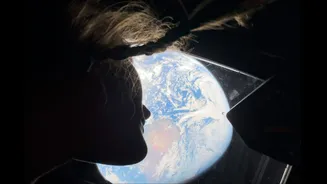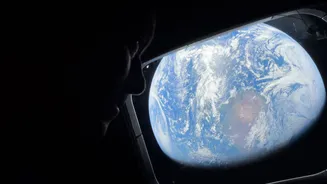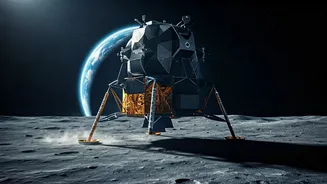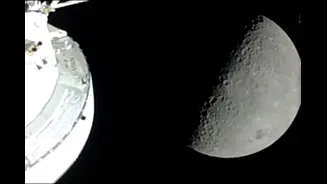






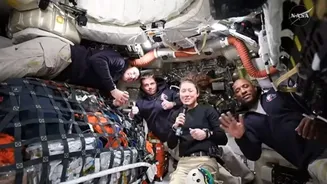
The four astronauts aboard NASA’s Artemis II mission have made their closest encounter with the Moon in the early hours of Tuesday, after 40 minutes of radio silence as they went behind the far side of the Moon.
The group is now on their way back to Earth.
The four astronauts were out of contact with NASA for 40 minutes as the Orion spacecraft arced around the far side of the Moon, further from home and more cut off than any humans have been for more than 50 years. “We will see you on the other side,” said pilot Victor Glover before the communications blackout.
For these 40 minutes, the astronauts took their time for lunar observation, including taking images and studying the Moon’s geology. Those images, plus laser and camera data from Orion itself, should sharpen maps of the lunar surface and help geologists piece together how the Moon’s crust was built and battered over billions of years, BBC reported.
NASA later managed to restore communications as the spacecraft reappeared from behind the Moon. “Houston, Integrity, comm check,” mission specialist Christina Koch said as she broke the silence from Orion. “It is so great to hear from Earth again.”
“You are Earthbound, and we’re ready to bring you home,” Houston mission control said.
ALSO READ: ‘America First’ On Moon: How NASA Realigned Lunar Mission Artemis With Trump’s Policy
Where Is Artemis II Now?
NASA Administrator Jared Isaacman said Artemis II had reached its maximum distance from Earth. “On the far side of the Moon, 252,756 miles away, Reid, Victor, Christina, and Jeremy have now traveled farther from Earth than any humans in history and now begin their journey home,” he said on X.
Artemis II has reached its maximum distance from Earth.
On the far side of the Moon, 252,756 miles away, Reid, Victor, Christina, and Jeremy have now traveled farther from Earth than any humans in history and now begin their journey home. Before they left, they said they hoped…
— NASA Administrator Jared Isaacman (@NASAAdmin) April 6, 2026
“Before they left, they said they hoped this mission would be forgotten, but it will be remembered as the moment people started to believe that America can once again do the near-impossible and change the world,” he said, while congratulating the crew and the entire NASA team.
The crew was expected to reach a maximum distance of 252,760 miles (406,778 kilometres) from Earth, about 4,105 miles (6,606 km) further than Apollo 13. The milestone marks the first time humans have ventured so far into space, giving the astronauts a chance to view areas of the Moon never before seen by the naked eye.
The Artemis II mission involves a monumental lunar flyby, where the astronauts will spend over six hours studying and documenting lunar surface features. Their Orion capsule has already entered the Moon’s gravitational sphere of influence, allowing lunar gravity to dominate over Earth’s pull.