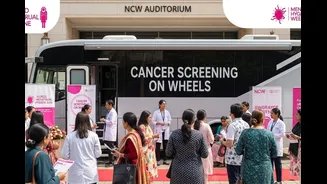







The National Commission for Women, in collaboration with SHEWings Foundation, launched the Cancer Screening on Wheels initiative at the NCW Auditorium, New Delhi, on the occasion of World Menstrual Hygiene
Week 2026.
The initiative involves a specially designed mobile screening bus that will provide doorstep preventive healthcare services to women, with a focus on early detection of cervical and breast cancer. The bus was inaugurated by Union Minister of State for Women and Child Development Savitri Thakur, NCW Chairperson Vijaya Rahatkar, NHPC Women’s Club President Shikha Gupta, and SHEWings Founder Madan Mohit Bhardwaj. Dr. Rajesh Mishra, Medical Director of SHEWings Cancer Centre, outlined the medical technology installed in the bus.
The scale of the problem in India is stark. According to the WHO’s GLOBOCAN 2022 report, India records over 120,000 new cervical cancer cases and close to 80,000 deaths annually — the highest death toll from the disease anywhere in the world, amounting to roughly one in four of all cervical cancer fatalities globally. On the ground, that translates to a new diagnosis every four minutes, and a death every seven.
The Cancer Screening on Wheels bus aims to address a core part of that problem — the gap between where women are and where healthcare is. The specially designed mobile unit will bring cervical cancer, breast cancer, and other preventive health screenings directly to women in remote and underserved communities, removing the barriers of distance, cost, and time that keep early detection out of reach for millions.
SHEWings Founder Madan Mohit Bhardwaj said: “The Cancer Screening on Wheels initiative is an important step towards reaching women at the grassroots level. Through this bus, women will have access to awareness, screening, and preventive healthcare services directly at their doorstep.”
The launch was part of a broader national dialogue on menstrual health and women’s well-being. Discussions covered menstrual hygiene, PCOS, hormonal health, nutrition, cervical and breast cancer awareness, and breaking taboos around women’s health. An interactive audience session encouraged participants to openly discuss menstrual myths, healthcare accessibility, and women’s wellness.
NCW Chairperson Vijaya Rahatkar said: “Periods are not shame, they are a natural biological process. Society must move from silence to awareness and from stigma to dignity. Open conversations, awareness, and accessible healthcare support are necessary for every woman.”
Union Minister Savitri Thakur emphasised that breaking silence around menstruation and women’s health is essential for building a healthier and more empowered society.
The programme concluded with a collective pledge toward a #PeriodFriendlyWorldby2030.
As conversations around women’s health continue to grow louder, initiatives like Cancer Screening on Wheels highlight the growing need to make preventive healthcare more accessible and easier to reach for women across the country. For millions of women, especially in underserved communities, access itself can be the difference between life and death. By taking screening, awareness, and preventive care directly to women’s doorsteps, the initiative hopes to turn early detection into a right rather than a privilege.
Whether this model can create long-term impact at scale remains to be seen, but for now, it marks a significant step towards making preventive healthcare more accessible to women across India.