









Grandmother’s Discipline
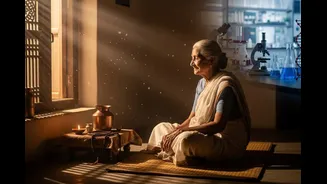
It did not begin for me in a laboratory. It began in the quiet discipline of my own grandmother. Every day, she woke before 4 a.m. She ate nothing after sunset the previous evening — usually around 6 p.m.
— and maintained a daily fast of nearly 17 hours. In the stillness before sunrise, she would sit for meditation and then walk to the temple. Only after her bath, around 11 a.m., would she gently break her fast. There were no fitness apps. No glucose monitors. No longevity podcasts. No biohacking vocabulary. No Silicon Valley guru explaining “circadian rhythm” or “metabolic flexibility”. There was just discipline.
Ancient Rhythm, Modern Science
Years later, while deeply immersed in nutrition science for my documentary The Evidence – Meat Kills, that memory returned to me with new force. I came across research from Dr Rima Dada’s laboratory at AIIMS, New Delhi, which examined the effect of yogic practices and pranayama on biological ageing. Studies from her group have explored how yoga-based lifestyle interventions, including practices such as pranayama and meditation, may influence telomere length, telomerase activity, oxidative stress, inflammation and DNA repair (Tolahunase et al., 2017; Sharma et al., 2022).
For me, it was a moment of recognition.
Here was India’s premier medical institute using the language of modern molecular biology to examine what generations of Indians had practised quietly in their homes, temples, ashrams and daily routines.
My grandmother would never have used the word “telomere”. She did not know the language of cellular ageing. But she knew something deeper through lived experience — that breath, food, sleep, restraint, rhythm and inner calm were not separate departments of life. They formed one integrated discipline.
That is the quiet genius of Indian wellness traditions.
New Names for Old Wisdom
Again and again, we see the same pattern. A practice emerges from Indian civilisation. It is preserved for centuries through family habits, spiritual disciplines and community customs. Then, somewhere along the way, modern Indians begin to mock it as outdated. A few decades later, the West rediscovers it, renames it, studies it, packages it and sells it back to us in expensive vocabulary.
A grandmother waking before sunrise becomes “circadian optimisation”.
A yoga teacher guiding the breath becomes “parasympathetic activation”.
Dhyana becomes “mindfulness”.
Simple early dinners become “time-restricted eating”.
Restrained eating becomes “metabolic flexibility”.
Fasting becomes “autophagy activation”.
Emotional steadiness becomes “nervous system regulation”.
And an Ayurvedic warning against irregular sleep, anger, overeating and mental agitation suddenly returns as the fashionable language of cortisol, inflammation and stress biology.
The vocabulary changes. The white coat arrives. The podcast appears. Silicon Valley adopts the trend. And suddenly, many educated Indians begin to respect what their own civilisation had lived for centuries.
This is not an argument against modern science. Far from it. Modern medicine is one of the greatest achievements of humanity. Antibiotics, surgery, imaging, emergency care, vaccines, intensive care and evidence-based pharmacology have saved hundreds of millions of lives.
Nor is this a call for blind glorification of every ancient claim. Not every traditional belief was automatically scientific. Not every old practice deserves to be romanticised. Evidence matters. Rigour matters. Testing matters.
But the reverse arrogance is equally foolish: the assumption that nothing had value until the West measured it.
Civilisations observed human health for thousands of years before the first smartwatch was invented. Many insights were preserved not through journal papers but through disciplined living. A grandmother may not know the biochemical pathway but she may still know the rhythm of life.

Yoga’s Return
Yoga is perhaps the clearest example.
For decades, large sections of India’s English-speaking elite dismissed yoga as old-fashioned, mystical or embarrassing. Then came American yoga studios, celebrity endorsements, neuroscience studies, MRI scans and international wellness brands. Suddenly, yoga became global. What was once seen as backward became premium.
Meditation followed the same route.
Indian traditions had refined the arts of silence, attention, breath and mental discipline long before the corporate world discovered burnout. The word “mindfulness” became fashionable only when stress became an epidemic among the affluent. Executives who may once have laughed at dhyana now pay handsomely to learn stillness at luxury retreats.
Jain Fasting Tradition
Fasting too has travelled the same path.
Jain traditions, in particular, have long embedded the principles of restraint, early eating, digestive rest, simplicity and the avoidance of late-night food. Long before the modern wellness industry spoke of insulin sensitivity, autophagy and cellular repair, Jain households understood the moral and physical discipline of eating less, eating early and eating with awareness.
Then came the 2016 Nobel Prize in Physiology or Medicine, awarded to Japanese scientist Yoshinori Ohsumi for his discoveries related to autophagy — the body’s cellular recycling and house-cleaning process (Nobel Prize in Physiology or Medicine, 2016). Modern science celebrated what it had now beautifully explained. But in many Indian homes, some version of this wisdom had existed as daily practice for generations.
This does not diminish the Nobel achievement. It deepens our appreciation of both science and tradition. Science explains the mechanism. Tradition often preserved the behaviour.
India’s WFPBNO Roots
My own journey took a similar route.
While making The Evidence – Meat Kills, I immersed myself in nutrition research and gradually moved towards a strict Whole Food Plant-Based No-Oil lifestyle. This was not fashion. It was evidence. I was influenced by doctors and researchers such as Dr Michael Greger, Dr John McDougall, Dr Caldwell B. Esselstyn and Dr Neal Barnard, and by the growing body of work connecting excess dietary fat, animal products, endothelial dysfunction, insulin resistance and chronic disease.
Here again, India had some of the answers hidden in plain sight.
What we now call Whole Food Plant-Based No-Oil eating is not as alien to India as many people imagine. Long before the phrase WFPBNO was coined in the West, many Indian kitchens had already perfected oil-free, steamed, fermented and whole-food meals.
India’s Zero-Oil Foods
Look at the traditional foods of Kerala and South India: idli, puttu, appam, red rice, sambhar, rasam, steamed vegetables and fermented rice-dal preparations. These were not “diet foods”. They were everyday foods — built around grains, pulses, fermentation, steaming and digestion-friendly simplicity.
Gujarat gave us dhokla, one of the finest examples of fermented, steamed food made from rice, dal or besan. North and West India had dal dhokli, matra chaat, boiled chana, sprouts, sattu, khichdi, millet rotis, roasted tubers and countless pulse-based meals. Much of this food, in its original home form, needed little or no oil. It was filling, plant-based, fibre-rich and deeply connected to local climate, labour, digestion and season.
The tragedy is that many of these foods were later drowned in oil, ghee, tadka and restaurant-style excess. What was once simple, steamed and nourishing became heavy, greasy and performative. The original wisdom lay not in extravagance but in restraint.
That is why the modern zero-oil movement is not really a foreign idea being imported into India. In many ways, it is a return — a return to the steamed idli, the fermented dhokla, the humble puttu, the dal-based meal, the chana chaat, the early dinner and the disciplined kitchen of our grandparents.
Modern nutrition science may now speak of fibre, gut microbiome, insulin sensitivity, endothelial health and anti-inflammatory eating. But Indian homes had already created living examples of these principles — not as theory, but as breakfast, lunch and dinner.
The Glucose Obsession
Today, the wellness world is fascinated by continuous glucose monitors. People track every rise and fall in blood sugar as though life itself can be reduced to a graph. There is value in measurement, of course. But there is also a danger in obsession.
A glucose rise after eating fruit, rice or dal is not the same thing as metabolic disease. The deeper problem is often insulin resistance — the inability of the body to handle glucose properly because the metabolic system has been damaged over time. Research on lipid-induced insulin resistance has shown how excess fat accumulation inside muscle and liver cells can interfere with insulin signalling (Samuel and Shulman, 2010). Dr Michael Greger has popularised this idea for a wider audience, arguing that diabetes is not simply a disease of “carbohydrates” but is deeply linked to fat toxicity and impaired insulin function (Greger, 2015; Greger, 2016).
In that sense, many of our older food traditions were wiser than today’s gadget-driven anxiety. They emphasised moderation, plant-centric eating, early dinners, seasonal food, simplicity and restraint. They did not ask us to live in fear of every glucose curve. They asked us to live in rhythm.
That is the difference between wisdom and biohacking.
Biohacking often begins with anxiety. Wisdom begins with balance.
Cortisol and Calm
The same applies to the current obsession with cortisol. Suddenly, cortisol has become the villain of the wellness world. Social media blames it for belly fat, fatigue, mood swings, poor sleep and almost every modern discomfort. Of course, stress hormones matter. Chronic stress is real. But Indian systems of thought had already understood the broader truth: mental agitation damages the body.
Yoga, Ayurveda and traditional disciplines did not divide the human being into isolated organs. They saw food, sleep, breath, thought, routine, emotion and conduct as part of one continuous field. A disturbed mind was not merely a psychological problem. It was a physiological disturbance.
Modern science is slowly returning to that integrated view.
It now speaks of inflammation, oxidative stress, endothelial function, gut health, mitochondria, telomeres, circadian biology, vagal tone and nervous system regulation. These are valuable concepts. They help us understand mechanisms with clarity. But behind many of them lies a simple truth older traditions had long grasped: the body thrives on rhythm and suffers from excess.
Ayurveda’s Integrated View
This is where Ayurveda deserves serious attention.
Ayurveda may not have used the vocabulary of mitochondria, dopamine, telomerase or heart-rate variability. But it understood that lifestyle is medicine. It understood that digestion, sleep, mental state, environment and daily routine are deeply connected. It understood that anger, greed, overeating, late nights and irregular habits disturb the organism. It understood that health is not merely the absence of disease but the presence of balance.
The modern wellness industry is now rediscovering this in fragments.
One year the buzzword is detox. Then inflammation. Then microbiome. Then cortisol. Then autophagy. Then mitochondrial health. Then biological age. Then epigenetic reprogramming. Tomorrow it may be neuroinflammation or some new wearable metric.
The cycle continues.
Meanwhile, a simpler wisdom sits quietly in our own civilisational memory: wake early, breathe deeply, eat modestly, avoid excess, respect digestion, calm the mind, walk, meditate, reduce violence in food and live with restraint.
Perhaps that is why my grandmother’s routine now appears to me not as old-fashioned but astonishingly advanced.
She did not optimise her life. She disciplined it.
She did not chase longevity. She lived in a way that made longevity possible.
She did not need a device to tell her when to stop eating. Sunset was enough.
Self-Respect in Science
India must not reject modern science. We need more science, not less. We need more research, more clinical trials, more rigorous validation and more honest dialogue between traditional knowledge and contemporary medicine.
But we must also recover our intellectual self-respect.
The tragedy is not that the West studies Indian practices. That is welcome. The tragedy is that many Indians begin to value their own inheritance only after Western approval arrives.
The task before us is not blind pride. It is mature confidence.
We must be able to say: yes, modern science is essential. But yes, our civilisation also preserved profound observations about human health, discipline and longevity. The two need not be enemies. The laboratory can illuminate what tradition preserved. Tradition can inspire questions that science has only begun to ask.
The Wisdom of Rhythm
In the end, true wellness is not a fad. It is not a gadget. It is not a fashionable word trending on social media.
It is rhythm.
It is restraint.
It is breath.
It is food without violence and excess.
It is sleep, silence and self-command.
It is the wisdom of living with the body, not in permanent war against it.
And perhaps, after all the podcasts, papers, devices and trends have had their moment, modern man may finally arrive where my grandmother had quietly begun — before sunrise, in silence, with an empty stomach, a steady breath and a mind at peace.