







North America’s Death Valley is infamous worldwide for its extreme heat and aridity, ranking among the hottest and driest places on Earth. But over the past few weeks, something extraordinary has occurred,
surprising scientists: instead of breaking heat records, rainfall records are being shattered.
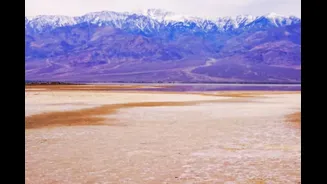
A long-lost lake, Lake Manly, which disappeared thousands of years ago, has returned, confirmed by the National Park Service (NPS).
Return Of Lake Manly
The lake once existed at Badwater Basin, the lowest point in North America. During the Ice Age, Lake Manly was at its peak, reaching depths of around 300 metres (1,000 feet). As the Ice Age ended, the lake dried up, vanishing for the past 10,000 years.
Recent record-breaking rainfall has revived the lake, although it remains shallow. According to the NPS, in many areas, the water is just ‘above the shoes’, making boating impossible. Still, seeing water flow in the middle of the desert feels like a near-miraculous sight.
Record-Breaking Rainfall
Death Valley typically receives less than 2 inches of rain annually, making this recent weather highly unusual. Between September and November, the region experienced its wettest fall on record, with 2.41 inches of rain. November alone saw 1.76 inches, breaking previous monthly records.
While the numbers may seem small, for Death Valley, they are extraordinary. Where every drop is usually treasured, the desert has now been flooded with enough water to bring a lake back to life.
Nature’s Warning Or Wonder?
Is this a sign of climate change? Scientists remain uncertain about the exact causes of this unusual weather, though it is linked to shifting global climate patterns. As the planet warms, extreme weather events, including droughts and floods, are becoming more frequent.
The revival of Lake Manly is a stark reminder that Death Valley wasn’t always dry. Millions of years ago, the region was shaped by ice, rivers, and lakes. Between 128,000 and 186,000 years ago, Lake Manly stretched 100 miles at its fullest.
Tourism And Safety Concerns
The reappearance of the lake has attracted many visitors, eager to witness the desert’s transformation. However, officials have advised caution, as storms and heavy rain have blocked numerous roads with debris. Both paved and unpaved park roads remain closed in several areas. Tourists are urged to check official NPS updates before planning a visit.
It is also unclear how this unusual rainfall will affect the park’s renowned wildflowers, leaving scientists and visitors alike curious about the broader ecological impacts.