







Employment generation under the government’s revamped rural job guarantee programme declined sharply in July, falling 49.94 per cent year-on-year, according to official data.
The decline came after the
government replaced the two-decade-old Mahatma Gandhi National Rural Employment Guarantee Scheme (MGNREGS) with the newly launched Viksit Bharat – Guarantee for Rozgar and Ajeevika Mission (Gramin), or VB-G RAM G, from July 1 this year.
As per official data available on August 9, the VB-G RAM G scheme generated 7.67 crore person-days in July 2026. This was 49.94 per cent lower than the 15.33 crore person-days generated under MG-NREGS during the same month last year.
A person-day is a unit of measurement based on the ideal amount of work completed by one person in a working day.
While the VB-G RAM G dashboard recorded 7.67 crore person-days for July, the Ministry of Rural Development said around nine crore person-days were generated during the first month of the scheme’s implementation.
The number of households availing themselves of the rural job guarantee programme also fell significantly. In July, 68.94 lakh households benefited under VB-G RAM G, down 51.45 per cent from 1.42 crore households under MGNREGS in the corresponding month last year.
Rural Employment At Five-Year Low
The number of households and person-days recorded under the rural jobs programme were the lowest in the past five years.
At 0.68 crore, the average number of households that availed themselves of VB-G RAM G was less than 40 per cent of the average 1.72 crore households recorded over the previous four years.
Similarly, the 21.56 crore average person-days generated over the previous four years were significantly higher than the 7.67 crore person-days recorded in July this year, with July’s figure standing at around 35 per cent of the average.
In March 2025, NREGS generated 17.56 crore person-days, a 0.70 per cent decline from the 17.69 crore person-days recorded in March 2024. The year-on-year fall in monthly employment generation under NREGS continued until June 2026, the last month of the scheme.
July Drop Comes Amid Erratic Monsoon
The decline in employment generation under VB-G RAM G in July comes amid an erratic monsoon. According to the India Meteorological Department (IMD), 50 per cent of the country’s 741 districts reported deficit-to-serious-deficit rainfall between June 1 and August 3.
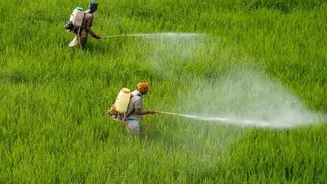
The rural job guarantee programme becomes a fallback option for unskilled agricultural labourers in such circumstances.
Data from the Union Ministry of Agriculture and Farmers Welfare showed that kharif crop coverage stood at 894.22 lakh hectares as of July 31, 2026. This was 26.50 per cent lower than the 920.72 lakh hectares recorded during the corresponding period last year.
Sources said the decline in employment generation could be linked to a pause in the scheme during the Kharif sowing season. However, there is no data available on pauses during the sowing season.
Government Says Transition Was ‘Smooth, Seamless’
Responding to an email from The Indian Express, an official with the Ministry of Rural Development said, “VB-G RAM G Act, 2025 has been implemented successfully across all rural areas of the country with effect from July 1, 2026. The transition from MGNREGA to VB–G RAM G has been smooth, seamless and technology-enabled, with all States/UTs notifying their respective schemes and the complete administrative and digital ecosystem being operationalised before commencement of the programme from day one.”
“To facilitate uninterrupted implementation, the Central Government has provided a record Budget estimate of ₹95,692 crore for FY 2026–27, the highest ever for any rural employment programme,” the official said.
“Accordingly, the programme is being implemented effectively nationwide. More than 98% of rural households demanding employment have been offered work. During the first month of implementation, around nine crore person-days have been generated, with attendance being captured through the NMMS using face authentication together with the prescribed exception-handling mechanism in genuine cases. More than 1.33 crore rural workers have been offered employment as per their demands for employment and works are being executed through more than nine lakh active worksites, ensuring adequate availability of employment opportunities,” the official said.
The official added that around 63 per cent of the total person-days generated so far have been contributed by women, substantially exceeding the statutory requirement of one-third participation.
“All provisions of the VB-G RAM G Act have come into force with effect from July 1, 2026, including the statutory provision relating to the notified peak sowing and harvesting season, which is being implemented by the states in accordance with local agro-climatic conditions. The ministry is continuously monitoring implementation through Area Officer visits, regular review meetings, technology-enabled dashboards and field-level feedback,” the official said.
VB-G RAM G Guarantees 125 Days Of Work
The VB-G RAM G scheme guarantees 125 days of wage employment to rural households during a financial year, compared with 100 days under NREGS.
The scheme also provides for a pause in the employment guarantee for “a total period aggregating to 60 days in a financial year, covering the peak agricultural seasons of sowing and harvesting” during which work will not be undertaken.