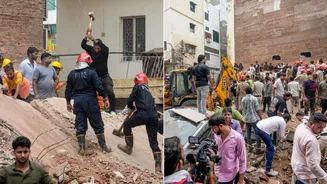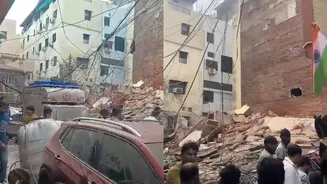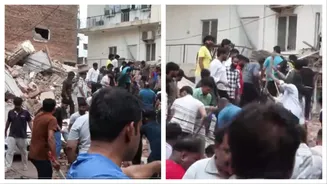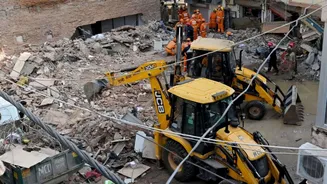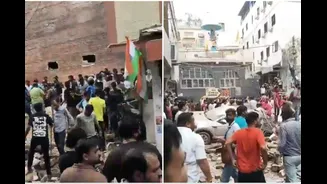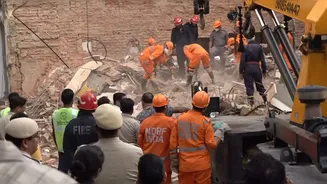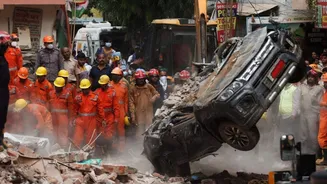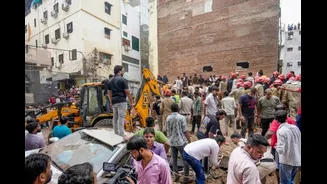

Delhi Building Collapse: The death of seven students in a building collapse in Delhi’s Satya Niketan has brought the city’s chronic shortage of hostel accommodation into sharp focus, exposing a decades-old
gap between the number of students enrolled at Delhi University and the number who can actually find a place in university or college hostels.
Every year, more than 50,000 students enrol in Delhi University (DU), one of India’s premier public universities known for its relatively affordable higher education. At least two-thirds of its students come from outside Delhi. With more than 2 lakh students enrolled across its colleges at any given time, the university has hostel accommodation for only around 9,000 students.
DU runs 18 hostels, while only nine of its colleges have hostel facilities on their campuses.
The shortage is particularly acute in South Campus, where the Satya Niketan building collapse took place. According to DU’s website, just three university-run hostels serve the campus — Geetanjali Hostel for women, Saramati Hostel for men and Aravalli P.G. Hostel.
One of the students killed in the Satya Niketan collapse was enrolled at Atma Ram Sanatan Dharma (ARSD) College in South Campus. The college’s principal, Professor Gyanatosh Kumar Jha, said the institution is now “thinking of providing a hostel facility” for its students “in the coming time.”
For students unable to secure a university or college hostel seat, the alternatives are limited: pay significantly higher rent for an apartment in a nearby locality or opt for a paying guest (PG) accommodation.
For many DU students, particularly those from low-income families, the latter is often the only financially viable option. The university’s relatively low tuition fees attract students from across the country, but the lack of affordable on-campus accommodation can add a significant financial burden to their education.
This has fuelled a boom in PG accommodations in areas surrounding South Campus, including Satya Niketan, Moti Bagh, Anand Niketan and Munirka. A double- or triple-sharing room in these areas typically costs between ₹8,000 and ₹12,000 a month.
But the lower rents often come with compromises on space and living conditions. Many PGs operate out of converted residential properties, with students sharing small rooms and dealing with cramped or poorly ventilated spaces. Questions over building safety and compliance have also come to the fore following the Satya Niketan tragedy.
Anmol Yadav, whose friend was trapped in the building collapse, said the incident highlighted a reality that students have faced for years: DU’s inadequate hostel infrastructure leaves many with little choice but to seek affordable accommodation in such PGs.
The tragedy has also triggered political demands for an urgent expansion of hostel infrastructure.
Rajya Sabha MP and Delhi University professor Manoj Jha has written to Prime Minister Narendra Modi seeking “urgent intervention” following the Satya Niketan collapse. He said the incident had exposed a “grave crisis” of student accommodation at the university and urged the Centre to announce an emergency, ring-fenced financial allocation for constructing public hostels for DU students.
AAP MP Sanjay Singh also pointed to the shortage of hostel accommodation, calling it a major reason students are pushed towards PGs.
“How are these operations allowed to continue in such dilapidated, unsafe buildings? We are seeing nothing but empty rhetoric from BJP leaders. But there is no clear roadmap or plan regarding concrete action… All this happens due to collusion, where everyone, from top to bottom, is involved in corruption,” he said.
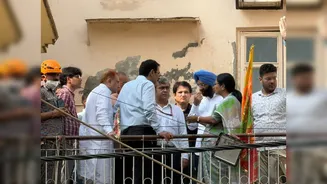
Kanhaiya Kumar, in-charge of the NSUI at the All India Congress Committee, claimed that only 5% of DU students have access to hostel accommodation. Targeting Delhi Chief Minister Rekha Gupta, he said the BJP had promised hostel facilities during its election campaign but was now talking about conducting an audit.
“Regarding Delhi Chief Minister Rekha Gupta, who was campaigning at Delhi University last year — the pamphlet she held promised hostels for everyone. Who are you trying to fool? Now that you are in a position of power, you talk about conducting an audit? This is simply shirking responsibility,” he said.
Kumar further criticised the government’s approach, arguing that the scale of the hostel shortage required concrete action rather than political rhetoric.
Rajya Sabha MP and senior advocate Kapil Sibal described the incident as a reflection of systemic failure.
“When the university lacks hostel facilities, and you have accommodated students in this area, and then the roof collapses, the students are far from safe. It is truly distressing,” Sibal said.
The Satya Niketan tragedy has therefore raised a larger question beyond the safety of one building: how long can Delhi University’s hostel infrastructure remain so far behind the scale of its student population? With tens of thousands of students competing for a few thousand hostel beds every year, the shortage continues to push students towards private PGs and rented accommodation — often without adequate safeguards for safety, space and affordability.