






A powerful 7.8-magnitude earthquake struck the Philippines on Monday, leaving at least four people dead and more than 200 injured, according to state authorities.
The earthquake triggered tsunami alerts
in several countries, including Japan and Indonesia, prompting emergency evacuations and safety measures in coastal areas.
The offshore quake struck south of General Santos City, a major urban centre with a population of about 720,000 people.
Authorities urged residents in vulnerable coastal areas to move to safer locations as fears of tsunami waves spread across the region.
Buildings collapse as aftershocks hit
A series of strong aftershocks shook the affected region beginning around two hours after the initial quake, according to the United States Geological Survey. The strongest aftershock measured 6.5 in magnitude.
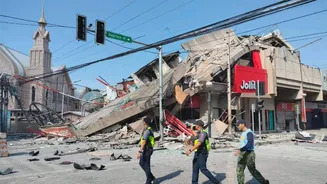
Videos showed widespread damage in General Santos City. A shopping centre housing a Jollibee fast-food restaurant was reduced to rubble, while a school building collapsed completely. Officials said the school was unoccupied at the time.
“Lord, it has really collapsed! … The building has really collapsed!” a bystander was heard shouting in footage showing the structure falling.
Casualties reported
Police Major Roland Catoburan said two people were killed in Alabel, a municipality near General Santos City. “We have casualties. A wall fell on them,” he told AFP.
He added that some police stations suffered structural damage, with officers barred from re-entering buildings because of cracked walls.
Master Sergeant Robert Dagon of the General Santos City police separately confirmed another reported death and four injuries. “Many buildings were affected, but I cannot enumerate them now because we are busy with ongoing rescues,” Dagon said.
Authorities later reported that the death toll had reached at least four, while more than 200 people were injured.
Tsunami warnings trigger evacuations
The Pacific Tsunami Warning Center warned that tsunami waves could reach coastal areas within three hours of the earthquake. The advisory covered the Philippines, Indonesia, Palau, Taiwan and Papua New Guinea.
Philippine President Ferdinand Marcos suspended classes in affected areas of Mindanao on what was due to be the first day of the school year. He also urged residents living near the coast to leave immediately.
“Move to higher ground now. Do not wait,” Marcos said. “Your life is more important than anything left behind.”
In Kiamba, a coastal town near the epicentre, around 50,000 residents had already moved to safer locations. Regional disaster chief Agripino Dacera said nearly 80 per cent of the town’s population had evacuated. “All the villages along the coast were instructed to proceed to evacuation centres,” he said.
The airport in General Santos was closed until further notice.
Regional alerts and seismic history
The earthquake also prompted evacuation warnings in parts of Indonesia and Malaysia. Indonesia later lifted its tsunami alert.
Japan issued a tsunami advisory for sections of its Pacific coastline, warning that waves of up to one metre could reach several regions.
The Philippines lies on the Pacific Ring of Fire, an area known for intense seismic activity and frequent earthquakes.
In October, eastern Mindanao was hit by earthquakes measuring 7.4 and 6.7, which killed at least eight people. Just days earlier, a magnitude-6.9 earthquake killed 76 people and damaged or destroyed around 72,000 buildings in Cebu province, according to government figures.