





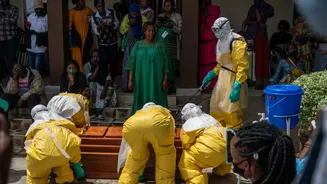
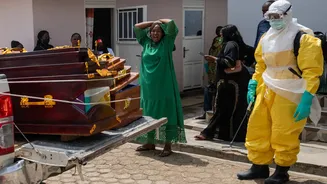
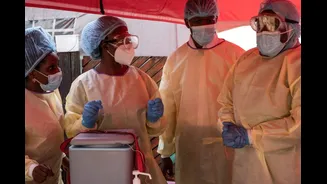
The World Health Organization (WHO) officially declared the active Ebola outbreak a Public Health Emergency of International Concern (PHEIC) on May 16, 2026. Concurrently, the Africa Centres for Disease
Control and Prevention (Africa CDC) declared it a Public Health Emergency of Continental Security. Is there a vaccine for the strain that is driving the outbreak in the Democratic Republic of the Congo and Uganda? News18 explains.
Why there is no vaccine for the strain that caused the outbreak
There is currently no licensed or approved vaccine specifically for the Bundibugyo strain (BVD) driving this outbreak in the Democratic Republic of the Congo and Uganda.
The biological, historical, and economic reasons for this gap include:
1. Ineffective Cross-Protection: Existing vaccines like Ervebo are highly effective, but they exclusively target the Zaire ebolavirusstrain. Because the Bundibugyo strain is genetically distinct, antibodies generated by Zaire-focused vaccines do not recognize or protect against it. While health agencies are reviewing whether the Zaire vaccine could act as a partial stopgap, experts warn its cross-efficacy against Bundibugyo may only be around 50%.
2. A Historically Rare Strain: Prioritising a vaccine requires historical data and a high threat level. Before this 2026 emergency, the Bundibugyo strain had only ever caused two small, recorded outbreaks in human history (in 2007 and 2012). Because it remained dormant for over a decade, global scientific research and funding naturally shifted toward the more common Zaire strain and the Marburg virus.
3. Vaccine Development Timelines: Vaccine candidates for the Bundibugyo strain do exist in the laboratory—including experimental mRNA versions—but they have not yet passed human clinical trials. The WHO projects that it will take six to nine months to accelerate manufacturing and fast-track human trials before viable doses are ready for public deployment.
4. Funding Reductions: The sudden acceleration of this rare strainhas caught the global health community off guard, coinciding with severe international containment bottlenecks. Massive recent funding cuts to major public health and foreign aid agencies have severely slowed down the financial pipeline required to manufacture and test new emergency medical countermeasures rapidly.
With agency inputs