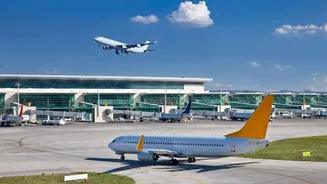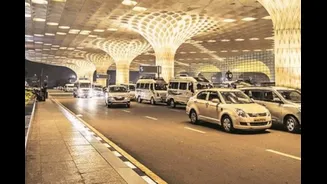




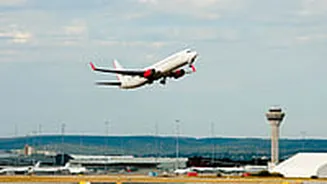

Think twice before going live from CSIA‘s boarding gate or filming that runway view from Pune Airport. India’s aviation regulator has tightened rules on photography and videography at airports — and the
penalty isn’t just a deleted video. It could be a spot fine, confiscated phone, or a place on the No-Fly List.
The crackdown operates on two levels: a longstanding but now strictly enforced framework under Rule 13 of the Aircraft Rules, 1937 that governs all civilian airports across India, and newer, sharper directives issued in 2025 specifically targeting military joint-use airports — places like Amritsar, Jammu, Srinagar, Jaisalmer and Goa’s Dabolim — following India’s border tensions with Pakistan.
For Mumbai flyers using Chhatrapati Shivaji Maharaj International Airport, the primary rules in play are the civilian ones. But if your next trip takes you through any border-region airport, the restrictions are significantly stricter.
What Exactly Is Banned At Airports Like Mumbai’s CSIA?
Quite a lot more than most travellers realise. Under Rule 13 of the Aircraft Rules, 1937, no person shall take any photograph at a government aerodrome or from an aircraft in flight except in accordance with terms and conditions of a written permission granted by the Director General of Civil Aviation.
That’s the baseline law — decades old, but frequently ignored and now being actively enforced.
At civilian airports, photography is permitted in open terminal areas — think arrival halls, food courts, retail zones. But security checkpoints, boarding gates, aprons, aircraft handling zones, runway buses and any operational area are off-limits.
The DGCA guidelines reinforce this with specific language about social media content: videos posted online that accidentally capture security arrangements, surveillance systems or staff operations are considered violations even when the content appears harmless. Intent is not a defence.
What About At Border Airports — Amritsar, Srinagar, Jammu, Jaisalmer?
Here the rules are absolute. The DGCA order for civilian operations at defence airfields states that aerial or ground photography and videography are strictly prohibited at all times during a passenger’s travel — including when inside the terminal, in vehicles en route to or from the aircraft, outside the aircraft, during pushback, taxiing, takeoff, and while the aircraft is flying below 10,000 feet.
The directive, effective from May 20, 2025, applies to all scheduled, commuter and non-scheduled flights operating from defence-controlled airfields across India, including Goa’s Dabolim, which operates as a civil enclave within a military base.
The trigger: in recent years, passengers had taken photos or videos through aircraft windows during takeoff or landing at these airbases and later posted them on social media — sometimes inadvertently revealing military activities, the layout of airbases and other sensitive areas.
The window-shades-down rule — which required shades to remain closed during takeoff and landing at these airports — has since been withdrawn, but the photography ban continues to apply.
What Happens If You Get Caught?
At civilian airports, the consequences escalate with the seriousness of the violation. Minor infractions — someone filming near a boarding gate — can result in security personnel directing you to delete the content immediately.
Repeated violations or footage that captures sensitive security infrastructure can attract financial penalties under civil aviation rules, confiscation of devices for investigation, and a formal recommendation to the DGCA for inclusion on the No-Fly List.
The No-Fly List is a real and consequential instrument. Under the Civil Aviation Requirements on handling unruly passengers, misconduct is categorised into three levels: Level 1 attracts a ban of up to three months, Level 2 up to six months, and Level 3 a minimum of two years or more without limit.
Photography violations at sensitive areas, especially those deemed a security risk, would be treated as serious misconduct — not a minor social media overstep.
At military airports, violations may be treated as acts supporting risks to national security, attracting legal action beyond standard civil aviation penalties.
So Can You Film Anything At All?
Yes — within limits. General terminal areas at civilian airports (food courts, arrival halls, departure concourses away from security zones) are broadly permissible for personal photography. Selfies at the check-in counter: generally fine. Filming the runway from the gate lounge: not fine.
For those who want to create content professionally, there is a legitimate pathway — but it requires advance planning. Below is a quick reference:
| Purpose | Permission Required? | Who to Approach | Where it Applies |
|---|---|---|---|
| Personal photography in open terminal areas | Generally no | — | Civilian airports (CSIA, BLR, DEL, HYD etc.) |
| Reels / vlogs in security or operational zones | Prohibited | Not permitted even with permission | All airports |
| Commercial filming (ads, documentaries, brand content) | Yes — formal prior permission | Airport management + relevant security agencies | All civilian airports |
| Any photography at military joint-use airports | Prohibited entirely | — | Amritsar, Jammu, Srinagar, Jaisalmer, Dabolim |
| In-flight photography on commercial routes | Permitted if it does not compromise safety or violate crew instructions | Follow crew guidance | All commercial flights (except military airports below 10,000 ft) |
Why Is This Suddenly Being Enforced More Strictly?
Two things happened simultaneously. First, the social media boom created an entire genre of airport content — travel vlogs, lounge walkthroughs, runway gate selfies — that collectively pushed what airports tolerate in public areas. Security agencies began flagging instances where operational layouts, staff positions and surveillance camera placements appeared in frame, even in innocent-looking content.
Second, the India-Pakistan border situation in May 2025 brought sharply into focus how much strategic infrastructure sits alongside civilian operations at joint-use airports.
The 2025 directives were introduced as a precautionary security measure following hostilities along the western border, aimed at preventing any unintended capture of sensitive military activities or infrastructure. The civilian airport crackdown and the military airport ban are separate in origin but converging in enforcement culture.
For Mumbai travellers at CSIA — India’s busiest international hub — the practical advice is simple: film your latte at the lounge, not the gate or the tarmac.