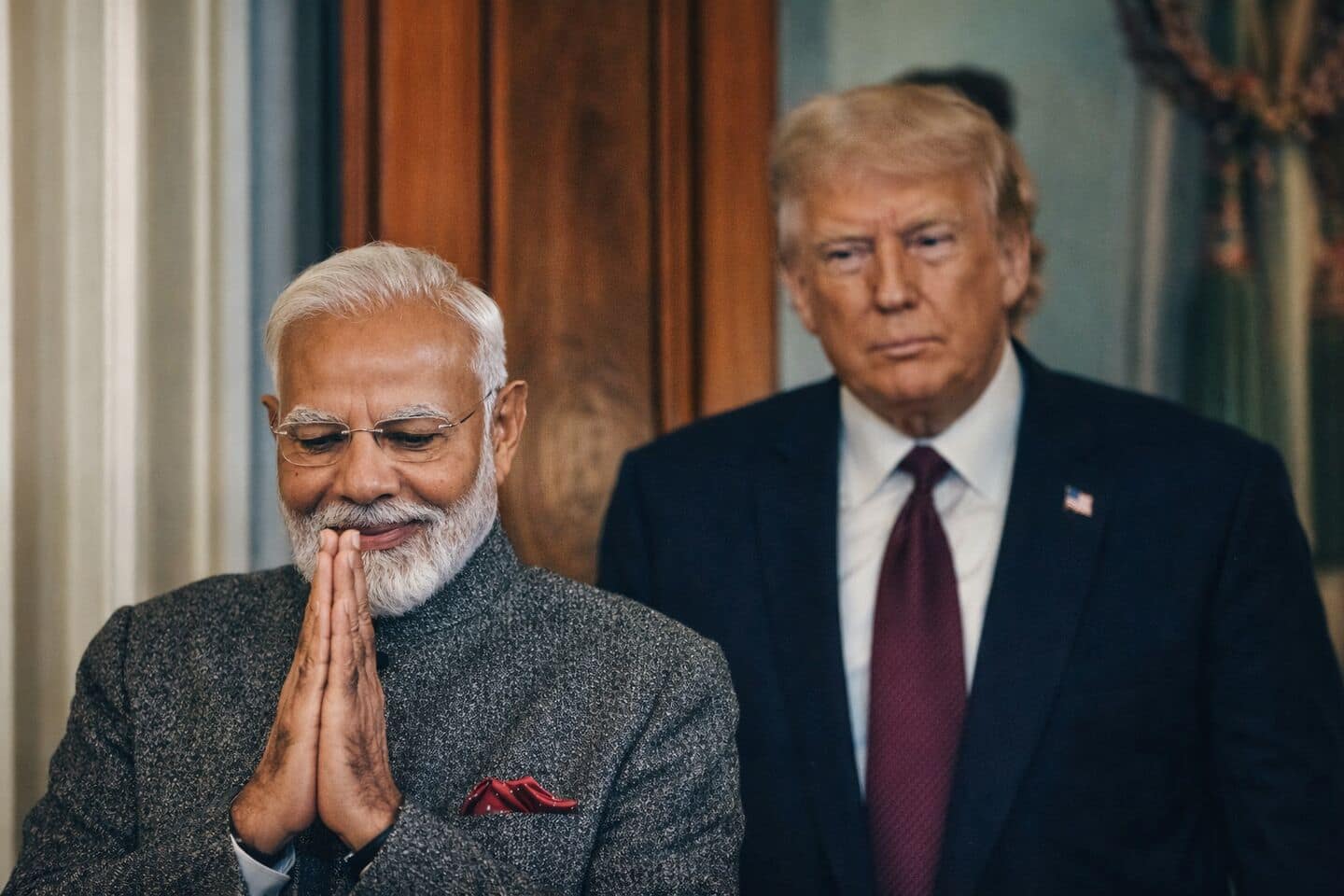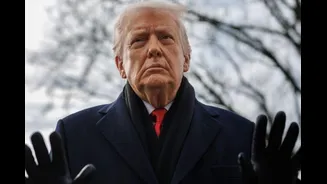

Since Donald Trump took office in January 2025, he has upended global trade by imposing reciprocal tariffs and immigration bans, illegally invading Venezuela, and promoting his ‘Make America Great Again’
(MAGA) agenda. More recently, he has been pushing for the “annexation” of Greenland — the world’s largest island located in the North Atlantic Ocean.
His policies signal the collapse of a global system overseen by the World Trade Organization (WTO), which now faces an existential threat at the hands of its own creator: the United States.
Trade experts and diplomats are warning that the US may be preparing to either formally exit the WTO or render it irrelevant by continuing to block its core functions. This would not be a symbolic gesture. It would represent a decisive break from the rules-based trading system that shaped globalisation after the Cold War.
For India, this would not only have repercussions for exports and trade disputes. It also raises deeper questions about how vulnerable economies protect themselves when power imbalances dominate global negotiations.
Why The WTO Has Become A Liability To Washington
Trump’s hostility towards the WTO did not emerge overnight. Even during his first term, he repeatedly described the organisation as “unfair” and “biased” against the US. At the heart of that anger lies a fundamental ideological clash.
The WTO was set up in 1995 on the idea that all members, large and small, operate under the same rules. Tariff ceilings are legally binding. Disputes are settled by panels, not power. And the “Most Favoured Nation” principle requires countries to extend the same trade terms to all members unless a formal agreement says otherwise.
For Trump, this framework is a constraint, not a safeguard. His economic worldview prioritises unilateral leverage over negotiated restraint. Binding limits on tariffs restrict his ability to punish countries he sees as trade offenders. WTO rulings that strike down US tariffs are viewed not as legal judgments but as infringements on national sovereignty.
Blocking the WTO’s appellate body — the court that enforces trade rulings — was therefore not an accident of bureaucracy. It was a strategic decision. By refusing to approve new judges, the US ensured that dispute rulings could no longer be enforced, effectively disabling the system without formally leaving it.
Is The WTO Already On Life Support?
In practice, the WTO’s enforcement mechanism has been paralysed for years. Dispute panels can still issue rulings, but without a functioning appellate body, those rulings are unenforceable. Countries can appeal “into the void,” freezing cases indefinitely.
The result is a growing culture of non-compliance. Major economies increasingly impose tariffs first and justify them later, or not at all. Trade rules still exist on paper, but the referee has left the field.
A formal US withdrawal would deepen this crisis. The US remains the world’s largest economy and one of the WTO’s founding architects. If it walks away, the organisation risks becoming a hollow institution where rules exist but enforcement depends entirely on voluntary compliance.
For smaller and mid-sized economies, that distinction is critical. Without enforcement, trade law becomes aspirational rather than protective.
Why Experts Feel The US Should Exit The WTO
Henrik Horn, Professor of International Economics, Research Institute of Industrial Economics, and Petros C. Mavroidis, Professor at Columbia Law School, “For the US, an exit from the WTO might have the advantage of allowing the US to apply whatever trade restrictions it desires with less damage to its international reputation (to the extent this is a concern).
“With the desire for increased protection deeply engraved in US politics, and no WTO-compliant ways to achieve this, US violations of its WTO obligations will likely continue.”
The stressed that the US has a history of violating any existing multilateral commitments. The US in 1929 had not joined the League of Nations. But this was an act of unilateralism with no regard for negative international spillovers.
In the Nixon regime, the US imposed 10% import surcharge on all goods irrespective of origin. The next time the US violated a system was under the Reagan government. To address trade imbalances, the administration agreed on voluntary export restraints from several countries, mainly Japan, a clear violation of Article XI of General Agreement on Tariffs and Trade (GATT).
“While the US was a driving force behind the creation of the WTO, it soon became frustrated by the constraint that the agreement, as implemented, imposed. Of particular concern was the restrictions the WTO imposed on the ability of the US to shield its domestic markets through contingent protection. Both the George W. Bush and Barack Obama administrations continued to use the contentious ‘zeroing’ procedure in anti-dumping investigations. While many countries have violated the WTO Agreement, the repeated nature of the US breaches makes them stand out as violations not only of the letter of the agreement (as interpreted by panels and the Appellate Body), but also of its spirit,” the professors wrote in the column for the Centre for Economic Policy Research, a European non-profit organisation established in 1983.
What A World Without The WTO Would Look Like
If the WTO collapses or becomes irrelevant, global trade will not stop. But it will change in fundamental ways.
Trade disputes would increasingly be resolved through retaliation rather than adjudication. Powerful economies would impose tariffs, quotas or regulatory barriers with fewer consequences. Smaller countries would have limited ability to challenge these moves, except through countermeasures they often cannot afford.
Supply chains would fragment further along geopolitical lines. Trade blocs would harden around strategic alliances rather than efficiency. Businesses would face greater uncertainty, as market access would depend less on treaties and more on shifting political relationships.
For consumers, this would likely mean higher prices, as tariffs and supply disruptions ripple through global markets. For exporters, especially from developing economies, it would mean volatile demand and unpredictable access to key markets.
What Impact Would This Have On India?
India has often had a complicated relationship with the WTO, frequently pushing back against trade liberalisation that threatens domestic farmers or small manufacturers. But despite its criticisms, India has relied on the WTO’s legal framework.
Indian pharmaceutical exports have used WTO rules to challenge Argentina’s import rules. India also navigated challenges from other members regarding its own IP laws (like TRIPS) as it transitioned to a TRIPS-compliant regime. India leveraged WTO agreements to push for market access for its generic medicines against stricter local standards, even as it reformed its own laws to meet global IP standards
Agricultural producers have benefited from predictable tariff regimes. India’s IT services sector depends on stable cross-border trade norms, even when labour mobility remains contested.
Without a functioning WTO, India’s ability to challenge trade barriers imposed by larger economies would weaken significantly as it removes the primary platform for enforcing rules, providing legal recourse via the Appellate Body, and ensuring stability, forcing India towards less influential bilateral talks and risking being excluded from new trade blocs.
India’s ongoing push to become a global manufacturing hub also depends on certainty. Export-led growth requires predictable market access. If tariff regimes become unstable and trade rules fragmented, long-term investment decisions become riskier.
In a world where power replaces law, countries that follow rules are often disadvantaged relative to those willing to break them.
Could India Gain From A Weaker WTO?
There is, however, a counter-argument. Some policymakers argue that a weakened WTO could give India more flexibility to implement policies for food security for farmers, which it often struggles to achieve in consensus-based WTO talks.
Freed from strict subsidy rules and tariff bindings, India could support domestic industries more aggressively. Strategic sectors such as semiconductors, green energy and advanced manufacturing could receive greater protection. Trade negotiations could shift towards selective bilateral or regional deals that reflect India’s priorities.
But this flexibility comes with costs. Without multilateral rules, stronger economies would enjoy even greater freedom to deploy trade weapons. India’s bargaining power in bilateral negotiations with the US or EU would be weaker than in a multilateral forum where coalitions matter.
What Comes Next For India’s Trade Strategy
India cannot control whether the WTO survives in its current form. But it can prepare for a world where its protections are weaker.
That means strengthening domestic manufacturing not just through protection, but through productivity. It means diversifying export markets to reduce dependence on any single bloc. It means engaging actively in alternative trade arrangements while continuing to push for multilateral reform.
Most importantly, it means recognising that institutional erosion abroad has direct consequences at home.
If the WTO falls, it will not be replaced by a neutral referee. It will be replaced by raw bargaining power. For India, the question is no longer whether the WTO needs reform. It is whether the country is ready for a global trading system where rules are optional and power is decisive.