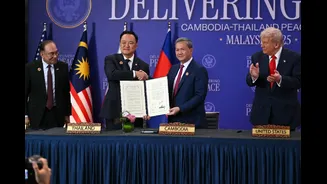

Fighting continued along the Thailand–Cambodia border on Saturday morning, hours after US President Donald Trump, acting as a mediator, declared that he had secured a ceasefire between the two countries.
Trump on Friday wrote on Truth Social that he had spoken to Thai Prime Minister Anutin Charnvirakul and Cambodian Prime Minister Hun Manet and that both sides had agreed to “cease all shooting effective this evening” and return to a peace agreement formalised in October.
The reality on the ground, however, told a different story. Thailand’s foreign ministry explicitly disputed Trump’s claim that a ceasefire had been agreed, while Prime Minister Charnvirakul said any halt in fighting would depend on Cambodia first ceasing its attacks. Cambodia did not confirm any truce either; instead, its defence ministry said Thai jets had carried out airstrikes on Saturday morning. Cambodian media reported Trump’s announcement without elaboration, even as clashes continued across multiple points along the border.
The episode has exposed the fragile nature of the July ceasefire that Trump had previously promoted as a diplomatic breakthrough, and highlighted why renewed fighting in December has come as little surprise to those tracking the dispute.
What Triggered The Latest Fighting In December
The current escalation was triggered by a skirmish on December 7, when two Thai soldiers were wounded in a disputed border area. Thailand said its engineering team, working on an access road, came under fire from Cambodian troops. The incident collapsed an already fragile ceasefire brokered in July and led to a renewed spread of fighting along multiple stretches of the border.
Within days, artillery fire, rocket attacks and airstrikes were reported at multiple points along the Thailand–Cambodia border. Villages in affected areas were evacuated for the second time in five months, with hundreds of thousands of civilians displaced on both sides.
About two dozen people have been officially reported killed in the latest round of fighting, with Thailand acknowledging the deaths of 11 of its soldiers and claiming significantly higher Cambodian military losses. Cambodia has not released military casualty figures but has said at least 11 civilians were killed and dozens wounded.
Why The July Trump-Brokered Ceasefire Was Always Fragile
The ceasefire Trump helped push through in July brought an end to five days of fighting between Thailand and Cambodia. The clashes were described by regional observers as the worst between the two countries in more than a decade. The truce was brokered by Malaysia but driven by strong pressure from Washington.
At the time, both countries were facing an imminent deadline to negotiate lower tariff rates on key exports to the United States. Trump threatened to withhold trade privileges unless both sides agreed to halt hostilities. Under that pressure, Thailand and Cambodia signed on to a ceasefire, which was later formalised in October at a regional meeting in Malaysia that Trump attended.
But the deal papered over deep mistrust rather than resolving it. Thailand was deeply uneasy about internationalising what it sees as a bilateral border issue and only accepted the ceasefire under economic duress. Cambodia, the smaller of the two militaries, welcomed outside mediation, believing it was disadvantaged in direct talks with Bangkok.
That fundamental divergence meant the ceasefire rested more on external pressure than genuine reconciliation.
A Border Dispute With Deep Historical Roots
The Thailand–Cambodia land border stretches more than 817 kilometres and has been contested for over a century. Much of the dispute dates back to colonial-era maps drawn by France in 1907, when Cambodia was under French rule. Those maps left ambiguities that both countries have interpreted in their favour ever since.
While the disputed areas are often small and sparsely populated, they carry immense symbolic value. Both militaries frame the conflict as a defence of national sovereignty, making compromise politically costly.
Tensions worsened sharply in 2025. In May, clashes that killed a Cambodian soldier sparked nationalist backlash on both sides. Thailand imposed strict border restrictions, while Cambodia retaliated by banning Thai films and restricting imports of Thai goods.
Why Trust Has Completely Broken Down
Since July, trust between the two sides has eroded further. Thailand has accused Cambodia of laying new landmines in disputed areas, alleging that at least seven Thai soldiers have lost limbs as a result. Thai authorities say they have presented evidence of these violations and cite them as proof of Cambodian bad faith.
Cambodia denies wrongdoing but has continued to engage Thai forces along the border. Thailand, in response, has refused to release 18 Cambodian soldiers captured during the July fighting.
The Thai military now says any ceasefire is meaningless unless Cambodia first withdraws its forces and ends the use of landmines, conditions that Phnom Penh has not publicly accepted.
Domestic Politics And Hardening Positions
Domestic political pressures have also fuelled the renewed fighting. Thai PM Charnvirakul heads a fragile political setup and dissolved Parliament on Friday to pave the way for early elections next year. Amid this instability, he has effectively given the military a free hand to manage the border conflict.
Thai commanders say their objective is to inflict sufficient damage on Cambodian forces to ensure they cannot threaten border communities again. They also want to seize strategic hilltop positions that would give Thailand a military advantage in any future clashes.
In Cambodia, PM Hun Manet governs under the long shadow of his father, former leader Hun Sen. Hun Sen’s decision earlier this year to leak a confidential phone conversation with Thailand’s then prime minister inflamed tensions and triggered political fallout in Bangkok. Many in Thailand now believe Cambodia has interfered in their domestic politics, further hardening public opinion against compromise.
Why Trump’s Latest Claim Failed To Hold
Trump’s latest ceasefire announcement came after midnight in Bangkok, following phone calls with both leaders. But Thai officials later clarified that Anutin had merely explained Thailand’s position, not agreed to halt fighting unconditionally. Cambodia’s response was equally cautious, thanking Trump and Malaysia’s prime minister for their efforts without mentioning any ceasefire.
On the battlefield, Thailand has continued airstrikes on what it says are strictly military targets, while Cambodia has fired thousands of BM-21 rockets. These rockets are notoriously inaccurate and have landed in civilian areas despite evacuations, injuring non-combatants and deepening public anger.
A Conflict That Refuses To End
For now, Thailand says it is not ready for diplomacy. Cambodia, Bangkok insists, must first demonstrate sincerity, beginning with a verifiable end to landmine use. Cambodia, meanwhile, continues to seek international engagement, portraying itself as the weaker party facing a more powerful neighbour.
Trump may yet attempt to “bang heads together” again, as he did in July. But as the past few months have shown, another ceasefire on paper may only delay the next round of fighting. Until the underlying mistrust is addressed, the Thailand–Cambodia border dispute looks set to remain one that simply will not die.