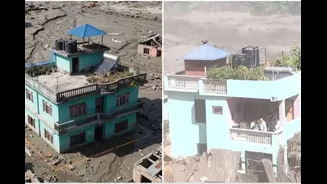



The devastating floods in Nepal have sharpened concerns over the growing instability of the Himalayan cryosphere, prompting Uttarakhand to step up monitoring of glaciers and glacial lakes across the state.
Uttarakhand Disaster Management Minister Madan Kaushik said teams had been asked to remain vigilant and watch for signs of a similar threat emerging in the region.
“Since we share a border with Nepal, as a neighbour, and also have a similar geographic situation, we have asked our department to monitor all the glaciers and known glacial lakes in the region,” Kaushik told AFP. “We have asked our teams to be vigilant and monitor if a similar situation is emerging anywhere in the state,” he added.
Among the hazards drawing particular attention are “hanging glaciers” — a relatively little-known form of unstable mountain ice that scientists have been studying closely in the Indian Himalayas.
But what makes these glaciers different, why can they become dangerous, and how exposed is India to the threat?
What Exactly Is A Hanging Glacier?
Hanging glaciers are ice masses situated on steep valley walls or in hanging valleys, often separated from larger trunk glaciers. Because they lie on steep terrain or terminate abruptly at cliffs, they can repeatedly shed ice through calving and avalanches rather than flowing steadily through a broader valley.
An April 2026 study titled Basin-scale inventory and exposure assessment of hanging glaciers, Central Himalaya, published in npj Natural Hazards, mapped 219 hanging glaciers in the Alaknanda basin of the Garhwal Himalayas, together covering about 71.7 ± 3.5 sq km.
Nearly 30% of the total hanging ice mass volume identified by the researchers is concentrated in the Upper Alaknanda basin. The glaciers had an average surface slope of about 33 degrees.
Why Are Hanging Glaciers Becoming A Concern In The Himalayas?
The risk increases as the Himalayas warm and glaciers retreat.
As a glacier melts and pulls back, parts of the ice that were once connected to or supported by a larger glacier can be left behind on steep mountain slopes. With less ice supporting them from below, these sections can become increasingly unstable and more prone to breaking off.
The April study says Himalayan glaciers are increasingly showing “geometric and dynamic instability” because of rapid warming and changes in climate. In simpler terms, glaciers are not only losing ice — their shape, movement and stability are also changing.
On steep slopes, those changes matter because a large section of unstable ice can detach suddenly and rush downhill as an avalanche.
What Happens If A Hanging Glacier Breaks Off?
A major break-off can send a mass of ice and rock racing downhill under gravity, gathering snow, rocks and sediment along the way and increasing its destructive power.
The consequences may extend beyond the avalanche itself. According to the study, glacier break-offs can damage infrastructure, threaten populations and ecosystems and block rivers downstream. Water can accumulate behind such a blockage and create a further flood threat if the natural dam subsequently fails.
A single collapse can therefore develop into a cascading disaster involving an ice-rock avalanche, debris flow, river blockage and flooding.
How Severe Could An Avalanche Be In Uttarakhand?
The scale could be enormous. In the study’s simulations, avalanche flows at Badrinath reached a maximum height of 51 metres — roughly comparable to a 15- to 17-storey building — while flows along the Badrinath-Mana road reached 48 metres.
In other words, a major collapse could send a deep, fast-moving mass of ice, rock and debris through areas containing settlements and critical infrastructure, rather than remaining confined to the high mountain slopes where the glacier breaks away.
The researchers modelled potential impacts from 25 hanging glaciers, with Mana, Badrinath, Hanuman Chatti and Ghangharia among the areas that could be exposed.
These simulations represent a worst-case scenario in which the entire hanging ice mass collapses. They are intended to show which areas could lie in an avalanche’s path and the possible scale of the impact, rather than predict that a particular glacier will collapse or when it might happen.
Why Is The Risk To People And Infrastructure Rising?
As construction pushes further into mountain valleys, the same avalanche that might once have affected a sparsely populated area can now threaten far more homes, buildings and people.
Within the areas covered by the study’s avalanche simulations, built-up surface exposed to potential avalanche flows is projected to rise from 8,025 sq metres in 2000 to 151,800 sq metres by 2030.
The number of people living within those exposed areas is also projected to increase from 380 to 8,540 over the same period.
Was A ‘Hanging Glacier’ Behind The Nepal Disaster?
Scientists are still examining the processes behind the Nepal disaster.
Jeffrey Kargel, a senior scientist at the Planetary Science Institute, told The Independent that a glacier close to Langtang Lirung peak and a mass of bedrock had detached from the mountain’s upper northern slope.
“We know that a glacier close to Langtang Lirung peak and a mass of bedrock detached from the upper north slope,” he said. “It is a small ‘hanging glacier’ that lost its lower part.”
Kargel said retreat of the glacier in a warming climate was likely important to the failure because the retreating ice lost support that had previously helped hold its lower portion in place, “leaving it ‘hanging’ and susceptible to this collapse event.”
Pam Pearson, Director of the International Cryosphere Climate Initiative, told The Indian Express that the April study underscored the need to closely monitor hanging glaciers to provide better warning to vulnerable downstream communities.
Can India Prepare For A Hanging Glacier Collapse?
Scientists cannot necessarily predict the exact timing of every glacier failure, but monitoring can help identify signs of growing instability and give authorities time to reduce exposure.
A March 2026 Perspective titled Ice-rock avalanches in a warming Himalaya indicate pathways toward effective preparedness, published in Communications Earth & Environment, compared the 2021 Chamoli disaster in Uttarakhand with the 2025 ice-rock avalanche at Blatten in Switzerland.
In Chamoli, a massive rock-and-ice collapse into the Rishiganga valley destroyed hydropower infrastructure and bridges and killed more than 200 people. At Blatten, a huge ice-rock avalanche buried much of the village, but signs of instability allowed residents to be evacuated and only one person died.
The difference, the study said, “was not luck, but preparedness, monitoring, and rapid response”.
For India, identifying potentially hazardous glaciers is therefore only the first step. Glacier and slope monitoring needs to feed into early-warning systems, evacuation planning and decisions over development in vulnerable mountain valleys.
“The goal is not to predict every avalanche, but to systematically reduce the likelihood that a foreseeable mountain hazard becomes an avoidable human catastrophe,” Anshuman Bhardwaj of the University of Aberdeen told The Indian Express.