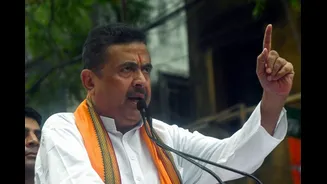





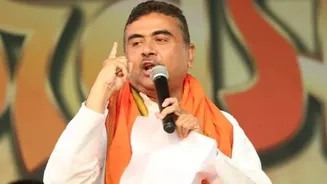
The arc of Suvendu Adhikari is not just a personal political journey, but is also the main character in the story of Bengal’s tectonic shift. As the BJP inches toward forming its first government in the state
since Independence, Adhikari has emerged as the unmistakable frontrunner for the chief minister’s chair. His rise is not accidental. It is the result of a carefully built political persona that blends grassroots aggression, insider knowledge of the Trinamool Congress, and strong backing from the BJP’s central leadership.
Once a trusted lieutenant of Mamata Banerjee, Adhikari began his political journey as a teenager. His crossover to the BJP in December 2020, after resigning from her cabinet, marked the beginning of a high-stakes political duel. What followed was not merely defection, but a direct confrontation that would redefine Bengal’s political landscape. Adhikari did not just switch sides, he weaponised his insider knowledge of Trinamool’s machinery. From being seen as Banerjee’s protégé to becoming her fiercest rival, he turned the battleground into a personal and ideological contest, one that resonated far beyond Nandigram, his political stronghold.
The Nandigram Strongman Who Rewrote the Script
Adhikari’s roots in a powerful political family in East Midnapore gave him an early organisational edge. But it was his role in the Nandigram anti-land acquisition movement that first catapulted him into prominence. Years later, that same land became the stage where he would script one of Bengal’s most symbolic political upsets.
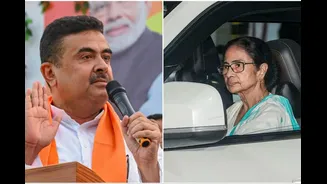
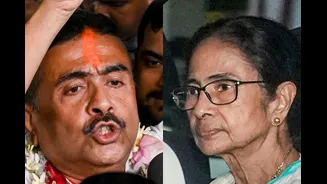
Defeating Mamata Banerjee once in Nandigram was seismic. Doing it twice, across two elections—2021 and 2026—cemented his image as the only leader capable of directly challenging her dominance. These victories were not just electoral; they carried psychological weight, puncturing the aura of invincibility around the Trinamool supremo.
Adhikari entered politics in the late 1980s as a member of the Congress party’s student wing, Chhatra Parishad. His formal electoral career began in 1995, when he was first elected as a councillor for the Kanthi Municipality under the Indian National Congress. He joined the newly formed TMC with his father, Sisir Adhikari. He rose to national prominence during the 2007 Nandigram movement. And almost 23 years later, he joined BJP on December 19, 2020, in a BJP rally and in the presence of Union Home Minister Amit Shah.
Several party insiders of Trinamool Congress attributed his exit as the ‘biggest political event’ in the state around that time and also claimed that his exit was allegedly caused by Mamata Banerjee’s nephew, Abhishek.
There are several anecdotal accounts of how Suvendu Adhikari became one of Mamata Banerjee’s most trusted lieutenants. He is often credited with breaking the CPM’s resistance by crossing over the Tehkhali bridge in Nandigram, an episode that later gave Mamata Banerjee a significant political advantage.
He is also said to have played a key role in handling the LWE crisis in Bengal’s Lalgarh region. According to these accounts, he proposed infiltrating Naxal ranks using party cadres, a strategy that allegedly led to the exposure of several Maoist operatives and the eventual killing of Maoist leader Kishenji. Additionally, Adhikari was reportedly entrusted with strengthening the Trinamool Congress’s position in Congress strongholds such as Malda and Murshidabad, where the party made notable inroads over time.
What sets Adhikari apart is his street-fighter persona. Unlike many BJP imports, he did not remain confined to strategy rooms. He was visible on the ground leading protests, mobilising cadres, and navigating a hostile political terrain marked by violence and multiple cases filed against him, many of which he has consistently termed politically motivated.
Delhi’s Chosen Face, Bengal’s Calculated Gamble
For the BJP, Adhikari is not merely a regional leader, he is the bridge between Delhi’s ambition and Bengal’s complex social fabric. Union Minister Amit Shah was among the earliest to recognise his potential, projecting him as the face of the party’s Bengal push when it needed a credible local anchor. It was Shah’s decision that made him fight against then Chief Minister Mamata Banerjee in her home turf – Bhabanipore.
This backing was not incidental. The BJP’s Bengal strategy required someone who understood Trinamool from within, could command organisational loyalty, and had the political heft to convert Hindu consolidation into votes. Adhikari fit that template almost perfectly.
His appeal cuts across layers, administrative experience from his Trinamool days, grassroots connect in rural Bengal, and now, a central endorsement that signals authority. In a state where leadership often defines electoral outcomes, the BJP’s bet on Adhikari now comes across as both pragmatic and high-risk.
When BJP forms the government, elevating him as Chief Minister, it would send a clear message that Bengal’s political centre of gravity has shifted. From the corridors of Nabanna once dominated by Mamata Banerjee, power may well pass to the man who once walked beside her, and then chose to walk straight into opposition fire.
In that sense, Suvendu Adhikari’s ascent is more than a leadership choice.