







There was a time when retail and hospitality competed almost entirely on experience, design, service, scale, and sensory appeal. Today, that equation is shifting. Experience still matters, but increasingly,
it is being filtered through a sharper, more consequential lens: how sustainable that experience truly is.
On the surface, this shift can look aesthetic, more greenery, natural materials, softer lighting. But beneath it lies something far more structural. Sustainability is no longer a layer added to spaces; it is beginning to define how they are conceived, built, and operated.
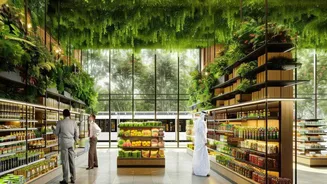
As Mauvin Godinho, Cabinet Minister of Goa, puts it, “Green is what nature is at its best. Environments rooted in nature encourage more positive and creative thinking, and this is now shaping how retail and hospitality spaces are designed to create more mindful and engaging experiences.”
This is an important reframing. “Green” is no longer just about environmental compliance, it is being positioned as a driver of consumer psychology and engagement. Spaces that feel closer to nature are not just more responsible; they are more desirable.
Nowhere is this convergence more visible than in tourism-led economies like Goa, where the pressure of high footfall meets the fragility of local ecosystems. Here, sustainability cannot remain an individual business choice, it has to be systemic.
Godinho further explains how initiatives under the Swachh Bharat Mission have evolved from basic sanitation drives into more complex, infrastructure-led interventions. Material recovery facilities across Panchayats, integrated waste management systems, and decentralised models like waste-to-energy and biogas, such as the WOOW (Wealth Out of Waste) initiative, are attempting to rewire how entire regions handle consumption and waste.
“In Goa, sustainability in retail and hospitality is no longer limited to individual establishments. Through initiatives under the Swachh Bharat Mission, we are building systems where businesses become active participants in a circular economy rather than contributors to waste,” notes Godinho.
This marks a clear shift from isolated sustainability efforts to shared ecosystems of accountability.
A similar systems-thinking approach is emerging within organised retail itself.
At Nexus Select Trust, sustainability is being embedded not as an afterthought, but as a design principle. As Nilesh Singh, Senior Vice President – ESG and Business Excellence at Nexus Select Trust, explains, the next generation of retail destinations will be defined by how responsibly they coexist with their environments, not just how they attract consumers.
That ambition is visible in operational choices that go beyond surface-level claims. The portfolio’s green building certifications, including IGBC Platinum ratings, signal an emphasis on energy efficiency and responsible construction from the outset. Water stewardship, often overlooked in urban retail is addressed through Zero Liquid Discharge systems, ensuring that water is treated, recycled, and reused within the ecosystem rather than adding pressure to city infrastructure.
But perhaps more telling is how sustainability extends beyond the physical boundaries of the mall. Lake rejuvenation initiatives and the expansion of solar energy adoption suggest a broader understanding of impact, one that includes surrounding communities and long-term ecological balance.
In this model, retail spaces are no longer just consumption hubs; they are becoming urban environmental actors.
Hospitality, too, is undergoing a similar recalibration, though often expressed through more tactile, guest-facing interventions.
At Shangri-La Bengaluru, Rahul Joshi, General Manager, Shangri-La Bengaluru, explains, “At Shangri-La Bengaluru, sustainability is deeply embedded in how we operate and innovate. From our in-house bottling plant and bamboo key cards to supporting electric mobility and on-site waste decomposition, every step is intentional.”
Through initiatives like Rooted in Nature, the hotel emphasises locally sourced, organic ingredients while ensuring minimal waste and full product utilisation. Beyond its immediate operations, its partnership with Veritree focuses on ecosystem restoration and tree planting, extending sustainability beyond the property itself.
What ties these approaches together is a common realisation: sustainability is no longer a vertical, it is a connective tissue.
It links design to operations, infrastructure to experience, and businesses to the communities they operate within.
But this convergence also raises a more complex question. As sustainability becomes central to brand identity, how do we distinguish between systems that are genuinely transformative and those that are simply well-articulated?
Because the risk, as always, lies in oversimplification. A green-certified building does not automatically ensure responsible operations. A nature-led design does not guarantee low environmental impact. And community-linked initiatives, while important, must be evaluated for scale, consistency, and measurable outcomes.
The next phase of this evolution will likely be less about visibility and more about verifiability.
Consumers and increasingly, regulators are beginning to look beyond intent. They are asking harder questions about resource use, waste recovery, energy sourcing, and long-term ecological impact. In response, brands will need to move from storytelling to systems that can withstand scrutiny.
What we are witnessing, then, is not just a trend, but a structural shift. Retail and hospitality are no longer separate from the environments they operate in. They are becoming extensions of them, shaped by ecological constraints, community expectations, and the growing demand for accountability.
The spaces of the future will not just be immersive or luxurious. They will be regenerative, resource-aware, and system-driven. And increasingly, that will be the experience consumers choose.