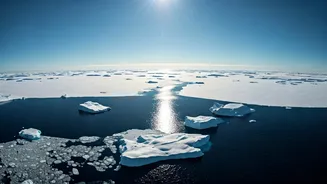









A seemingly remote Arctic island — Greenland — has become one of the most talked-about geopolitical flashpoints in early 2026. Once a background piece of NATO strategy in the High North, Greenland now
sits at the heart of an international dispute that has strained ties between the United States, Denmark, its ally, and Greenland itself. At the centre is US President Donald Trump’s renewed campaign to bring Greenland under American control, either through purchase, political pressure, or, in the most extreme formulation, force. This has elicited sharp pushbacks that illuminate deeper tensions in global order, alliance politics, and U.S. strategic priorities.
WHY THE US IS TALKING ABOUT GREENLAND
Greenland is massive — roughly the size of Western Europe — but sparsely populated; it has just about 57,000 people. It lies at the gateway to the Arctic and contains strategic assets and geographical advantages coveted by many powers:
- Its Arctic location is central to North Atlantic defence and monitoring of missile and space activity — disciplines long supported by the U.S. through Pituffik Space Base under a 1951 defence agreement with Denmark.
- Its mineral and rare-earth resources are economically valuable in high-technology industries and defence supply chains.
- Increasing great-power competition in the Arctic — partly as thawing ice opens new routes and military corridors — has elevated its strategic importance.
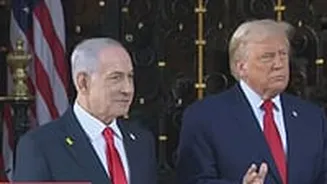
In a January 2026 interview, US President Donald Trump said full “ownership” of Greenland was “psychologically important” to him personally — a vivid insight into why the administration has pressed the issue with unusual intensity.
Trump has argued that U.S. control or influence over Greenland is needed to counter Russia’s and China’s expansion in the Arctic — claims that experts and local observers have challenged as exaggerated or inaccurate.
Administration figures have floated a range of options: from negotiating direct payments to Greenlanders as an inducement to secede, to deepening U.S. military presence, to even invoking the possibility of military force.
GREENLAND’S LEADERS: “WE CHOOSE DENMARK — NOT THE US”
Greenland’s political leadership has responded with unambiguous rejection of any notion of U.S. takeover or annexation:
- Prime Minister Jens-Frederik Nielsen repeatedly stressed that Greenland “chooses Denmark… NATO… and the EU,” reinforcing that the territory’s future must be decided by Greenlanders themselves.
- A joint statement by major Greenlandic parties declared they do not want to be American, maintaining that decisions must respect international law and self-determination.
- Surveys indicate that a large majority of Greenlanders oppose US governance or annexation.
Greenland’s government has also turned to NATO for defence frameworks, reinforcing that any security matters should be managed through the alliance rather than unilaterally by the US.
DENMARK: A NATO ALLY STANDING FIRM ON SOVEREIGNTY
Denmark — the sovereign power over Greenland — has forcefully pushed back against Washington’s overtures:
- Danish Prime Minister Mette Frederiksen has declared that Greenland is “not for sale” and that any attempt to coerce or control it would endanger Denmark’s long-standing alliances.
- She warned that hostile U.S. actions toward a NATO ally would fundamentally undermine the alliance and its mutual defence guarantees.
- Copenhagen has warned that threatening a NATO ally erodes mutual trust and could undermine the very foundation of the alliance built after WWII.
This stance is not simply symbolic. International law codifies territorial integrity and self-determination — frameworks that reject predatory territorial acquisition. Past treaties between the U.S. and Denmark, including the 1951 defence agreement, explicitly recognise Danish sovereignty over Greenland, undercutting any legal argument for forced transfer of control.
NATO AND EUROPEAN REACTION: ALARM AND SOLIDARITY
European leaders have joined Denmark in signalling serious concern:
- Several EU and NATO states have warned that any unilateral U.S. attempt to seize Greenland — even rhetorically — could “spell the end of NATO” and severely damage transatlantic relations.
- European defence officials have referenced mutual assistance clauses that could obligate them to aid Denmark if an ally is attacked.
- Diplomatic pressure is building for cooperative approaches to Arctic security that do not involve overturning sovereign rights or alliance norms.
- This breadth of pushback is significant: the notion that a leading NATO member should threaten territorial acquisition from another reveals deep alliance tension and institutional stress.
WHY AN INVASION IS UNLIKELY BUT THE RHETORIC MATTERS
Legally and practically, Greenland is part of the Kingdom of Denmark and not open to purchase or annexation under current international law.
Denmark administers foreign policy for Greenland, and any changes to its status require consent from both Denmark and Greenland.
- NATO’s collective defence obligations would complicate any scenario where one ally sought to seize territory from another.
Still, Washington already enjoys significant strategic access to Greenland through existing treaties, meaning that, in practice, the U.S. can maintain or even expand military presence with Danish consent without altering sovereignty.
WHAT THIS REVEALS ABOUT US FOREIGN POLICY IN 2026
The Greenland episode is not just about one icy territory. It reflects larger currents in US strategy — especially under an administration willing to blend assertive rhetoric, transactional thinking, and unilateral posturing in pursuit of geopolitical advantage.
This pattern mirrors other U.S. engagements, such as the maximum pressure diplomacy with Iran, where sanctions, military warnings, and punitive strategies are pursued alongside conventional diplomacy. Such approaches underscore a broader strategic posture emphasising hard power leverage, pressure tactics, and expansive assertions of national interest — even at the risk of straining alliances and international norms.
Viewed through that lens, the Greenland crisis fits a broader pattern: U.S. foreign policy that increasingly prioritises doctrine over diplomacy, confrontation over consensus, and unilateral influence over multilateral cooperation.
A CRISIS OF PERCEPTION, LAW AND STRATEGY
The Greenland crisis is far more than a quirky headline. It has become a profound geopolitical flashpoint:
- Greenland and Denmark have rejected U.S. claims and put sovereignty first.
- NATO and European allies have warned that coercive moves could undermine collective defence and alliance cohesion.
- International law clearly prioritises territorial integrity and self-determination, not conquest.
And in the backdrop of other high-tension foreign-policy arenas — including U.S.–Iran tensions — this episode underscores a broader critique: that America’s global strategy in 2026 is increasingly shaped by aggressive, unilateral rhetoric, which may achieve immediate attention but risks long-term fractures in alliances and legal norms.
Ultimately, the debate over Greenland isn’t just about geography — it’s about who sets the rules of global engagement in the 21st century, and how power is balanced with principles of sovereignty, partnership and law.