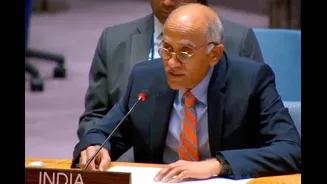

India on Tuesday strongly criticised Pakistan at the United Nations Security Council (UNSC), accusing it of misusing international platforms to pursue what New Delhi described as a divisive and hostile
agenda against India.
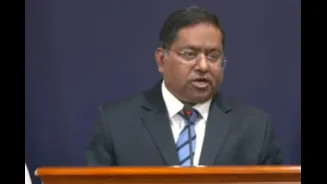
Speaking at the UNSC Open Debate on “Leadership for Peace”, India’s Permanent Representative to the UN, Ambassador Harish P, objected to Pakistan’s reference to Jammu and Kashmir, calling it “unwarranted” and reflective of Islamabad’s “obsessive focus on harming India and its people”.
The ambassador said a non-permanent member of the Security Council that repeatedly raises bilateral issues in multilateral forums cannot be expected to uphold its responsibilities under the UN Charter. “A serving non-permanent Security Council Member that chooses to further this obsession in all meetings and platforms of the UN in pursuit of its divisive agenda cannot be expected to fulfil its designated responsibilities and obligations.” Harish’s remarks echo India’s long-standing position that Jammu and Kashmir is an internal matter and Pakistan has no locus standi to raise it at international platforms.
In a sharp rebuttal, the Indian envoy also questioned Pakistan’s democratic credentials, citing the jailing of former prime minister Imran Khan, banning of the then ruling political party, and what he described as the military’s role in engineering constitutional changes to grant lifetime immunity to its top defence leadership.
“Pakistan, of course, has a unique way of respecting the will of its people,” Ambassador Harish said, underscoring India’s repeated efforts to highlight Pakistan’s internal political instability and the outsized role of its military establishment.
The envoy, while referring to the Indus Waters Treaty, said India entered into the agreement 65 years ago in good faith and in a spirit of goodwill and friendship. “Throughout the six-and-a-half decades, Pakistan has violated the spirit of the treaty by inflicting three wars and thousands of terror attacks on India. In the last four decades, tens of thousands of Indian lives have been lost in Pakistan-sponsored terror attacks, the most recent of which was the Pahalgam attack in April 2025, which involved religion-based targeted killing of 26 innocent civilians by Pakistan-sponsored terrorists. It is in this backdrop that India has finally announced that the treaty will be held in abeyance until Pakistan, which is a global epicentre of terror, credibly and irrevocably ends its support for cross-border and all forms of terrorism.”
Reaffirming India’s security stance, the envoy made it clear that New Delhi would continue to respond firmly to cross-border terrorism. “India will counter Pakistan-sponsored terrorism in all its forms and manifestations with all its might,” he said.
India has consistently used UN platforms to call out Pakistan for supporting terrorism, pointing to attacks such as the 2001 Parliament attack, the 2008 Mumbai terror attacks, the 2016 Uri attack, and the 2019 Pulwama bombing. New Delhi has also repeatedly accused Islamabad of sheltering UN-designated terrorists and failing to act against terror groups operating from its soil.
Pakistan, for its part, routinely raises the Kashmir issue at the UN, despite India maintaining that the matter was settled bilaterally under the Simla Agreement and later the Lahore Declaration.
Tuesday’s exchange reflects the continued strain in India-Pakistan relations, with New Delhi signalling that it will push back strongly against any attempt by Pakistan to internationalise bilateral disputes or deflect attention from its own record on terrorism and governance.






![[WATCH]: T20 World Cup 2026: Abhishek Sharma reveals massive health update ahead of Pakistan clash](https://g-mob.glance-cdn.com/public/fc/image/_6qWvVYj_1x0.webp)