







BJP has swept West Bengal in a verdict that has stunned India. With leads in over 190 seats against TMC’s dwindling tally, the saffron party is set to form the state’s first-ever right-of-centre government
— ending 49 unbroken years of Left and TMC rule . Now, one question is gripping Bengal’s political circles: when will the swearing-in be, and will it fall on one of Bengal’s most sacred cultural dates?
The speculation began with a remark Modi made at his final rally in Barrackpore on April 27 — the last day of campaigning. “This is my last rally in this election. I’m going back with the confidence that I will definitely attend the BJP’s swearing-in ceremony after the May 4 results. And that only increases my enthusiasm,” he declared to thunderous cheers. The crowd knew what it meant. Modi doesn’t make promises he doesn’t keep.
What Is Pochishe Boishakh — And Why Does It Matter?
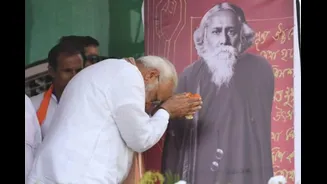
Rabindranath Tagore’s Jayanti is traditionally celebrated on the 25th day of the Bengali month Boishakh, known as Pochishe Boishakh. In 2026, it falls on May 9.
For Bengal, this is not just a date on the calendar — it is an emotion. Tagore was born on this day, always celebrated his birthday on Pochishe Boishakh during his lifetime, and even composed a special song — “He Nutan, Dekha Dik Arbar” — for the occasion just weeks before his death in 1941.
To hold a swearing-in on this day would be a cultural statement of extraordinary weight — a new government taking oath on the birthday of the man who wrote India’s national anthem.
What Did Modi Actually Say About The Date?
No direct Modi quote specifically naming Pochishe Boishakh or May 9 as the swearing-in date has been confirmed. What is on record is his Barrackpore promise to attend — and the BJP’s well-established tradition of choosing symbolically loaded dates for major ceremonies.
The buzz connecting the two has largely emerged from Bengali political circles and social media, where the May 9 date is being discussed with growing excitement. BJP sources have not officially confirmed a date yet.
But Is May 9 Constitutionally Realistic?
The timeline is tight — but not impossible. Before any swearing-in can happen, Mamata Banerjee must first tender her resignation to the Governor, who will then invite BJP as the single largest party to form the government.
BJP must also formally identify and communicate its Chief Minister candidate — a name the party has deliberately kept under wraps throughout the campaign.
In recent BJP wins, swearing-in ceremonies have followed results within six to nine days. With results declared on May 4, May 9 leaves only five days for this entire process to play out.
If Mamata resigns promptly and BJP moves swiftly on its CM pick, the date is achievable. Any delay on either front, and the ceremony slips to May 10 or beyond.
Why Would May 9 Be A Masterstroke?
For a party that spent the entire campaign assuring Bengalis that it understood their culture, their language, and their soul — choosing Tagore’s birth anniversary for the swearing-in would be the final, definitive punctuation mark.
Amit Shah had promised a Chief Minister who would be Bengali-born and Bengali-speaking. Modi had arrived at BJP headquarters in a dhoti, to a Bengali campaign anthem. A swearing-in on Pochishe Boishakh would complete the arc — telling Bengal that the BJP doesn’t just want to govern the state, it wants to belong to it.
What Comes Next?
With BJP firmly on course for a historic majority, the formal process of government formation will begin in the coming days.
The Governor will invite the single largest party to form the government, after which a Chief Minister — whose identity BJP has kept deliberately under wraps — will be announced.
Whether the oath falls on May 9 or another date, one thing is certain: as Modi put it from the BJP headquarters stage, “The sun has risen in West Bengal, for which many generations have waited eagerly.” The ceremony, whenever it comes, will be historic.