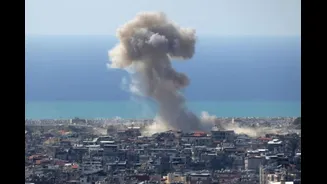








Global leaders and organisations have reacted strongly to Israel’s latest strikes on Lebanon, even as a ceasefire between the United States and Iran comes into effect, raising concerns over a wider regional
escalation.
US President Donald Trump said Lebanon was not part of the truce arrangement, attributing the situation to Hezbollah’s role. In an interview with PBS, he described the conflict as a “separate skirmish” and added that “that’ll get taken care of too”.
However, Pakistan’s Ambassador to the US, Rizwan Saeed Sheikh, contradicted this claim, stating in a CNN interview that Lebanon was “explicitly part of the US-Iran ceasefire” and that its inclusion was “clear to all parties”.
The Islamic Revolutionary Guard Corps (IRGC) warned it would respond if Israel continues its attacks on Lebanon, signalling the risk of further escalation.
Meanwhile, European leaders also voiced concern. Spain’s Prime Minister Pedro Sanchez criticised Israeli Prime Minister Benjamin Netanyahu, saying his “contempt for life and international law is intolerable.” France’s President Emmanuel Macron stressed that including Lebanon in the ceasefire was essential for achieving lasting peace in the region.
Turkiye accused Netanyahu of undermining peace efforts, with its foreign ministry stating that the attacks were worsening the humanitarian crisis in Lebanon.
Strong reactions also came from international organisations. The United Nations condemned the strikes, with spokesperson Farhan Haq saying the UN “strongly condemns” Israel’s actions. The UN human rights chief described the attacks as “nothing short of horrific.”
Middle Eastern nations issued similar statements. Oman condemned the strikes, while Egypt’s foreign ministry said the attacks showed a “premeditated intent” to derail efforts aimed at reducing tensions. Qatar called the offensive a “brutal series” of attacks, terming it a “dangerous escalation” and a violation of international law and United Nations Security Council Resolution 1701.