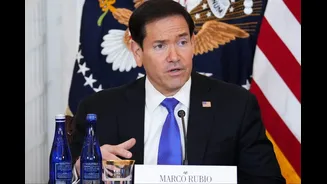









US Secretary of State Marco Rubio has told several foreign counterparts that the United States is not expected to initiate new strikes against Iran “for the time being”, according to an Axios report citing
a US official and a second source familiar with the matter.
Instead, the Trump administration is focusing on other forms of pressure against Tehran, including a new sanctions initiative and continued maritime pressure around the Strait of Hormuz, Axios reported.
LIVE Updates On The US-Iran War
According to the report, Rubio made clear that the US is not planning a return to major combat operations against Iran at present. However, the US official said he did not rule out military strikes if Iran attacks first.
Rubio reportedly outlined the administration’s current Iran policy during phone calls with several of his foreign counterparts.
The approach includes avoiding military action against Iran for the time being, increasing economic pressure through the US naval blockade and the latest Treasury Department sanctions push, and moving as much oil as possible through the Strait of Hormuz and into global energy markets.
A second US official cited by Axios said the policy is expected to remain in place at least until after the US midterm elections, after which a new military campaign could again be considered.
The reported shift comes as the Strait of Hormuz remains central to the wider conflict and the global energy crisis.
According to Reuters calculations cited in one of its reports, countries affected by conflicts in 2026 produced around 45 million barrels of oil per day based on 2025 output, accounting for more than 43 per cent of global supply.
It mentioned that US and Israeli attacks on Iran six months ago triggered what has become the largest oil supply crisis on record, with no clear end in sight.
ALSO READ | ‘Illicit Unilateral’: China Warns US Of Retaliation Over New Sanctions On Iran, Trading Partners
The Russia-Ukraine war has also caused production and refining cuts, including in Kazakhstan, while the conflict in Libya and US restrictions on Venezuelan oil exports have added further pressure.
The disruption in the Gulf alone is estimated at around 5 million to 7 million barrels per day, with Saudi Arabia rerouting oil towards the Red Sea and Gulf exporters attempting to move oil through the Strait of Hormuz.
The waterway normally carries around one-fifth of the world’s oil and liquefied natural gas exports.
Reuters also reported that conflicts in the Gulf and Ukraine have reduced global refining capacity by about a tenth.
Ukraine has targeted Russian refineries, while Russia has faced fuel shortages and imposed gasoline and diesel export restrictions.
Higher fuel prices have contributed to inflation and higher borrowing costs, while US diesel prices have reached record levels despite refiners operating at peak capacity.
ALSO READ | US Sanctions 4 Indian Firms, 3 Nationals Over Iran Trade Under ‘Operation Economic Outcast’
The Strait of Hormuz has also become a key part of Washington’s strategy.
One US official told Axios that the US Navy’s mine-clearing operation in the strait represents a “watershed moment” in the war, largely neutralising one of Iran’s main sources of leverage.
At the same time, Iran and Oman are discussing a framework to restore navigation through the strategic waterway.
According to AFP, Omani Foreign Minister Badr Albusaidi and Iranian Foreign Minister Abbas Araghchi discussed a phased framework that would establish a temporary joint navigational corridor through the strait and launch a joint project to clear mines.
Albusaidi said he hoped the two countries would “soon announce” the temporary corridor.
Technical negotiations are expected to address a permanent navigational corridor, future administration of the waterway, information-sharing, traffic management and navigational and security services.
Iran and Oman also said discussions should involve other states bordering the Gulf.
ALSO READ | Mojtaba Khamenei’s Voice Heard For First Time As Iran Releases Another Undated Video Since War