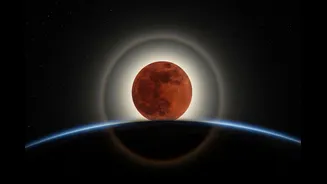

This year, the festival of Holika Dahan will be observed on Tuesday, March 3, and the day holds special significance due to a major astronomical event. The biggest lunar eclipse of the year will occur
on the same day as Holika Dahan.
This rare celestial phenomenon is expected to attract both astronomy enthusiasts and the general public. On this day, the Moon will appear reddish, which is why it is commonly called a Blood Moon. But the key questions remain—will this eclipse be visible in India, and will the Sutak period apply? Let’s find out.
The Lunar Eclipse Will Be Visible In India
In Vedic astrology, eclipses—whether lunar or solar—are traditionally considered inauspicious. Regardless of where an eclipse occurs, its impact is believed to extend across the entire world, affecting humans, animals, birds, and nature itself.
A lunar eclipse occurring on Holi is considered an especially rare event. Notably, the year 2026 will witness four eclipses in total, including two lunar and two solar eclipses.
This particular event will be a partial lunar eclipse, visible only in certain parts of India. Since the eclipse will be visible within the country, the Sutak period will be applicable. For a lunar eclipse, the Sutak period begins nine hours before the eclipse, while for a solar eclipse, it begins twelve hours prior.
Lunar Eclipse In Leo Zodiac Sign
According to Vedic astrology, a lunar eclipse on the day of Holi is an uncommon and significant occurrence. During this eclipse, the Moon will be positioned in the Leo zodiac sign, where it will be in conjunction with Ketu.
As per Indian Standard Time (IST), the eclipse will begin at 3:20 PM and conclude at 6:47 PM. The first lunar eclipse of the year is expected to last for 3 hours and 27 minutes.
This year, the Full Moon (Purnima) of the Shukla Paksha in the month of Phalgun falls on Tuesday, March 3, 2026. The Purnima tithi will begin at 3:20 PM and end at 6:47 PM, coinciding exactly with the duration of the eclipse.
How a Lunar Eclipse Occurs
A lunar eclipse occurs when the Earth comes between the Sun and the Moon, blocking sunlight from reaching the Moon. As a result, the Earth’s shadow falls on the Moon, causing it to appear partially or completely obscured. This phenomenon generally takes place two to three times a year, but its occurrence on Holi makes it particularly significant from both religious and astronomical perspectives.
Eclipse Will End Before Moonrise
Special attention must be paid to the Sutak period during an eclipse. Sutak refers to the time before and after an eclipse when certain religious practices are restricted. During this period, religious rituals and prayers are generally avoided, and consumption of food and water is also prohibited.
Importantly, in India, this lunar eclipse will conclude before moonrise. As a result, the lunar eclipse occurring on Holika Dahan is being referred to as a ‘Grastodaya’ eclipse.
What To Do During the Sutak Period
- Take a holy bath after the eclipse ends.
- Clean the home temple and purify idols by sprinkling Gangajal.
- Chanting mantras and meditation during the eclipse is considered auspicious.
What Not To Do During the Sutak Period
- Avoid eating food or drinking water.
- Avoid touching idols of deities during this time.
- Refrain from performing religious rituals, havans, or prayers.
- Pregnant women should take special precautions and are advised not to step outside.
- Avoid sleeping during the eclipse period.
Lunar Eclipse: A Remarkable Astronomical Event
This lunar eclipse presents a fascinating opportunity for astronomy enthusiasts to witness a rare celestial event. From a scientific perspective, the eclipse holds immense importance as it allows researchers to study planetary alignments and their effects.
The rare coincidence of Holi and a lunar eclipse once again highlights the unique intersection of religious traditions and astronomical phenomena. By following the prescribed guidelines, people can safely observe and appreciate this extraordinary cosmic event.