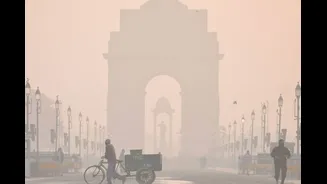









Delhi’s air quality has started to deteriorate as the monsoon retreats, with the city’s AQI rising to 169. The reading is at the upper end of the Central Pollution Control Board’s (CPCB) ‘moderate’ category,
with dry weather, weak winds and local emissions contributing to the rise.
The India Meteorological Department (IMD) said conditions are favourable for further withdrawal of the southwest monsoon. The monsoon is likely to withdraw from Delhi in the next two to three days, with no rain activity expected this week.
Delhi’s AQI has climbed rapidly from 88 on Friday to 118 on Saturday, 160 on Sunday and 169 on Monday. PM2.5 and ozone were reported to be the dominant pollutants during the recent deterioration.
Why is Delhi’s air worsening?
Monsoon showers had helped keep Delhi’s air relatively clean by washing pollutants out of the atmosphere. With little or no rain forecast, dust and exhaust emissions can remain suspended for longer.
Weak winds are also reducing the dispersion of pollutants, allowing emissions to accumulate over the city. Traffic, road dust, construction and other local urban sources are adding to the pollution levels. The likely withdrawal of the monsoon is bringing clearer and drier conditions, which can allow AQI levels to rise further.
Delhi had experienced relatively clean air over the past month because of monsoon rains and strong winds. In September, the city recorded 12 ‘satisfactory’ and eight ‘moderate’ air quality days.
Winter pollution has not peaked yet
Despite the deterioration, the current pollution levels do not yet represent Delhi’s winter peak. The worst phase typically begins later, when night-time temperatures fall, the atmospheric mixing layer becomes shallower and winds become weaker and more variable. These conditions can trap pollution closer to the ground.
Crop-residue burning across Punjab and Haryana is another seasonal factor. It usually begins around September and peaks from mid-October to November. Delhi’s pollution generally rises sharply from October and remains elevated through February.
The current rise is therefore an early warning that the meteorological conditions allowing pollution to build up are returning, even though the full winter smog pattern has not yet begun.
Eight stations record ‘poor’ air
While Delhi’s overall AQI was 169, eight of the city’s 42 active monitoring stations recorded ‘poor’ air quality on Monday.
Siri Fort and Chandni Chowk recorded the highest AQI at 221, followed by IGI at 219, Burari at 215, Wazirpur at 213, Patparganj at 208, Narela at 207 and IIT at 202.
Delhi recorded a maximum temperature of 35.6°C on Monday and a minimum of 25°C. According to the IMD, the maximum temperature is likely to remain around the same level, while the minimum temperature may gradually fall to 22-23°C by the weekend.
What does AQI 169 mean?
According to CPCB standards, an AQI of zero to 50 is ‘good’, 51 to 100 ‘satisfactory’, 101 to 200 ‘moderate’, 201 to 300 ‘poor’, 301 to 400 ‘very poor’ and 401 to 500 ‘severe’.
An AQI of 169 is therefore officially ‘moderate’, but is close to the ‘poor’ threshold. Sensitive groups, including people with asthma, older adults, children and those with heart or lung disease, should reduce prolonged or strenuous outdoor activity when pollution rises.
Monsoon withdrawal underway
The IMD said the southwest monsoon has withdrawn from parts of Rajasthan, Haryana and Punjab.
“Conditions are favourable for its further withdrawal from the remaining parts of Punjab, Haryana-Chandigarh-Delhi, Rajasthan and parts of Saurashtra & Kutch, Jammu-Kashmir, Himachal Pradesh, Uttarakhand and West Uttar Pradesh in the next two to three days,” the IMD stated.
Delhi’s Monday AQI was the highest since July 19, when it stood at 171 in the ‘moderate’ category. On July 9, the city recorded its cleanest air day of the year, with an AQI of 48 in the ‘good’ category.
The last ‘poor’ air quality day was recorded on July 12, when the AQI was 246. The brief deterioration on July 12 and 13 was attributed to dust carried by winds from Afghanistan, Iran and Pakistan towards northwestern India, including Delhi, leading to elevated PM10 concentrations.