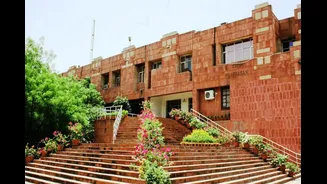

If we thought the dust had settled on the issue of anti-national sloganeering within the precincts of one of India’s premier higher education institutions—Jawaharlal Nehru University—with the crackdown
on student leaders like Kanhaiya Kumar, Umar Khalid, Shehla Rashid and Anirban Bhattacharya in 2016, the hiatus was perhaps only waiting to be broken by another, more insidious incident. On the night of 5 January 2026, in the immediate aftermath of the denial of bail to both Umar Khalid and Sharjeel Imam—directly accused of inciting mob violence and communal riots in Delhi in 2020, and of threatening to cut off the North East from the rest of India by blockading the Chicken’s Neck Corridor—JNU student bodies, mainly affiliated to Left-oriented political dispensations, reportedly raised highly objectionable slogans calling for the death of Prime Minister Narendra Modi and Home Minister Amit Shah. An FIR was lodged subsequent to the said sloganeering, and disciplinary proceedings were initiated against the offending students by the university, including possible eviction from hostels and potential arrest. Let us first consider the legal aspects of the matter in question. Of the many freedoms enjoyed by the citizens of India, the freedom of speech and expression guaranteed under Article 19(1)(a) of the Constitution of India is considered the bedrock of democracy, subject only to the reasonable restrictions placed upon it by Article 19(2). Needless to say, the scope and extent of this freedom, and the restrictions that may be placed upon it, have time and again been challenged in courts of law. If we contextualise the recent sloganeering incident at JNU and the subsequent FIR against the offenders, it once again brings into focus the protections provided by Article 19(1)(a) and the scope of reasonable restrictions, particularly with regard to the debate surrounding actual incitement to violence versus mere provocative advocacy. In Shreya Singhal v. Union of India (2015) 5 SCC 1, the Supreme Court distinguished between protected speech and unprotected incitement, observing that “mere discussion or advocacy is at the heart of Article 19(1)(a)” and that “it is only when such discussion… reaches the level of incitement that Article 19(2) kicks in.” In Superintendent, Central Prison v. Ram Manohar Lohia (1960) 2 SCR 821, it was stated that restrictions become justified only when a “proximate nexus” to harm is established, and not on the basis of remote fears. Precedents such as S. Rangarajan v. P. Jagjivan Ram (AIR 1989 SC 833) and Kedar Nath Singh v. State of Bihar (AIR 1962 SC 955) rejected vague “tendency” tests in the absence of an imminent risk of violence. The Supreme Court, in Kaushal Kishor v. State of U.P. (2023) 4 SCC 1, insisted on a precise balancing between the freedom of speech and expression and the imposition of restrictions thereon, emphasising the need to avoid overreach. The JNU episode also reminds us of Arun Ghosh v. State of West Bengal (1970) 1 SCC 98, wherein the Bench noted that what matters is the scale of disturbance and not personal affront, though risks of communal unrest may constitute grounds for the imposition of reasonable restrictions. It can, however, be argued that while Article 19(1)(a) stands as democracy’s “Ark of the Covenant” (Bennett Coleman & Co. v. Union of India, (1972) 2 SCC 788), demanding that we tolerate sharp criticism, it draws a firm line at threats to the life of constitutional figures, such as grave-digging threats that may genuinely endanger public peace. As was evident in the JNU sloganeering incident, direct threats were reportedly articulated, which may be viewed as personalised and lethal threats against constitutional figures and national leaders. These transcend mere policy critique in a tense context and may potentially provide a “spark in a powder keg”, as articulated in Shreya Singhal. Yet, it may also be argued that mere offence to authority falls short of the threshold; proof of realistic disorder and a demonstrable tendency to cause harm remain crucial. The law, therefore, mandates “reasonable” curbs that are narrowly tailored and context-driven. The JNU incident thus prompts careful scrutiny of whether inciteful speech alone suffices, or whether imminence of violence must be conclusively established. While the constitutional and legal position clearly provides for a wide ambit of debate and discussion, the political context remains firmly focused on the social and national security concerns associated with provocative, inciteful, and hate-driven sloganeering on university campuses. Not only does the ostensible mindset of the offenders in this instance become veritable cannon fodder for digital terror recruiters across the border and their proxies within India, it also calls into question the nation’s capacity to safeguard itself against external adversaries while contending with an internal minefield of enemies and detractors blinded by ideological hatred and indoctrination. This further places a glaring spotlight on the content, context, and delivery of higher education imparted to future generations through premier institutions of repute, which are increasingly perceived as transforming into virtual training grounds for anarchists and, for want of a better term, terrorists, masquerading as dissenters and self-styled warriors of democracy and social justice. It appears that little has changed in the conceptual atmosphere of JNU since 2016, where intellectual and ideological blindness continues to capture the imagination of young students and scholars, intoxicated by romanticised vitriol disseminated by motivated and surreptitious professors. Consequently, issuing death threats to constitutional offices and their occupants becomes normalised, with intellectual violence forming the lifeblood of a delusional and anarchic revolution that JNU appears perpetually to anticipate and prepare for. Whether those who have fallen foul of the Indian state in the latest incident will be judged strictly according to existing legal precedent on freedom of speech, or whether new precedents will be set to make an example of them, remains to be seen. What is certain, however, is that the final word on India’s internal enemies, the contours of freedom of speech and its reasonable restrictions, and the imperatives of national security has yet to be spoken. (Dr Monica Yadav is an advocate and Professor of Law at IILM University, Gurugram. Dr Roshni Sengupta is an author, political commentator, and Professor of Politics and Media at IILM University, Gurugram. The views expressed are personal and do not reflect those of News18.)