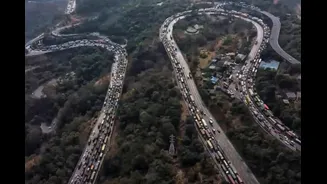








Barely weeks after an unprecedented 33-hour traffic paralysis brought one of the Maharashtra’s busiest corridors to a standstill, the state’s key highway network once again buckled under pressure on Monday,
as thousands of vehicles were caught in massive traffic snarls triggered by the summer holiday rush.
Since early morning, severe congestion was reported on both the Mumbai-Pune Expressway and the Mumbai-Ahmedabad National Highway, leaving commuters stranded for hours and exposing persistent infrastructural and traffic management challenges along these arterial routes.
On the Mumbai-Pune Expressway, long queues of vehicles stretched between 3-4 kilometres from the Adoshi Tunnel to the Missing Link near Khalapur. Motorists reported painfully slow movement, with several vehicles crawling for extended periods. While the exact trigger for the congestion remains unclear, officials suspect a sharp spike in outbound traffic towards tourist destinations, compounded by bottlenecks in the ghat section.
Police teams have been deployed at key points to regulate flow and ease congestion, but relief has been gradual.
The Mumbai-Ahmedabad National Highway presented an equally grim picture. In Palghar district, traffic queues extended up to 6-7 kilometres between Haloli and Varai near Manor. Commuters travelling from Gujarat towards Mumbai reported being stuck for 3-4 hours since early morning.
Here, the congestion appears more directly linked to ongoing infrastructure work. Flyover construction in the stretch, coupled with a surge in vehicular movement, has reduced road capacity and created choke points, worsening delays.
The situation mirrors last month’s chaos, when motorists were trapped for over 30 hours on the same expressway due to a combination of heavy traffic, roadwork constraints and poor lane discipline. The fallout was significant, with authorities later announcing toll refunds to over 1 lakh affected commuters.
What’s Driving The Highway Chaos
Recurring congestion on these highways points to a deeper, structural problem rather than isolated incidents. The ghat sections on the Mumbai-Pune route remain particularly vulnerable due to sharp gradients, heavy vehicle movement and limited scope for lane expansion. Even minor disruptions, a stalled vehicle or slight increase in traffic volume, can quickly snowball into large-scale gridlocks.
Simultaneously, infrastructure upgrades such as flyovers and missing link projects, while essential in the long term, are currently contributing to reduced carriageway space and inconsistent traffic flow. Add to this the seasonal surge in travel during holidays and weekends, and the system is pushed beyond its operational capacity.
Transport experts have repeatedly flagged the need for better traffic forecasting, staggered travel advisories and stricter regulation of heavy vehicles during peak hours to prevent such recurring breakdowns.
For now, authorities have advised commuters to avoid peak travel hours, explore alternate routes where possible, or postpone non-essential journeys. Travellers are also being urged to carry sufficient water and food, given the likelihood of prolonged delays.