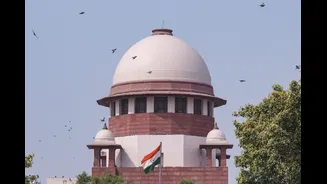

The Supreme Court on Friday stayed a Calcutta High Court order that had disqualified Mukul Roy as a member of the West Bengal Legislative Assembly for returning to the ruling All India Trinamool Congress
(TMC) after being elected on a Bharatiya Janata Party (BJP) ticket in 2021.
A bench comprising Chief Justice of India Surya Kant and Justice Joymalya Bagchi passed the interim order months ahead of the end of the assembly’s term in May and the upcoming state elections. The court issued notices seeking responses from Assembly Speaker Biman Banerjee and BJP leaders Suvendu Adhikari and Ambika Roy, who had moved the high court seeking Roy’s disqualification. The bench directed that counter-affidavits be filed within four weeks, followed by rejoinders within two weeks.
The appeal before the Supreme Court was filed by Roy’s son, Subhranshu Roy, citing his father’s hospitalisation. He argued that the Speaker had carefully examined the material placed before him and, in June 2022, rejected the disqualification plea.
On November 13, the Calcutta High Court overturned the Speaker’s decision. Adhikari and Ambika Roy relied on a June 2021 video purportedly showing Mukul Roy and his son joining the TMC at the party headquarters in the presence of Chief Minister Mamata Banerjee.
Subhranshu Roy contended that the Speaker had rejected the plea because the video lacked certification under Section 65B of the Evidence Act. His counsel, advocate Preetika Dwivedi, said the high court held such certification was unnecessary for deciding a disqualification under the Constitution’s Tenth Schedule (anti-defection law).
The Supreme Court, however, raised concerns about relying on uncertified electronic evidence, noting that in an era of artificial intelligence, such material must be tested for authenticity. Senior advocate Gaurav Agarwal, appearing for the BJP leaders, argued that Roy had clearly defected after being elected on a BJP ticket and could not continue as an MLA.
Noting that the assembly’s term ends in about four months, the bench said that not staying the high court’s judgment would have consequences. It also observed that the high court’s reasoning ran contrary to the Supreme Court’s 2020 ruling in the Arjun Panditrao Khotkar case, which held that a Section 65B certificate is a mandatory condition for admitting electronic evidence. Relaxing this requirement in disqualification cases, the court said, would undermine settled precedent.
The high court had earlier held that Section 65B certification was required only for secondary electronic evidence and relied on the video, a press conference transcript and other material, noting that Mukul Roy had not denied his presence at the event. It described the Speaker’s order as perverse.