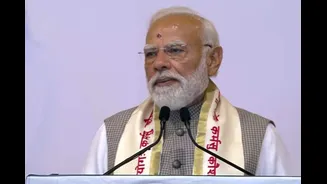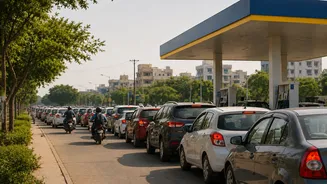








India is in the middle of an oil anxiety moment. The West Asia war between US-Iran and Israel unsettled global crude supply chains, and Prime Minister Narendra Modi has responded with an unusual appeal
to the nation — slow down, stay home, and save fuel.
In a call that has quickly rippled across boardrooms and employee WhatsApp groups, PM Modi urged offices, both private and government, to revive work-from-home arrangements, cut non-essential travel, and reduce fuel consumption wherever possible. It is a signal, not a mandate like the Covid-era.
But for a city like Hyderabad, home to over 9 lakh IT and ITES (Information Technology Enabled Services) employees packed into one of the most congested tech corridors in Asia, the signal carries serious arithmetic behind it.
The City That Never Stops Commuting
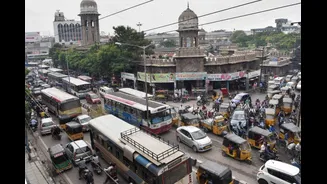
The stretch between Gachibowli, Madhapur, and HITEC City is, on most mornings, a slow crawl of two-wheelers, cabs, and chartered buses inching toward the same cluster of glass towers. Microsoft, Google, Amazon, Infosys, TCS, Wipro, Accenture — the roll call of companies headquartered or significantly present in Cyberabad reads like a global tech directory. The workforce supporting these offices runs to lakhs, drawn from across Hyderabad and its expanding suburbs along the Outer Ring Road.
The problem with this concentration is the commute it generates every single day.
A significant portion of these employees live 15 to 25 km from their offices. Many travel by private vehicle — cars or two-wheelers — because public transit, while improving, has not yet fully absorbed the commute burden in the western corridors. Add peak-hour congestion and the commute time stretches further, burning more fuel per kilometre than under free-flow conditions.
What The Numbers Suggest
Petrol price in Hyderabad on Tuesday stood at Rs 107.5 per litre, among the highest in the country.
Now consider this estimate. Hyderabad’s IT sector employs upward of 9 lakh people. If even half of them, or roughly 4.5 lakh, were to work from home just three days a week, and each person covers an average round-trip commute of 20km, that eliminates approximately 2.7 crore km of daily road travel every work from home (WFH) day.
Assuming an average fuel efficiency of 35 km per litre for two-wheelers and 15 km per litre for cars, a blended average of around 25 km per litre is reasonable. At that efficiency, 2.7 crore kilometres translates to roughly 10.8 lakh litres of petrol saved per WFH day.
At Rs 107.5 per litre, that is approximately Rs 11.6 crore saved in a single day. Across three WFH days per week, the weekly saving crosses Rs 34 crore. Monthly, it approaches Rs 140 crore — just from Hyderabad’s IT corridor, just from a partial shift.
These, of course, are illustrative numbers, not official projections. Mileage varies by commute distance, vehicle type, and traffic density. But even discounted significantly, the magnitude holds, and it makes Hyderabad’s IT workforce one of the most consequential levers India has for meaningful fuel conservation without shutting down any economic activity.
Why IT Sector Is Uniquely Placed To Act
The IT and ITES sector did not need to learn remote work in 2020. It already knew how. When the pandemic arrived, Hyderabad’s tech companies migrated their operations home within days and kept global clients serviced, international projects on track, and revenue intact. The sector essentially proved, under real-world pressure, that geography of the office chair is not the same thing as productivity.
Nashik-based IT employee union NITES made exactly this argument in a letter to Union Labour Minister Mansukh Mandaviya this week, squarely citing the Prime Minister’s appeal. The union said the IT and ITES industry is “uniquely positioned” to implement large-scale remote work without disrupting output, and pointed to the pandemic years as evidence.
It described the PM’s remarks not as a casual operational suggestion but as “a national call for collective responsibility during a sensitive period where reducing fuel dependency, traffic burden, and unnecessary consumption becomes part of contributing towards national interest”.
The letter also went further, pressing for formal remote-work advisories: “Employees in metropolitan cities spend several hours daily travelling despite performing work that can effectively be delivered remotely. This not only impacts physical and mental health, but also results in avoidable fuel usage and environmental burden.”
Now, The Pushback
The past two years have seen India Inc steadily reverse its pandemic-era flexibility. Companies across sectors tightened attendance norms, sent return-to-office communications with little to no room for negotiation, and made physical presence a de facto performance marker. The logic was about culture, collaboration, junior employee development — reasons that are not wrong, even if they were sometimes applied with little nuance.
That pushback is unlikely to disappear overnight. Managing Directors of staffing and HR firms have noted that remote work cannot be a blanket answer since manufacturing, healthcare, retail, and field operations all need physical presence. The IT sector’s situation is different precisely because the work is digital and the client delivery is outcome-based rather than presence-based.
What may change, however, is the framing. Industry observers have noted that when WFH is positioned as an employee benefit, companies resist it. When it is positioned as national interest and business continuity planning — which is exactly how the Prime Minister’s appeal frames it — the resistance looks less defensible. Hybrid work then becomes part of a company’s resilience architecture, not a concession to convenience.
The Hyderabad Opportunity
Hyderabad is not just any IT city in this conversation. It is the one with the largest and fastest-growing base of Global Capability Centres (GCCs) — over 350 as of early 2026, overtaking Bengaluru in new greenfield setups.
It is also a city where commute infrastructure, despite the Metro’s considerable expansion, has not kept pace with the scale of its tech workforce. The ORR is congested. The arterial roads into HITEC City log among the worst peak-hour speeds in the country. Fuel burned in that daily gridlock is fuel that produces no economic output whatsoever.
A structured, even partial, return to WFH among the city’s IT workforce would do something the Metro and road-widening projects cannot do quickly — it would remove vehicles from the road on the days it operates. Not as a workaround, but as a genuine demand-management tool.
The Prime Minister has opened that door. Whether Hyderabad’s tech majors walk through it, or wait for it to close again, remains to be seen.