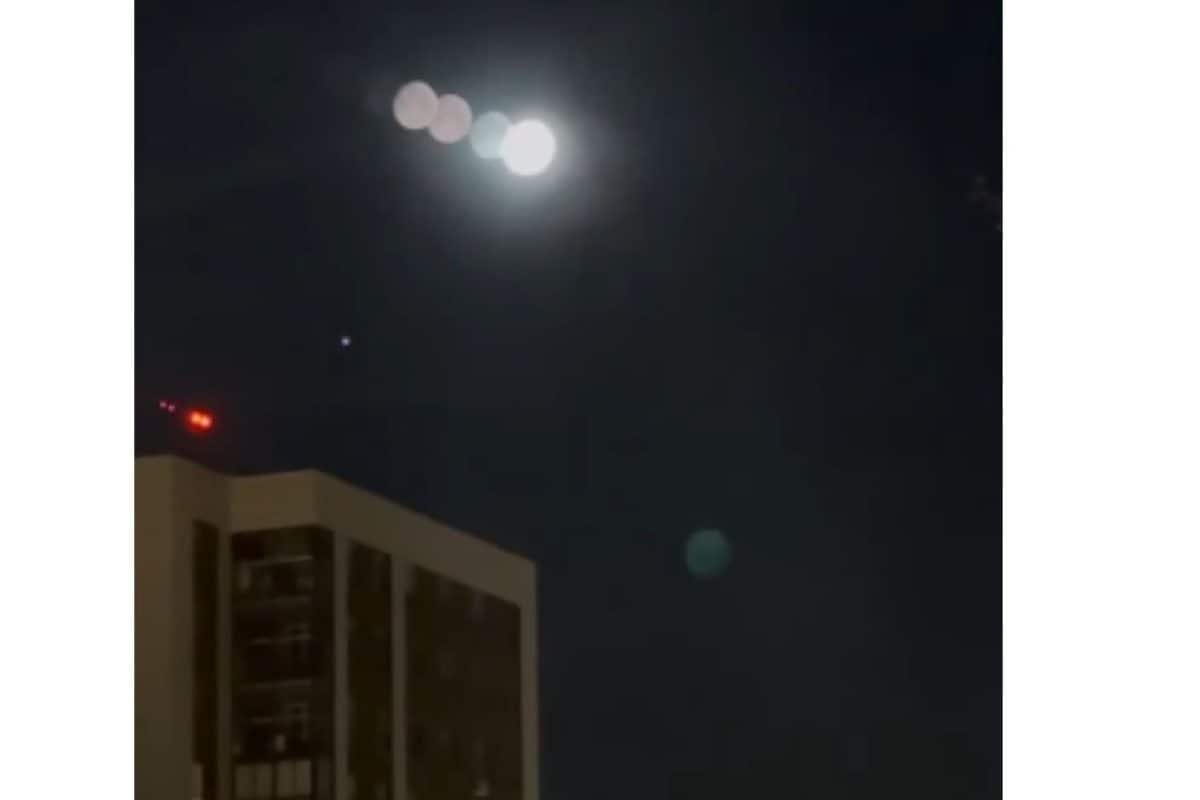







In a rare incident, the stargazers in Russia’s St. Petersburg were left mesmerised when they caught the glimpse of four moons known as Paraselene.
Several images of the spectacular optical illusion, which
creates the haunting impression of multiple moons flanking the Earth’s actual satellite, erupted on social media on Monday.
Four moons appear over Russia’s St. Petersburg
The spectacle, known as a paraselene, was created by moonlight bending through ice crystals in the frosty atmosphere pic.twitter.com/J5C5h4uDx8
— RT (@RT_com) February 1, 2026
A paraselene, also commonly known as a moon dog or mock moon, is produced by moonlight refracted through thin, hexagonal, plate-shaped ice crystals in high cirrus clouds. It is an atmospheric optical phenomenon where bright spots or “mock moons” appear to the sides of the Moon, caused by light refracting through high-altitude hexagonal ice crystals in cirrus or cirrostratus clouds.
🌑🌕🌑A rare phenomenon — a “paraselene” — was observed overnight over Moscow and the surrounding region
A paraselene, an optical illusion in which multiple Moon disks appear, occurs when light from the real Moon is refracted by flat ice crystals high in the atmosphere above the… pic.twitter.com/mRfzRu1Ilb
— NEXTA (@nexta_tv) January 31, 2026
According to NASA, they are seen at an angle of 22 degrees or more from the Moon. Compared to the bright lunar disk, paraselenae are faint and easier to spot when the Moon is low.
The paraselenae are positioned at the same elevation above the horizon as the Moon itself and the vertical extent depends on the wobbling of the ice crystals; larger crystals create taller paraselenae, skybrary reported.