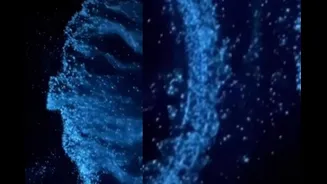

A rare natural phenomenon was reportedly witnessed at Mumbai’s Juhu Beach. Famous for being the backdrop of several Hindi films and its tasty street food, the beach was glowing at night, quite literally,
a few days ago. Videos circulating on social media websites show the waves emitting a bright blue light in the dark, as if straight out of a sci-fi film. Called bioluminescence by scientists, this phenomenon has rarely been witnessed at Juhu Beach.
A video of the glowing Juhu Beach has sparked debate on Instagram, with several people refusing to believe that one of Mumbai’s famous tourist spots could actually witness this phenomenon. Others claimed that the spectacle did happen, but on a smaller scale than shown in the clip.
What Is Bioluminescence?
It is a natural phenomenon that takes place when a living organism produces and emits light. Bioluminescence is made by energy that is released from chemical reactions occurring inside, or ejected by, the organism. Fireflies are a common example.
Are Fishes Also Bioluminescent?
Many marine organisms can produce a glowing light, such as plankton, some species of sharks and jellyfish, and more. The animals must have a molecule called luciferin that produces light when it reacts with oxygen. Many animals also make the catalyst luciferase, which can speed up the reaction of luciferin and oxygen.
For marine organisms, bioluminescence is a survival mechanism and helps creatures see in the deep ocean where light does not reach. It’s also useful for communication, luring prey or attracting a mate.
Why Do Waves Glow Due To Bioluminescence?
Dinoflagellates, which are small planktonic surface dwellers, are bioluminescent. When conditions are right, these single-celled organisms bloom in dense layers at the surface of the water, causing a sparkly sheen in the water at night. This can cause the waves to glow.
Where Can I See Bioluminescence In India?
Several places in India provide an opportunity to witness this phenomenon. One of the most famous spots is Bangaram Island, Lakshadweep. The uninhabited paradise emits a blue glow sometimes at night. Access is limited, so travellers need to plan ahead in terms of bookings.
Swaraj Dweep (Havelock Island), Andaman & Nicobar, comes alive at night for parts of the year. The best time to visit is between November and February.
Juhu Beach in Mumbai is not the only one in the city to witness this phenomenon. Bioluminescence has also been reported from Aksa Beach sporadically. Karnataka’s Padubidri Beach and Goa’s Betalbatim Beach are also famous.
Tips For Observing Bioluminescence In India
Visitors must keep in mind that the spectacle does not occur daily. Moonless nights are the best time to check this phenomenon. For marine bioluminescence, monsoon and post-monsoon times, i.e., from June to September, offer the perfect conditions.
People must choose locations away from city lights. It is better to visit the areas with an experienced guide, as many of the spots are ecologically sensitive areas. They must refrain from touching or collecting the glowing organisms.
Keeping these factors in mind will help visitors have an experience like no other at the beach.