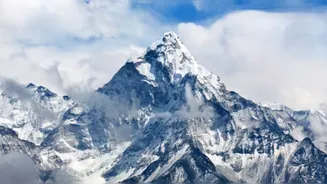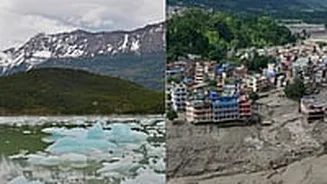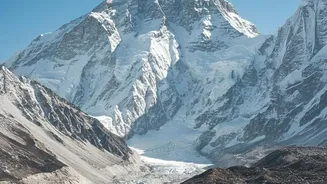


Nepal Floods: The glacier-collapse flood on the Nepal-Tibet border has brought renewed attention to a danger that extends beyond the immediate disaster zone: the possibility of cascading disasters across
the Eastern Himalayas.
According to a report in The Times of India, experts warn that an earthquake, rock or ice avalanche, extreme rainfall or sudden failure of a glacial lake can trigger a chain of landslides and flash floods capable of travelling far downstream.
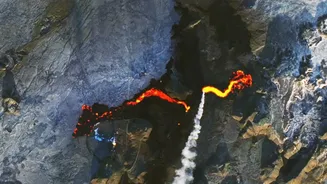
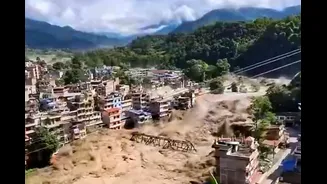
The recent disaster near the Nepal-Tibet border demonstrated how quickly such a chain can unfold. The collapse sent ice, rock and debris into the Lhende Khola river, unleashing a high-speed flood through valleys and settlements. The event was initially reported as an earthquake, but the US Geological Survey later determined that the collapse of glacial rock and ice itself generated the seismic signal. Scientists are still studying the precise sequence that destabilised the slope.
For Darjeeling, the event is significant even though the district lacks the large, high-altitude glacial lakes found in Sikkim.
Its vulnerability comes from something broader: Darjeeling sits within the same young and geologically unstable Himalayan system, with steep slopes, intense monsoon rainfall and significant seismic exposure.
One Disaster Can Trigger Another In The Himalayas
The biggest concern is not necessarily a single hazard, but what happens when one hazard sets off another.
A strong earthquake in mountainous terrain can produce impacts far beyond the initial ground shaking. It can trigger rockfalls and landslides, destabilise slopes already saturated by monsoon rain and block rivers. In glaciated areas farther upstream, the consequences can become even more complicated.
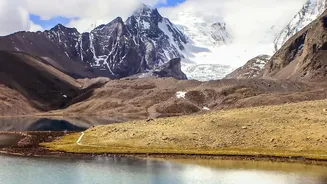
An avalanche of rock and ice can plunge into a glacial lake, generating a wave large enough to breach the natural moraine dam holding the lake back.
Similarly, a landslide can fall into a river and temporarily block its flow, creating a lake behind the landslide dam. If that temporary barrier later collapses, the stored water can surge downstream as a flash flood.
In other words, the first disaster does not necessarily mark the end of the danger – it can create the conditions for the next one.
Scientists refer to these interconnected events as cascading or compound hazards.
What Makes The Eastern Himalayas Particularly Vulnerable?
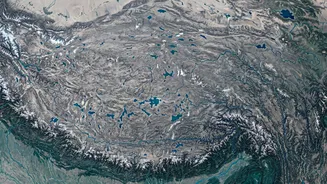
The Eastern Himalayas combine several factors that can amplify one another: steep and unstable terrain, heavy monsoon rainfall, active seismicity, glaciers, rivers and rapidly changing high-altitude conditions. Climate change is adding another layer of uncertainty.
Simon Cox, chief scientist at Earth Sciences New Zealand, told Reuters after the Nepal disaster that warming is creating conditions that can destabilise high-mountain rock and ice. Rising temperatures can increase meltwater, degrade frozen ground and alter freeze-thaw cycles. These changes can make some high-altitude slopes increasingly unstable.
This means that an earthquake, heavy rainfall event or avalanche may interact with a landscape that is already under greater stress.
Darjeeling Is Already Seeing Extreme Landslide Events
Darjeeling does not need to look far into the future to understand the risks. In October 2025, more than 300 mm of rain fell in parts of Darjeeling district in around 12 hours, triggering multiple shallow landslides and large debris slides, according to the national landslide forecasting centre of the Geological Survey of India (GSI).
An assessment by the National Remote Sensing Centre (NRSC) of ISRO recorded 24 deaths across the affected region, along with widespread disruption to roads and settlements.
The episode demonstrated how extreme rainfall alone can rapidly overwhelm vulnerable hill terrain. The concern is that rainfall may be only one part of a much larger chain of events.
Darjeeling Also Falls In High Seismic-Risk Zone
Darjeeling falls under Seismic Zone IV, categorised as a high-damage-risk zone under India’s seismic zoning system. The district’s disaster management plan identifies earthquakes and landslides among its principal hazards. A senior GSI official noted that the hill subdivisions repeatedly experience landslides during the monsoon.
An earthquake in such terrain could therefore have consequences extending well beyond the initial tremors.
Shaking could destabilise slopes, trigger rockfalls and landslides, block rivers and create temporary reservoirs. In areas with glaciers and glacial lakes, avalanches could potentially generate further flooding.
That interconnected risk is what makes the Nepal disaster particularly relevant to Darjeeling and the wider Bengal Himalayas.
Flood Risk In Darjeeling-Sikkim Highlands Is Already High
A study published this month in the Journal of Environmental Management, which analysed hydroclimatic conditions between 1951 and 2020, classified the Darjeeling-Sikkim highlands as a high-flood-risk zone.
The findings add to concerns that extreme rainfall and changing hydroclimatic conditions could increase pressure on already vulnerable mountain systems.
The risk does not stop at the mountains. Water and debris generated in the high Himalayas can move downstream into densely populated areas.
GLOF Threat Is Closer To Bengal Than It May Seem
The danger from glacial lake outburst floods (GLOFs) becomes particularly direct immediately north of Bengal. Modelling has indicated that possible GLOF scenarios could directly expose more than 10,000 people, around 1,900 settlements or structures, five bridges and two hydropower plants.
The region has already experienced what such an event can mean for downstream areas.
In October 2023, the outburst of South Lhonak Lake in North Sikkim sent a huge surge through the Teesta river system. The flood washed away bridges, damaged NH-10 and the Chungthang hydropower project, and continued downstream towards Bengal.
Kalimpong district suffered extensive damage, showing that a glacial failure occurring hundreds of kilometres upstream can eventually become a flash-flood emergency in the Bengal Himalayas.
GLOF Risk Could Rise Sharply In Coming Decades
The long-term warning from scientists is equally concerning. The International Centre for Integrated Mountain Development (ICIMOD) has warned that the Eastern Himalayas could approach “peak GLOF risk” around 2050.
Across the wider Hindu Kush Himalaya, overall GLOF risk could rise by about three times by the end of the century, according to the organisation.
ICIMOD has also warned that large rock-and-ice avalanches could become more frequent and larger as warming alters glaciers and permafrost. For communities downstream, this means the risk is not confined to the locations where glaciers and glacial lakesare found.
What Does This Mean For Darjeeling And Bengal?
For Darjeeling, the threat is best understood as a combination of risks rather than a single disaster scenario.
The district faces earthquake-prone terrain, unstable slopes and extreme rainfall, while glacial lakes and an increasingly unstable high-altitude cryosphere exist farther upstream.
- A severe earthquake could trigger landslides.
- A landslide could block a river.
- A blocked river could create a temporary lake.
- The lake could later burst.
- An avalanche could fall into an existing glacial lake and generate a destructive wave.
- And the resulting flood could travel far downstream.
That is the kind of cascading sequence that experts say needs to be considered when planning for disasters in the Eastern Himalayas.
Nepal Tragedy Shows Why Disaster Planning Must Change
The Nepal disaster underlines why earthquakes, landslides, GLOFs and flash floods can no longer be treated as completely separate risks in the Eastern Himalayas.
Preparedness increasingly needs to consider the entire chain. That includes monitoring glacial lakes and unstable mountain slopes, strengthening seismic-resistant construction, restricting development on vulnerable slopes and riverbanks, and creating river-basin-wide early warning systems.
For Bengal, such warning systems would ideally extend from the high Himalayas to downstream communities.
The central lesson from Nepal is therefore not that Darjeeling is facing an identical disaster. It is that the same Himalayan system connects hazards across borders and across hundreds of kilometres.
A disaster that begins high in the mountains can become a very different emergency much farther downstream. And as climate change alters glaciers, permafrost, rainfall and mountain stability, understanding those connections is becoming an increasingly urgent part of disaster preparedness.