







From factory workers to domestic helps, protests by the blue-collar workforce have erupted across several cities in North India to press for higher wages, better overtime pay and safer working conditions.
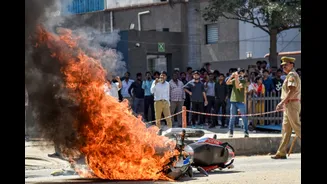
While demonstrations in manufacturing hubs of Noida had been going on since last week, the situation took a sharp turn on Monday when violence erupted, resulting in arson, stone-pelting and vandalism, while also paralysing traffic movement in the city.
Monday’s violence also brought attention to similar protests in Haryana’s Manesar and Faridabad, while inspiring protests by domestic helps for higher salaries in Noida’s residential hubs.
Here’s a round-up of labour protests that have erupted across cities this week:
Noida Labour Protests
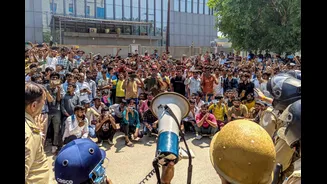
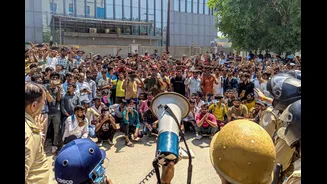
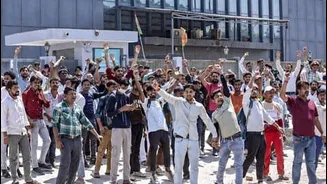
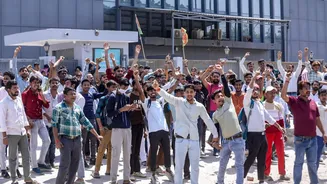
Thousands of factory workers, including women, went on strike on April 13, Monday to demand a wage hike, among other things. The protest had turned violent, leading to arson, stone-pelting and vandalism. The handling of the protests by the police drew criticism from some quarters, although officials maintained that “mild force” was used.
Officials said a large number of workers from industrial units in Phase-2 and Sector 60 had gathered to press for long-pending wage revision demands and raised slogans. Similar protests were reported from Sector 62 and Sector 84, including at a Motherson company unit. NH-9, a key link between Delhi and western Uttar Pradesh, was also blocked.
The protests soon escalated, with some protesters torching vehicles, including a police SUV, vandalising property and pelting stones.
While protesters alleged heavy-handedness by the police, officials said “minimum force was used wherever necessary to maintain law and order”.
The protests triggered widespread traffic snarls across Noida and Greater Noida. Traffic police said diversions were put in place and movement was gradually being restored at key points, including the Chilla border and the Noida-Greater Noida Expressway.
Long queues of vehicles stretching several kilometres were reported at the Delhi-Noida border, with major congestion at Sector 62, National Highway-24, Sector 63 and the Chilla border. Protesters had also blocked key routes, including stretches connecting Sector 62 to Sector 16 and NH-9.
Later, a high-level committee constituted by the Uttar Pradesh government said it is open to dialogue with protesting workers and urged them to come forward to resolve their issues through talks.
Gautam Buddh Nagar District Magistrate Medha Roopam said the government had already accepted the primary demand regarding a wage hike and issued additional directives to improve labour conditions.
Earlier, the Uttar Pradesh government hiked minimum wages across worker categories following unrest in Noida, with revised rates coming into effect from April 1 retrospectively.
FIRs were later filed against RJD spokespersons Priyanka Bharti and Kanchana Yadav as well as X handle @ItsKtyni and a Facebook profile with the name Jitendra Sharma for allegedly linking an incident in Madhya Pradesh, where a man was beaten up by police, to the ongoing labour protests in Noida. All the accused individuals shared this video while falsely claiming it depicted events occurring in Noida along with misleading captions, police said.
IMT-Manesar: Protests For Pay Hike
Since the first week of April, thousands of employees have been protesting outside the tehsil office in Gurgaon’s IMT-Manesar area, demanding a pay raise. While they demonstrated peacefully for several days, on April 9, there were sudden incidents of vandalism, arson and rioting outside several companies. Police used force to restore peace in the area.
The Gurugram Police, alleging a conspiracy, arrested six accused on Monday after companies filed a case at the IMT-Manesar police station under various sections of the Bharatiya Nyaya Sanhita (BNS). Investigations reportedly revealed that these individuals were not employed by any companies, yet they were trying to incite the workers to violence.
The six accused arrested were identified as Akash from Rohtak, Harish Chand from Pauri Garhwal, Pintu Kumar from Bihar’s Madhubani district, Raju Singh from Udham Singh Nagar, Shyambir from Badaun district in Uttar Pradesh and Ajit Singh from Jind district in Haryana.
Taking action in connection with the violence, vandalism and stone-pelting during the protest, the IMT-Manesar police arrested 55 workers, including 25 women, last Friday and sent them to the Bhondsi jail.
A senior police officer said 44 accused, including women, were given an opportunity to submit the necessary forms for bail, but they were unable to provide the surety and other documents.
Faridabad Auto Sector Protests
Workers of an automotive components manufacturing factory protested for the second day at Sarai Khawaja area on April 14, Tuesday to press for the implementation of the minimum wage hike announced by the Haryana government last week.
According to police, 23 protesters were detained when they tried to block a road outside the Motherson Sumi factory and an FIR was registered.
Around 1,000 morning shift employees of the company gathered outside the company around 8 am and blocked the service road of the Delhi-Agra Highway.
On Monday, the factory workers had blocked the Delhi-Agra National Highway passing through Prithla village in Palwal and also in Sarai Khwaja, paralysing traffic for hours.
A protester claimed that they are being made to work 16 hours a day and are only paid Rs 11,000 per month.
“In this era of inflation, it is becoming difficult to survive on such a low salary. When we were protesting, the police chased us away with a lathi charge,” the protester alleged.
Noida: Domestic Workers Protest
Besides factory workers, domestic helps have also been protesting in Noida, demanding better pay and hours. In Noida Sector 121, domestic workers employed at Cleo County, a high-profile residential society, staged a protest outside the complex, demanding a wage hike. Several videos shared on X showed large groups of workers gathered at the site, calling for better pay.
The workers assembled outside Cleo County, taking to the streets as they pressed for higher salaries and improved working conditions. “We will not return to work until our wages are increased,” many protesters said, raising slogans.
Noida: Private University Staff Protest
Workers at a private university in Greater Noida’s Dadri staged a protest on Wednesday, April 15, demanding a salary hike. Unlike the workers’ protest in Noida two days earlier, this demonstration remained peaceful and was brought under control after talks with the demonstrators.
Hundreds of men and women squatted on a road outside the Shiv Nadar University entrance gate in the Dadri area and raised slogans pressing for their demands. They demanded an increase in salaries and a doubling of the overtime payment, among other issues.
Bhiwadi: Private Firm Employees On Protest
Employees of a private company have been protesting outside the firm’s unit in the Pathredi industrial area of Bhiwadi, demanding a hike in wages. On Monday, the protesting workers sat on a dharna and blocked the road outside the Suprajit Engineering Limited gate, raising slogans and disrupting traffic. Mild force was used to disperse the protesters and clear the road, officials said.
Labour Unrest In Bulandshahr
Labour unrest reached Bulandshahr on Monday, with over 100 workers staging a nearly four-hour protest outside TAG Tropical Agrosystems (India) in the Sikandrabad industrial area, demanding higher wages and basic benefits.
The workers alleged harassment by contractors and pointed to low pay, long hours, and the lack of provident fund (PF) and Employees’ State Insurance (ESI) coverage. They sought a minimum monthly wage of Rs 15,000 for women and Rs 20,000 for men for 12-hour shifts.
Senior administrative officials later assured the protesters that their demands would be addressed in line with labour laws, after which the workers called off the protest and returned to work.
Weeks before Noida and Manesar, protests were also reported from Bihar, Gujarat and Panipat in Haryana.
- Barauni In Bihar: The first instance of worker unrest this year emerged in Barauni, an industrial town in Bihar, on February 2. Labourers protested against proposed revisions to minimum wages and demanded fixed eight-hour workdays, along with social security benefits such as provident fund coverage and inclusion under the Employees’ State Insurance Corporation (ESIC).
- Panipat In Haryana: Similar protests also took place across other refineries, including at Indian Oil Corporation Ltd’s Panipat refinery on February 23, where at least 30,000 contractual workers staged protests demanding better wages and working conditions. The protest turned violent with angry workers throwing stones at security personnel and vandalising vehicles.
- Surat In Gujarat: Days later, on February 27, a protest by 5,000 contract workers of Larsen & Toubro (L&T) working at the AM/NS (ArcelorMittal Nippon Steel) project site at Hazira, Surat, turned violent. Several policemen sustained injuries and vehicles were set on fire.
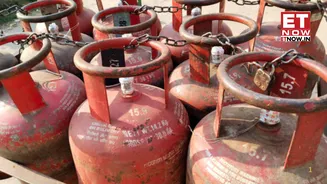
The shortage of LPG cylinders amid the US-Iran war that has sent the cost of living higher has also fuelled protests in manufacturing hubs across cities.
Workers have been asking for additional support for the purchase of LPG cylinders, the cost of which has risen 3-4 times in the black market. This has increased the existing clamour for an increase in minimum wages.