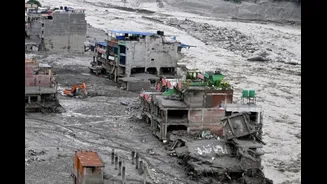






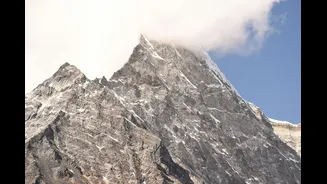
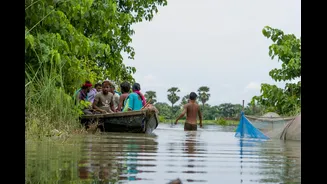
A global team of glaciologists and scientists from the World Weather Attribution (WWA) have concluded that climate change was one of the triggers for the devastating rock and ice avalanche in Nepal on August
26 that killed nearly 1,400 people with over 5,179 still missing.
The rapid-attribution analysis just completed by the team points to record warming in July-August in the region, which is likely to have caused the glacier instability and its eventual collapse. The analysis is not peer-reviewed yet, but the team says it was carried out using peer-reviewed methods to investigate the role of climate change in one of Nepal’s worst disasters in recent years.
According to the analysis, the disaster was a compound crisis, caused by a combination of geological and climate factors, and not just the result of a single extreme weather event.
While the slope was geologically vulnerable, the analysis says the above-normal temperatures in the months leading up to the final collapse may have weakened it further. “When you combine high-elevation permafrost degradation with glacier retreat, and record summer heat, the structural integrity of these mountain walls is compromised,” remarked Professor Walter Immerzeel, Mountain Hydrologist, Utrecht University.
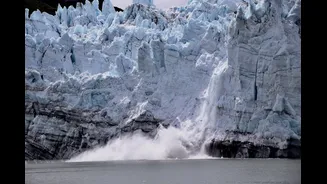
He further highlighted that climate change from the burning of fossil fuels is pushing the freezing line – the 0℃ isotherm – upward by roughly 100 metres per decade, exposing perennially frozen ground and bedrock to thaw conditions that are longer and warmer than before.
This essentially means that the altitude at which the water freezes in the mountains is going upwards every decade, causing rapid melting of glaciers and thawing of the permafrost that holds the mountain together. Furthermore, permafrost at 4,500-5,000 metres altitude where a part of the glacier collapsed is very sensitive to rising temperatures. “These factors combined with further de-stabilisation by a 7.8 earthquake in 2015 are thought to be the primary cause of the disaster,” the study concluded.
“July and August were exceptionally warm. We found that climate change is transforming the high mountain environment influencing many of the possible drivers of this collapse. This increases the risk in a region that is already exposed to high seismic activity,” said Dr Ben Clarke, Extreme Weather and Climate Change Researcher, Imperial College London during the media briefing on Wednesday.
An international scientific collaboration, the World Weather Attribution brings together scientists from across countries to analyse and communicate the possible influence of climate change on extreme weather events. It includes researchers from Imperial College London, the Red Cross Red Crescent Climate Centre, the Royal Netherlands Meteorological Institute (KNMI), and partner institutions globally.
Professor Friederike Otto, Professor of Climate Science, Imperial College London said the report isn’t a traditional World Weather Attribution study as it did not look at a single extreme weather event, but a multi-stage mountain disaster with many factors influencing causality. “Yet the climate justice reality is as sharp as ever,” she added.
Stark Warning Of Climate Crisis
With nearly 1,400 people with over 5,179 still missing, Manjeet Dhakal, Director of Climate Analytics South Asia said the Bhote Koshi catastrophe has become a stark warning of the growing risks people are facing with the rapidly warming Himalaya. “The magnitude of this disaster is testing Nepal’s response capacities and the limits of adaptation,” he warned.
The analysis draws attention to the above-normal temperatures in July and August 2026 – directly before the collapse, which were the warmest on record locally. The researchers also believe that high snowfall in October and November 2025 may have also added large amounts of meltwater in the months preceding collapse.
While they agree that such events are harder to predict, and early warning remains a challenge, they also drew attention to what needs to be done – climate adaptation.
“For a nation that’s done virtually nothing to contribute to this problem, it underlines the need to find fairness in helping climate vulnerable nations cope with the problems they have not unleashed,” said Madhab Uprety, Senior Technical Advisor and Asia-Pacific Focal Point, Red Cross Red Crescent Climate Centre.