







Often it begins quietly, at 2 a.m. while reaching for a glass of water, or while waiting at a traffic signal. A fleeting thought about a meeting from three days ago suddenly spirals into a mental interrogation:
Did I sound unprofessional? Why did I say those exact words? Do they think I’m incompetent?
Slowly, the mind starts replaying the same moment from different angles again and again. Each time, a new possibility appears, a new mistake, a new fear. Gradually, the mind grows exhausted, leaving you not just physically tired but mentally numb.
This is what overthinking really looks like. It is not merely the habit of thinking too much; it is a relentless mental loop that pulls us back to small moments from the past which overwhelm us. The mind becomes an emotional courtroom where we play every role at once, the accused, the judge, and the lawyer, and, more often than not, the verdict is delivered against ourselves.
The more we dwell on a thought, the more confused and helpless we begin to feel. In reality, the moment we keep replaying in our minds has often already been forgotten by everyone else. The truth is that most people don’t remember those moments nearly as intensely as we imagine. The meeting we are still replaying in our heads three days later may already be forgotten by everyone else who was there.
That is the biggest illusion of overthinking: it convinces us that every small detail is enormously important, when in reality it often isn’t. The problem is that overthinking rarely offers solutions; it only exhausts us.
And this experience is far more common than many people realise. More recent data, such as the Centre Fresh India Overthinking Report, suggests that the scale of the issue is even larger than previously believed. According to the report, up to 81% of Indians say they spend three or more hours a day overthinking, highlighting how deeply this silent mental habit has become embedded in everyday life.
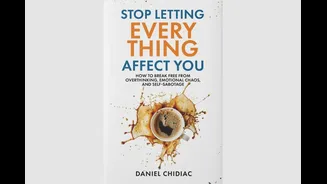
It is this growing phenomenon of overthinking that many modern self-help books attempt to address. One such book is ‘Stop Letting Everything Affect You’ by Daniel Chidiac. Through this book, Chidiac explores how people can learn to manage their thoughts and stop letting small events take control of their mental space.
The book emphasises that overthinking is not just a mental habit; it can also have serious consequences for overall well-being. Constant mental stress can slowly affect both mental and physical health, leading to anxiety, exhaustion, and even physical symptoms such as headaches, sleep disturbances, and fatigue.
Chidiac does not propose complex psychological models or elaborate theories to explain the cycle of overthinking, nor are his suggestions rigidly prescriptive. Instead, he draws from day-to-day experiences, examining them within their context and offering insights that feel surprisingly simple, almost as if the solutions had always been in front of us, waiting to be noticed.
By offering practical insights and reflections, Chidiac encourages readers to become more aware of their thought patterns and develop healthier ways of responding to everyday situations, rather than getting trapped in endless cycles of overanalysis.
Chidiac illustrates how the mind easily falls into mental loops through simple, everyday situations. Consider what happens when someone does not reply to a message immediately. Instead of calmly assuming that the person might simply be busy, the mind quickly spirals into self-doubt: Did I say something wrong? Are they upset with me? Are they losing interest?
Similarly, if a friend appears distant, rather than considering that they may be having a difficult day, the mind jumps to a far more personal conclusion: They must be upset with me. Did I do something? What if they no longer want me in their life?
According to Chidiac, the brain is uncomfortable with uncertainty. To fill that gap, it creates a narrative, one that often tilts toward negativity. Over time, these are not just passing thoughts; they begin to harden into core beliefs that shape how we see ourselves and interpret the world around us.
Chidiac writes, “This cycle of hope and disappointment is further enabled by your lack of boundaries. People don’t automatically know how to treat you—you show them. Every time you tolerate something that makes you uncomfortable, every time you bite your tongue instead of speaking up, every time you say yes when you really mean no, you send a message. And the message is this: My feelings don’t matter. My needs don’t matter. You can treat me however you want, and I will accept it.”
Through such reflections, Chidiac reminds readers that the habit of overthinking is often tied not just to the mind but also to the patterns we allow to develop in our relationships. Learning to set boundaries, therefore, becomes a necessary step toward reclaiming emotional balance and protecting one’s mental space.
While almost everyone slips into overthinking at times, for some people, it gradually hardens into a persistent pattern. Thoughts begin to circle endlessly, with one worry giving birth to another, creating a loop that affects both emotional balance and even physical well-being. Yet research offers a reassuring perspective: nearly three-quarters of those who receive appropriate help are able to recover, suggesting that overthinking is not a fixed personality trait but a habit of mind that can be unlearned.
Highlighting this fact, the author goes beyond merely identifying the genesis of the problem of overthinking and offers advice to tackle it, which is both practical and easy to follow.
In the third part of the book, where Chidiac turns to solutions, he again avoids presenting a rigid list of complicated dos and don’ts. Instead, he focuses on simple but often overlooked truths, things we already know but rarely pause to acknowledge or accept.
One such insight comes when he writes that the first step toward emotional freedom is recognising that carrying everyone else’s emotional weight is not compassion; it is a learned pattern that often begins long before we even have the language to describe it. Research in developmental psychology, he notes, suggests that many chronic over-givers were once children who learned that their worth depended on how well they could attend to the needs of others.
To begin breaking this pattern, Chidiac suggests what he calls an “energy exchange audit.” The idea is straightforward: track your significant interactions and note three things—
How you felt before the interaction: energised, neutral, or depleted.
What emotional weight did you carry during the interaction?
How did you feel afterwards?
By doing this consistently, the reader is encouraged to look for patterns: Which interactions leave you drained? In which situations do you find yourself carrying emotional burdens that are not really yours?
Chidiac makes it clear that the purpose of this exercise is not to judge others. Rather, it is to develop a clearer awareness of where one’s emotional energy is being spent—and often, unknowingly, depleted. This quiet awareness, he suggests, is the beginning of reclaiming one’s mental space.
It is in this context that Daniel Chidiac’s ‘Stop Letting Everything Affect You’ becomes particularly relevant. Rather than presenting dense psychological frameworks or complex therapeutic prescriptions, the book acts as a practical guide for navigating everyday emotional struggles. Chidiac approaches the problem through familiar life situations, gently unpacking the patterns that keep people trapped in cycles of doubt, disappointment and emotional exhaustion.
By focusing on awareness rather than rigid rules, Chidiac encourages readers to observe their emotions, set healthier boundaries, and recognise where their energy is being drained. In doing so, he presents overthinking not as a fixed condition but as a pattern that can be understood and gradually broken.
(Pragati Pandey is a Noida-based freelance writer who writes on books, pop culture, and ideas. Views expressed are personal and do not necessarily reflect those of News18)