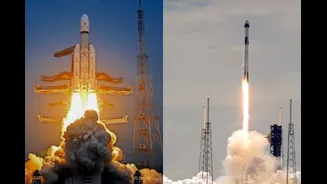






The Launch Vehicle Mark-III (LVM3), often dubbed as India’s heaviest rocket and ISRO’s ‘Bahubali’, roared off the pad at Sriharikota early on Wednesday, December 24, placing a 6,100kg US communications
satellite, ‘Blue Bird’, into orbit. The success has once again ignited the long-running debate over who really rules the global launch market on cost; India’s space agency ISRO or Elon Musk’s SpaceX.
On one side stands ISRO, celebrated for its frugal engineering and ‘jugaad’ mindset. On the other is SpaceX, which has rewritten the economics of spaceflight through reusable rockets. With both players now competing for the booming commercial launch market, the question is simple: whose ride is cheaper?
SpaceX’s Falcon 9 is by far the world’s busiest rocket. Various reports peg the cost of a Falcon 9 mission at about $6.7 million (roughly Rs 550-560 crore). ISRO’s LVM3, by comparison, is estimated to cost in the range of Rs 400-450 crore per launch. At first glance, India appears to have the edge.
But the real metric that matters in the business of space is ‘cost per kg’, how much it takes to loft a single kg of payload into orbit. On that front, capacity becomes crucial.
ISRO’s LVM3 can carry roughly 8-10 tonnes to low-Earth orbit (LEO). Wednesday’s mission, at 6,100kg, marked one of its heaviest commercial payloads. SpaceX’s Falcon 9, however, can haul up to 22.8 tonnes to LEO, meaning that even if the headline mission cost is higher, the per-kg price tends to be lower. Industry estimates suggest Falcon 9’s cost per kg hovers around $2,700-3,000, keeping SpaceX ahead on pure pricing. LVM3, for now, is slightly more expensive on that scale.
The decisive factor is reusability. SpaceX routinely lands and refurbishes its boosters, dramatically reducing the effective cost of subsequent launches. LVM3 is still expendable, each rocket is used once and discarded, which keeps India at a disadvantage.
ISRO, however, is far from complacent. Work is on to develop a reusable launch vehicle (RLV) and the Next-Generation Launch Vehicle (NGLV). A future reusable vehicle, informally referred to as ‘Surya’, is also on the drawing board. Once India masters booster recovery and reuse, the economics could shift significantly.
Yet, despite SpaceX’s price advantage, global customers continue to sign up with ISRO, including the US firm behind Wednesday’s mission. The reasons are compelling.
LVM3 boasts a 100% success rate, making it a highly trusted workhorse in an industry where even a single failure can wipe out hundreds of millions of dollars. Availability is another. With SpaceX’s order book packed, getting a timely launch slot can be difficult, pushing companies to look elsewhere. There is also a strategic angle; governments and corporations are wary of depending on a single dominant provider and increasingly view India as a credible alternative.
Also, while SpaceX often flies rideshare missions, likened to a bus service, ISRO is willing to offer dedicated launches, closer to a taxi ride, for customers needing precise orbital insertions.
India’s private space sector is also shifting gears, with start-ups such as Skyroot and Agnikul building ultralow-cost launchers for small satellites, further widening the country’s footprint in the commercial market.