







The BJP on Friday stepped up its attack on the West Bengal government over Kolkata’s deteriorating air quality, citing official data tabled in Parliament to argue that the city’s pollution crisis has been
consistently ignored even as similar conditions in Delhi draw national attention.
BJP IT cell chief Amit Malviya said Kolkata’s “toxic air is no longer an allegation” but is now officially documented in government records.
“When AQI levels in New Delhi worsen, it becomes a national headline. But Kolkata’s air quality crisis is rarely discussed,” he said, targeting the Trinamool Congress-led state government.
Malviya was reacting to a reply given in the Rajya Sabha by Minister of State for Environment Kirti Vardhan Singh to a question raised by BJP MP Shamik Bhattacharya on Kolkata’s air quality.
The data presented showed that the city has repeatedly recorded poor to very poor Air Quality Index (AQI) levels, particularly during the winter months.
According to the figures placed in Parliament, Kolkata’s average AQI for November stood at 165 in 2023, 159 in 2024 and rose to 175 in 2025.
December readings were even more alarming, with averages of 176 in 2023, 159 in 2024 and a sharp spike to 202 in 2025.
An AQI above 200 falls in the “very poor” category, indicating severe respiratory distress and heightened risks for children, the elderly and those with pre-existing health conditions.
The BJP leader also highlighted findings from government studies on the sources of pollution in Kolkata.
As per official assessments, nearly 43 per cent of PM10 pollution in the city comes from dust emissions, while 29 per cent of PM2.5 is attributed to cooking emissions. Industrial activity accounts for 21 per cent of pollution, and vehicular emissions contribute around 20 per cent.
Malviya alleged that despite repeated directions from the Central Pollution Control Board (CPCB), the state has failed to act.
“The CPCB has consistently asked the West Bengal Pollution Control Board to prepare and implement action plans, control construction dust, curb waste burning, regulate industrial clusters and enforce emission norms. Yet, on the ground, nothing changes,” he said.
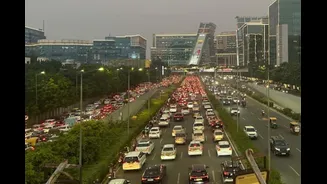
He pointed to continued open garbage burning, construction activities without dust control measures, worsening traffic congestion and industries operating with minimal oversight as evidence of what he termed “administrative apathy”.
The concerns mirror ground-level trends observed last winter as well. In November last year, as wind speeds slowed and winter conditions set in, Kolkata’s air quality deteriorated sharply.
For the first time that season, at least one monitoring station recorded “very poor” AQI levels. The city’s overall average slipped into the ‘poor’ category, while Jadavpur remained in the ‘very poor’ range throughout the day, signalling a steep rise in pollution.
Experts had attributed the spike to a combination of thermal inversion and weak dispersion conditions. During winter, cooler ground temperatures restrict vertical air movement, allowing pollutants to accumulate near the surface. With wind speeds often dropping below two metres per second, toxic particles remain trapped at breathing level.
“When the ground cools faster than the air above it, vertical air movement slows down drastically. Pollutants that would otherwise disperse remain trapped close to the surface,” a scientist from the West Bengal Pollution Control Board had explained at the time.
The BJP has now demanded accountability from the state government, arguing that the data exposed in Parliament underscores a long-standing environmental and public health failure in the state capital.