





The existing world order has not been kind to India so far, so we must not indulge in nostalgia or waste any effort trying to balance the new and old orders — we must instead focus solely on building rapidly,
reforming economically, and becoming prosperous, without unnecessary deliberation. It is here that BRICS becomes very relevant for India. What is fastest is often preferable to what is best in a rapidly changing global scenario.
The new world order, which shifted from unipolarity to multipolarity over the last two decades, now faces a choice between two scenarios. In the first case, countries would seek to increase their spheres of influence in a jungle where the strong eat the weak, a survival of the fittest, in a reductionist win-lose situation. It would be a world where the older ‘rules-based order’ gives way to a ‘no-rules-based’ disorder.
In the second case, countries would seek to enhance their spheres of security, recognising that multipolarity means finding ways to achieve win-win outcomes in small groupings of countries that come together for contained agendas that improve economic well-being and defence insurance. It would be a non-reductionist, holistic world with no friends and no enemies, only national interests. In this sense, the present century need not even be termed the century of Asia, or any similar phraseology. In this second scenario, the 21st century would be the century of the entire world.
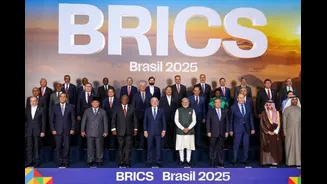
In such an era of rapid and sometimes unpredictable geopolitical changes, the dispersion of power from one pole, the US, to multiple poles across the world has organically coalesced as BRICS, which has now expanded from the original five nations (Brazil, Russia, India, China, South Africa) to the present time, when BRICS+ has 11 full member countries and 10 partner countries.
BRICS+ is a genuinely international grouping spanning Eurasia, Africa, and South America. The grouping was formed in 2009 to call for more adequate representation in the IMF’s Special Drawing Rights (SDRs). The transition from a mere representational grouping to one with significant economic weight has been remarkable. With India assuming the BRICS presidency in 2026, ideas and solutions for new payment systems and de-dollarised trade are gaining traction. It is in this regard that a deeper dive into the panchamukha of BRICS is worthwhile, also given the non-temporary nature of geopolitical turbulence emanating from the Western world.
The substitution of the US dollar as the world’s reserve currency by alternative means for countries to trade with one another has become a primary identity marker of BRICS+. India, with its UPI online payments system, has emerged as a clear leader in this field, as evidenced by Narendra Modi’s recent visit to Ethiopia. Complete de-dollarisation, which is indeed already underway in part, would see a greatly diminished US, both in its ability to act as the world’s policeman and in its inability to dominate other countries economically so that it continues its hegemon status, controlling the policies, big and small, of a vast number of countries.
Vladimir Putin’s visit to India has yielded essential takeaways for the strategic relationship between Russia and India, particularly in trade, energy security, and mutual investments. The fundamental observation remains the dollar-averse nature of this relationship, which India has found comfortable as well. One could very well say that the use of bilateral currencies between the two nations, instead of the dollar, while it sounds risky, is a blessing in disguise; the long-awaited deepening of ties, given the good friendship between the two nations, has finally begun to strengthen only after the weaponisation of the dollar and linked payment systems.
In this backdrop lies the Chinese state, with its increasingly rapid attempts to decouple economically from the US. There are two points to be made regarding this third member of BRICS. First, the idea of an imminent war between China and India is slowly starting to lose steam, due to several factors, the main ones being the unpalatable prospect of fighting a war of attrition in an unbearable terrain, and the fact that both these countries will increasingly need each other more, given their geographical proximity and comparable sizes.
Second, the Chinese state’s concept of security, which it has been sensitive about, is mainly oriented towards breaking out of the First Island Chain with increased rigour, given the American shift from being an Atlantic to a Pacific power. Having been plagued by systemic, long-lasting problems such as an alarming decline in its birth rate, rising unemployment, and burnt fingers from grandiose projects like the BRI, China cannot fight its battles alone.
The recalibration of the dependency dynamics between China and India is urgently needed to assess their future economic outlook. The nature of the problems and solutions faced by both countries is complementary. While this does not imply immediate shedding of pre-existing bad blood, it does open a brighter path, in contrast to detractors who imagine the only possible scenario as mushroom clouds over Delhi and Beijing.
India’s assertive demography complements Beijing’s stuttering demographic problem in two ways. It allows for easier people-to-people exchange between the nations, including possibly allowing Indian migrants to work in Chinese factories, and it also signals the strong possibility of the Chinese shifting some of their manufacturing to their neighbour, given their increasing inability to sustain human-intensive industry.
Similarly, China’s speed in building industry and infrastructure, along with its vast capital reserves, is much needed by India, which has lacked both speed and capital for the past few decades. All of this points to the need for India to play the game well with China, cutting through its intimidating wolf-warrior diplomacy, which is always driven by its internal politics.
The solidification of the India-China-Russia triad, while it will continue to be debated, has given rise to the world’s most substantial economic bloc. Having said this, India’s approach must be two-pronged. The first prong focuses internally. Since the inception of India as a republic, it has consistently lacked speed of action. There is a fundamental logic to this necessity.
In its quest for the perfect solution, India has sidelined and underestimated the importance of speed in nation-building, something the Chinese state effectively used to turn the Middle Kingdom from a ruined wasteland into a modern country in two decades. What is faster is often preferable to what is best.
The second prong relates to India’s western neighbour. Pakistan is the best example of a remnant of the old order, exemplified by its growing irrelevance on the global and regional stage, having become a rogue proxy state for greater powers attempting to checkmate others. The deep-rooted problems it faces, both internally and externally, including with the Afghans, signal the crumbling of an artificial state created to contain Bharat. The resurgence of Bharat’s hegemony will be complete when this artificial creation is finally consigned to the dustbin of history.
Brazil and South Africa occupy a special position within BRICS, owing to their geographic locations outside the Eurasian landmass. Brazil, which lies within the American sphere of influence, has proved to be a trustworthy member of BRICS, having managed to fend off arm-twisting from the US while maintaining strategic economic ties with countries of the Global South, despite the Monroe Doctrine, or a Trump-modified version of it, lingering above it. Similar comparisons can be drawn with South Africa’s political standing and geographical location; it has not compromised despite immense American pressure and remains the gateway to the Dark Continent.
Concurrently, and significantly, one sees the disintegration of the old order. Groupings like the G7 and NATO have reached the end of their shelf lives; the former is, for all intents and purposes, effectively defunct, having failed in its futile efforts to sustain the old ‘rules-based order’. While the UN is not yet at that stage, its stubborn refusal to include India as a permanent member of the UNSC and its inability to carry out much-needed reform could very well lead it down the same path.
Organisations like the SCO, the G20, and even the Trump-proposed C-5 grouping of the US, China, India, Russia, and Japan have gained significant traction, having captured existing geopolitical realities more accurately. On the other hand, the increasing irrelevance of the UK and the EU has been accelerated and cemented by their self-defeating attempts to defeat Russia on the battlefield, something they have pursued in vain, emptying their coffers and gambling all their cards. Today, while European leaders such as Emmanuel Macron and Kaja Kallas project bravado on the international stage, the harsh reality remains that the once-powerful continent possesses little military, economic, or energy independence.
The African Bush appears to be a jungle full of wild animals, yet there exists a remarkable equilibrium between the land, the climate, the forest, and, above all, the animals that inhabit it. Dominating this ecosystem are the Big Five: the Rhino, the Buffalo, the Elephant, the Lion, and the Leopard. Several other creatures, notably the Hippo, but also lesser beings such as the Giraffe, the Zebra, the Eland, the Crocodile, the Gazelle, the Wildebeest, the Cheetah, the Vulture, and the Hyena, form a unified whole.
The Big Five are the rulers of the Bush. None of them can kill another in a one-to-one conflict. None comes near the Elephant because of its sheer size. A group of Lions can surround and kill a Buffalo, and the reverse is also true. The Rhino is a solitary creature, practically blind but secure in its isolation — when provoked, it can run very fast. Its sheer size prevents others from attacking it. The Leopard is the creature of the night — it does not go near any of the other four, and likewise none of them venture close to it, not least because they do not know where it is. It remains too well hidden. Yet the Big Five dominate and control the Bush, and the others — even the Hippo, which swims in all waters, is amphibious, and can probably kill any of the other four barring the Elephant in a one-on-one conflict — can only watch as this remarkable ecosystem continues placidly.
Gautam R. Desiraju is at the Indian Institute of Science, UPES, and Rishihood University. Venkatakrishnan Asuri is a B.Tech student at IIT Madras. Views expressed in the above piece are personal and solely those of the writer. They do not necessarily reflect News18’s views.