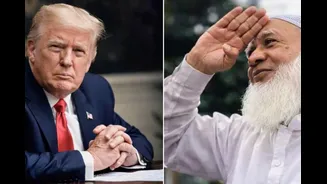

At a time when the United States claims to champion peace and democratic stability, its reported outreach to Jamaat-e-Islami in Bangladesh represents a dangerous strategic miscalculation.
By signalling
openness to an Islamist force with a violent past and deep ideological affinity with Pakistan, Washington is effectively sidelining more mainstream political actors such as the Bangladesh Nationalist Party (BNP), further weakening Bangladesh’s already fragile secular balance.
A Jamaat-influenced or Jamaat-led political outcome would not only endanger minorities and internal stability in Bangladesh but also open India’s eastern flank to renewed Pakistani interference and terror networks. If this trajectory continues, President Donald Trump must intervene before the damage becomes irreversible.
A LEAKED STRATEGY, A DANGEROUS SIGNAL
Recent revelations about American diplomatic manoeuvring in Bangladesh have sent shockwaves across the region. The US, it now appears, is seeking to cultivate ties with Jamaat-e-Islami, an organisation that opposed Bangladesh’s 1971 liberation from Pakistan and has long served as fertile ground for Pakistani strategic interests.
According to a report by The Washington Post, US diplomats recently met Jamaat leaders at the party’s regional office in Sylhet, one of several engagements with Islamist elements ahead of Bangladesh’s February 12 elections, in which Jamaat is expected to make its strongest showing in decades.
In a leaked audio recording, a US diplomat outlined what can only be described as a normalisation strategy. He stated that Bangladesh has “shifted Islamic” and bluntly added, “We want them to be our friends.” He then dismissed concerns about Jamaat’s ideological goals by claiming, “I simply do not believe that Jamaat can impose sharia.”
This is either naivete or dangerously irresponsible scheming.
MINORITIES REDUCED TO A FOOTNOTE
The same diplomat downplayed fears surrounding Jamaat’s historical hostility to secular constitutional norms, suggesting that economic pressure would be enough to rein in any excesses.
“If Jamaat were to seize all the Catholic schools in Bangladesh, they would have 100% tariffs put on them the next day,” he said.
The remark was revealing not just for its flippancy, but for what it ignored. Bangladesh’s most vulnerable minorities are not Catholic institutions but Hindus and other non-Muslim communities, who have already faced targeted violence since the political upheaval of 2024. Their safety did not appear to feature prominently in Washington’s calculus.
The diplomat also acknowledged that the trial of former Prime Minister Sheikh Hasina was neither free nor fair, yet bizarrely described her conviction, resulting in a death sentence, as “political genius” and “impressive.” The US Embassy in Dhaka later dismissed the episode as an off-the-record discussion, but the damage was already done.
FROM REGIME CHANGE TO ISLAMIST RESURGENCE
American actions in Bangladesh had raised eyebrows even before Sheikh Hasina’s ouster in 2024 through what was described as a “student-led” movement. In the aftermath, Nobel laureate Muhammad Yunus, long close to the Clinton Foundation, was installed as head of a caretaker regime.
Under Yunus’s watch, Islamist mobs attacked minorities, political violence surged, and Bangladesh’s liberation ethos was steadily eroded. Far from acting as a neutral caretaker, the regime presided over a systematic weakening of Bangladesh’s secular foundations.
Yunus cosied up to Pakistan and trampled ties with India, while systematically suppressing the spirit of Bangladesh’s liberation and banning the Awami League, the largest political party in the country.
INDIA’S RED LINES ARE CLEAR
India’s concerns are not theoretical. New Delhi designated Jamaat-e-Islami an “unlawful association” in 2019, a designation renewed in 2024. Against this backdrop, US engagement with Jamaat in Bangladesh does little to reassure Indian policymakers.
A post-election reset with Dhaka will be far more difficult if Jamaat, rather than a more mainstream BNP government led by Tarique Rahman, emerges as the dominant force. Jamaat would offer Pakistan a direct ramp into Bangladesh, creating a serious security threat for India’s eastern frontier.
China, too, would not be far behind in exploiting such instability. If such a setback is engineered or even enabled by US policy, it would leave a permanent scar on India-US relations.
AMERICA CAN WALK AWAY, INDIA CANNOT
When things go south, US diplomats playing with fire will be the first to evacuate. India, rooted in the region, will live with the consequences.
This asymmetry lies at the heart of New Delhi’s anger and anxiety. For an administration that claims to be non-interventionist and focused on its own hemisphere, Washington’s conduct in Bangladesh is deeply contradictory.
It revives the old pattern of external powers meddling in the Indian subcontinent under the guise of engagement or realpolitik often at the expense of local democracy and regional stability. If Trump allows this approach to continue, it will go far beyond trade disputes or tariff pressure.
This affront would be several notches higher, with long term consequences. It will amount to a security threat enabled by US policy – one that mirrors Pakistan’s long-standing destabilising role.
If Washington values its strategic partnership with India, the choice should be obvious: pull the plug on the Jamaat experiment before it is too late.