
Every day on India’s roads, nearly 474 lives are lost—an everyday tragedy that rarely makes headlines but leaves permanent scars on families and communities. In 2023, the country recorded over 480,000
road accidents, leading to approximately 173,000 fatalities. Beyond the statistics are shattered households, interrupted ambitions, and a crisis unfolding daily across cities, towns, and highways. With a significant share of victims in the 18–45 age group, road safety is not just a public health issue; it is a serious socio-economic challenge that affects productivity, livelihoods, and the country’s future.
Yet, despite repeated warnings and widespread awareness campaigns, unsafe road behavior persists. Overspeeding, distracted driving, the non-use of helmets and seatbelts, impatience, and reluctance to help accident victims remain common. These are not isolated lapses. They reflect a deeper pattern of haste, indiscipline, and a weakening sense of civic responsibility. Road safety, at its core, is not only about infrastructure, enforcement, or penalties—it is about the decisions people make in everyday moments, often when they are in a hurry or assume “nothing will happen.”
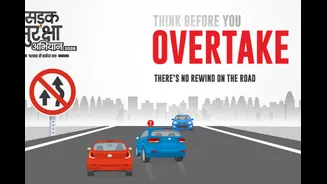
Recognizing the urgency of this challenge, the Ministry of Road Transport and Highways, under the leadership of Shri Nitin Gadkari, continues to strengthen the Sadak Suraksha Abhiyaan (SSA) as a nationwide public service awareness initiative. SSA 2026 signals a shift in approach—from simply generating concern to building real ownership among citizens.
Anchored in the theme “Parvaah Se Kartavya Tak,” Sadak Suraksha Abhiyaan 2026 is envisioned as a multi-layered national movement combining reflection, dialogue, creative expression, technology, and public participation. The aim is to make road safety personal, relatable, and actionable, especially for young people and families—moving beyond rule-following to value-driven behavior. The intent is clear: safety should become a way of life, not an obligation enforced only through fear of punishment.
At the heart of Sadak Suraksha Abhiyaan 4.0 is a framework built around four interconnected pillars:
● Kayda emphasizes discipline, respecting traffic rules, following signals, wearing safety gear, and remembering that laws exist to protect lives, not inconvenience commuters.
● Kartavya takes the message further, highlighting that road safety is not merely compliance; it is personal responsibility and duty toward oneself, one’s family, and fellow road users.
● Kavach reflects the role of technology and innovation in artificial intelligence, smart enforcement, predictive analytics, and in-vehicle safety tools that can help anticipate risks and prevent errors before they become fatal.
● Kranti looks toward lasting change: a cultural shift where safe behavior becomes instinctive, responsibility becomes habitual, and road safety is embedded into everyday life.
A central focus of SSA 2026 is shaping behavior early and reinforcing it consistently. Parents, guardians, educators, and role models play a defining role in what children absorb and repeat on the road—whether as pedestrians, cyclists, or future drivers. Roads are among India’s largest shared public spaces, and safety depends as much on everyday conduct as it does on laws, engineering, and enforcement.
Ultimately, safer roads will not be built by concrete and asphalt alone. They will be built when discipline replaces haste, empathy overcomes indifference, and responsibility becomes second nature.
Let’s make safety a habit every day, on every road because it is our Kartavya.