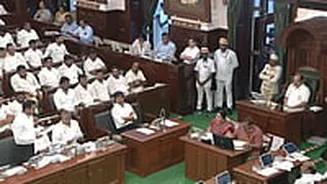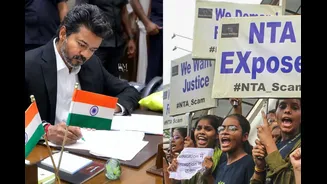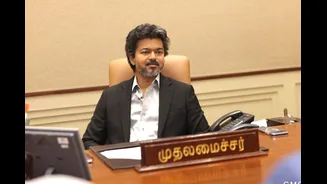








The Tamil Nadu Assembly, under Chief Minister C. Joseph Vijay’s government, on Tuesday passed a unanimous resolution demanding the complete abolition of the National Eligibility-cum-Entrance Test (NEET).
The state wants to dismantle the centralized test due to recurring paper leaks, systemic flaws, and the financial pressure of expensive coaching centres that disadvantage rural students. However, passing an assembly resolution does not legally end the exam.
WHY TAMIL NADU CANNOT END NEET ALONE
Tamil Nadu cannot unilaterallyscrap NEET due to constitutional divisions of power and existing central legislation.
Education falls under the Concurrent List (List III) of the Seventh Schedule of the Indian Constitution. This means both the State and the Union governments can legislate on it. However, if a state law directly conflicts with a central law, the central law prevails.
NEET is mandated by central legislation, specifically the National Medical Commission (NMC) Act, 2019, alongside amendments to the Indian Medicine and Homeopathy Acts. For a state to bypass these laws, the Union government must actively amend its own central acts.
For a state bill (like Tamil Nadu’s prior 2021 NEET Exemption Bill) to supersede a central law, it requires approval from the President of India under Article 254(2) of the Constitution. The President withheld assent to Tamil Nadu’s 2021 bill, leading the state to challenge the system in the Supreme Court.
A legislative resolution is an official expression of a state’s stance or an appeal to the Centre; it carries no legal authority to strike down a federal mandate.
HOW MEDICAL ADMISSIONS WOULD WORK USING CLASS 12 MARKS
If the Union government grants an exemption or amends central laws, Tamil Nadu plans to instantly revert to the normalised Class 12 board marks system that it successfully operated before NEET became mandatory nationwide in 2017.
Admissions would be structured as follows:
- A student’s performance in core science subjects—Physics, Chemistry, and Biology (or Botany & Zoology)—in their Higher Secondary Examination (Plus Two) would form the sole criteria for medical ranking.
- To ensure a level playing field among different educational boards (such as the Tamil Nadu State Board, CBSE, and ICSE), the state would reuse a normalisation method. The highest mark secured by a student in a particular subject within a board is scaled to 100, and marks of other students from that board are adjusted proportionally.
- Based on this regularised merit list, the Directorate of Medical Education (DME) would host state-wide counselling. Seats would be allocatedtransparently according to the candidate’s rank, preference, and the state’s strict communal reservation rules.
THE CORE ARGUMENT FOR THE CHANGE
The governmentmaintains that a return to Class 12 marks eliminates the structural inequalities of a single-day exam.
Under a board-marks system, students focus on their school curriculum rather than commercial, urban coaching centers, which heavily favor wealthy families over rural, Tamil-medium, and economically disadvantaged students.