







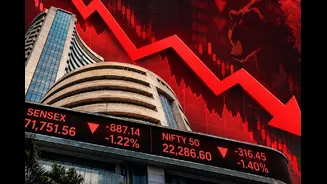
The domestic stock market witnessed a sharp rebound on Wednesday, November 25, with the Sensex and Nifty jumping more than 1% in early trade. The rally comes after a steep sell-off in the previous trading
session, with buying interest returning to heavyweight banking, financial services and information technology stocks.
The Sensex surged over 1,400 points, while the Nifty climbed close to the 25,800 mark. The strong opening was supported by a combination of sustained foreign institutional investor (FII) buying, a sharp decline in crude oil prices, positive signals from GIFT Nifty and bargain hunting following Monday’s correction.
The Nifty Bank also surged 1,170 points or 1.89 per cent to trade at 63,750 in the early session.
Key factors behind market rally today
1. FPIs Continue To Pump Money Into Indian Equities
Sustained buying by foreign institutional investors has emerged as another important support for domestic equities. According to provisional exchange data, FIIs bought Indian equities worth Rs 5,672.99 crore on November 23. This was particularly significant because the buying came even as benchmark indices plunged nearly 1.8% during the session.
Foreign investors have invested a record $14.28 billion in Indian equities so far in November. The inflows also reflect a shift in global investment allocation away from some overseas technology and AI-related stocks towards Indian equities.
Continued foreign buying is providing support to domestic market liquidity and helping absorb selling pressure.
3. Crude Oil Prices Fall Nearly 23% In November
The decline in international crude oil prices is another major positive for Indian markets. Brent crude futures fell to around $90.80 per barrel on Wednesday morning, extending their decline amid expectations of rising supplies and a potential global oil market surplus. Brent crude prices have fallen about 23% so far in November.
Lower crude oil prices are particularly beneficial for India, which relies heavily on imported petroleum to meet its energy requirements.
A sustained decline in crude prices can help reduce India’s import bill, ease pressure on the current account deficit, support the rupee and moderate inflationary pressures. It can also improve the operating margins of oil-consuming sectors such as aviation, paints, chemicals and logistics. This has helped improve the broader macroeconomic outlook for Indian equities.
4. Bargain Hunting After Monday’s Sharp Sell-Off
The sharp correction on Monday has also created an opportunity for investors to accumulate quality stocks at relatively lower levels. On November 23, the Sensex plunged 1,483.72 points, or 1.77%, to close at 82,435.99. The Nifty 50 declined 450.95 points, or 1.75%, to settle at 25,349.65.
The sell-off had come after a four-week winning streak, with investors booking profits across several sectors. Wednesday’s rebound suggests that investors are using the recent correction to buy into fundamentally strong companies, particularly heavyweight banking and financial stocks.
The sharp recovery in benchmark indices also indicates some short-covering, although the extent of short-covering cannot be established from the index movement alone.
5. Heavyweight Banking And IT Stocks Lead The Rally
Buying in heavyweight stocks has provided a significant boost to the benchmark indices. Banking and financial services stocks were among the biggest contributors to Wednesday’s gains. HDFC Bank advanced 3.45%, ICICI Bank gained 3.18%, while Bajaj Finance climbed 3.02% in early trade. Infosys surged 3.31%, while TCS and Tech Mahindra also traded higher.
Sectorally, the Nifty Financial Services index gained 2.34%, Nifty Private Bank advanced 2.25%, Nifty IT rose 1.98%, and Nifty Bank climbed 1.80%. The broader market also participated in the recovery, with the Nifty 100, Nifty 200 and Nifty 500 trading higher.
This broad-based buying indicates that the recovery was not restricted to a handful of index heavyweights.
Global Cues
Gobal market signals remain mixed. Asian equities witnessed significant selling pressure on Wednesday amid renewed concerns over US tariffs and weakness in technology and semiconductor stocks.
South Korea’s Kospi and Taiwan’s benchmark index came under considerable pressure, while Japan’s Nikkei also traded lower. On Wall Street, the Nasdaq Composite declined 1.48% on Tuesday, reflecting continued weakness in technology and AI-related shares.
Nvidia, AMD and other semiconductor stocks witnessed selling, adding to concerns about global technology valuations.