





Bengaluru’s infamous Outer Ring Road (ORR) traffic may soon hit tech workers where it hurts — their wallets.
Employees driving to offices along the ORR corridor could be asked to pay for parking inside
tech parks if a new proposal discussed by Bengaluru Traffic Police (BTP) moves forward. The idea came up during a stakeholder meeting involving traffic police officials, civic agencies, tech park representatives and the Outer Ring Road Companies Association (ORRCA), according to a report in The Times of India.
For lakhs of tech workers who currently park inside office campuses for free, the proposal could significantly change the daily cost of commuting to work, especially for those travelling long distances to ORR offices.
Why Free Parking Has Come Under The Scanner
Traffic police believe free parking inside tech parks is quietly encouraging employees to continue using private vehicles even as congestion worsens across the city’s busiest IT stretch.
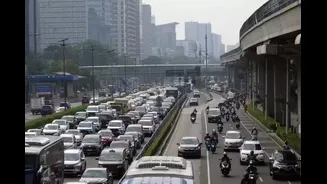
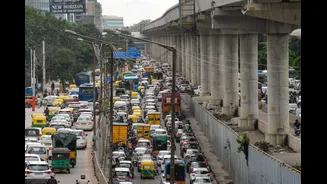
The ORR corridor, home to hundreds of tech companies and major campuses like Ecospace and Ecoworld, sees an estimated 8 to 10 lakh commuters every day. Officials say a large number of cars entering these campuses carry just one person.
Joint Commissioner of Police (Traffic) MN Anucheth was quoted by TOI as saying that when “something is offered free”, people naturally tend to use it more. “When you put a price on it, there is a probability that people might not (use it),” he added.
Bengaluru Traffic Police’s logic appears to be simple: if parking starts costing money, some commuters may shift to buses, Metro services or carpooling.
The concern is especially acute on the Iblur-Sarjapur Road-KR Puram belt, which continues to witness bumper-to-bumper traffic during office rush hours.
What The Proposal Means For Tech Workers
The proposal under discussion is not a blanket ban on private vehicles. Instead, authorities are exploring whether companies can discourage solo driving by making parking chargeable inside office campuses.
Officials also suggested that companies could reward employees who choose public transport or shared rides. One option being discussed is using parking fee collections to subsidise BMTC travel or other commute incentives.
As of now, there is no clarity on how much employees may be charged, whether the move would apply uniformly across tech parks, or when such a system could be implemented.
Still, even the possibility of paid parking is likely to trigger debate among Bengaluru’s tech workforce, many of whom already spend hours navigating ORR traffic every week.
More Ideas Being Discussed To Reduce ORR Traffic
Paid parking was reportedly only one of several ideas raised during the consultation.
Traffic police have also asked companies to encourage carpooling more aggressively, arguing that reducing single-occupancy vehicles could quickly ease road pressure.
Another proposal involves shared transport systems at the tech-park level instead of individual companies running separate fleets. Large campuses could potentially operate common shuttle services for employees travelling from nearby areas.
Authorities are also pushing for BMTC buses to operate from inside tech park campuses so employees do not have to walk long distances from bus stops. According to TOI, BMTC chartered services for tech companies have dropped sharply after the pandemic — from 560 to just 105 — despite offices reopening.
There were also discussions around staggered office timings to spread peak-hour traffic and even a monthly “car-free day” involving select companies.
Tech Industry Says Infrastructure Problems Cannot Be Ignored
While the industry body representing companies on the ORR welcomed the discussions, it also warned that behavioural changes alone would not solve Bengaluru’s mobility crisis.
“There is no denying that single-car usage behaviour has to change and people should travel together in pools. But… people work across different time zones, customers and work models,” TOI quoted Manas Das, president of ORRCA, as saying.
The association argued that employees turned to private vehicles over the years because public transport and last-mile connectivity remain unreliable in several parts of the city.
Among the improvements sought by the industry body are more BMTC services, smaller buses that can enter tech parks, safer bus stops, better feeder roads and stronger last-mile connectivity.