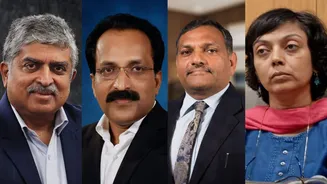







The Centre’s decision to constitute a high-level committee headed by Nandan Nilekani to help reform India’s examination and assessment ecosystem has revived a familiar pattern in Indian policymaking. Whenever
the country has faced a major education crisis – whether it was weak universities, rote learning, unequal access, outdated school structures or concerns over exam credibility – governments have often turned not just to politicians, but to scientists, scholars, administrators and technocrats.
The Nilekani panel, which comes at a time when public examinations and recruitment tests are under intense scrutiny, is only the latest chapter in a long history of expert-led reform efforts. From Dr S Radhakrishnan in 1948 to Dr K Kasturirangan in 2019, these commissions have proposed some of the biggest changes in Indian education: the 10+2+3 structure, the expansion of science education, university autonomy, activity-based learning, lighter school bags and the recent 5+3+3+4 framework under the National Education Policy (NEP) 2020.
Yet the story is also one of incomplete implementation. Several recommendations – such as a common school system, better teacher preparation and public spending of 6 per cent of GDP on education – have returned repeatedly over decades without being fully realised.
Here is a look at the seven major committees that sought to reshape India’s education sector.
Radhakrishnan Commission (1948-49): Rebuilding Universities
Independent India’s first major education commission was the University Education Commission, headed by philosopher and future President Dr Sarvepalli Radhakrishnan.
The commission included eminent academics and public intellectuals such as Dr Zakir Husain, scientist Meghnad Saha and other leading university administrators.
It was formed as India had inherited a colonial university system that was heavily examination-oriented and poorly equipped for research and nation-building.
Key recommendations
- Greater university autonomy
- Better salaries and service conditions for teachers
- Promotion of research-oriented higher education
- Creation of a national body to fund and coordinate universities
Impact
Its recommendations strongly influenced the strengthening of the University Grants Commission (UGC) and established the principle that universities should be centres of knowledge and research, not merely examination factories.
Mudaliar Commission (1952–53): Reforming Secondary Education
The Secondary Education Commission was chaired by Dr A Lakshmanaswamy Mudaliar. It was formed as secondary education was seen as overly literary and disconnected from employment and practical life.
Key recommendations
- Diversification of the curriculum
- Introduction of vocational education
- Reduction of rote learning
- Improvement in guidance and counselling
- Reform of examinations
Impact
The commission laid the foundation for the later 10+2 structure and encouraged the development of vocational streams in schools.
Kothari Commission (1964-66): Most Influential Education Commission
Widely regarded as the most important education commission in Indian history, the Education Commission (1964–66) was chaired by Dr DS Kothari, then Chairman of the UGC. JP Naik served as Member-Secretary, and the commission also involved UNESCO-linked international experts, educationists, scientists and specialists through multiple task forces and working groups.
It came at a time when India’s education system was fragmented, unequal and poorly aligned with national development goals.
Key recommendations
- The 10+2+3 structure of education
- A common school system
- Equal educational opportunity
- Science and mathematics for all students
- Work experience and social service
- Improvement in teacher education
- Public expenditure on education of 6 per cent of GDP
Impact
The 10+2+3 pattern became the national norm, science education expanded significantly and the National Policy on Education, 1968 drew heavily from the commission’s recommendations.
The common school system and the 6 per cent GDP spending target continue to be cited as unfinished agenda items even six decades later.
National Policy On Education 1986: Ramamurti Review (1990-92)
The National Policy on Education (NPE) 1986, introduced under the Rajiv Gandhi government, was not a commission in itself but a major reform framework. It was later reviewed by a committee headed by Acharya Ramamurti.
The review came after concerns persisted over centralisation, inequality, dropout rates and the quality of schooling.
Key recommendations of the Ramamurti Committee
- Decentralisation of educational administration
- Greater participation of teachers and communities
- Reduction in commercialisation
- More child-centred education
Impact
The policy was modified in 1992, though many of the decentralisation proposals were only partially implemented.
Yash Pal Committee (1993): Learning Without Burden
In the early 1990s, anxiety over heavy school bags, excessive homework and rote memorisation led to the formation of the committee headed by Prof. Yash Pal, noted scientist and educationist.
Key recommendation
The report became famous for the phrase “Learning Without Burden.” It proposed:
- Reducing textbook load
- Making learning activity-based
- Reforming board examinations
- Giving teachers greater flexibility
- Encouraging understanding rather than memorisation
Impact
The report profoundly influenced later curriculum reforms and became the intellectual foundation for many ideas incorporated in NCF 2005.
National Curriculum Framework (NCF) 2005: Changing How Children Learn
The National Curriculum Framework 2005 was developed by NCERT under the guidance of Professor Yash Pal. Key contributors included Krishna Kumar, teachers, child psychologists, language experts and educationists.
It sought to move beyond curriculum reform and change classroom pedagogy itself.
Key recommendations
- Constructivist learning
- Connecting knowledge to life outside school
- Flexible curriculum
- Peace education
- Inclusive education
- Continuous and Comprehensive Evaluation (CCE)
Impact
NCERT textbooks were rewritten, and the framework significantly altered the language and pedagogy of school education, although CCE later became controversial and was diluted.
From TSR Subramanian To Kasturirangan: The Road To NEP 2020
India’s most recent major education overhaul came through a two-stage process.
TSR Subramanian Committee (2015–16)
Headed by former Cabinet Secretary TSR Subramanian, the committee included administrators, education experts and policy specialists.
Key recommendations
- Focus on learning outcomes
- Teacher accountability
- Reintroduction of detention after Class 5
- Reform of higher education regulation
- Expansion of vocational education
- Greater use of technology
K Kasturirangan Committee (2017–19)
The drafting committee for the new education policy was headed by former ISRO Chairman Dr K Kasturirangan. The members included Vasudha Kamat, Manjul Bhargava, Ram Shankar Kureel, TV Kattimani, Krishna Mohan Tripathi, among others.
Key recommendations
- The 5+3+3+4 school structure
- Universal Early Childhood Care and Education
- Foundational literacy and numeracy
- Multidisciplinary higher education
- Four-year undergraduate programmes
- Academic Bank of Credits
- National Research Foundation
- A single higher education regulator
- Expanded use of technology
Impact
These recommendations became the backbone of NEP 2020, the most comprehensive education policy reform in decades.
A Pattern Across Decades
India has repeatedly relied on non-political expertise to address educational crises, from DS Kothari, Yash Pal, K Kasturirangan to Nandan Nilekani.
Some recommendations over the years have clearly transformed India:
- 10+2+3 structure
- Expansion of science education
- Strengthening of the UGC
- Navodaya schools
- NCERT curriculum reforms
- The 5+3+3+4 framework
- Foundational literacy initiatives
- Multidisciplinary higher education reforms
But several concerns have resurfaced in almost every generation:
- Exam obsession
- Rote learning
- Teacher quality
- Unequal access between government and private schools
- Adequate public funding for education
How Mandal Commission Impacted Education
The Mandal Commission (Second Backward Classes Commission, 1979) did not redesign India’s education system like the Kothari or Kasturirangan committees, but it fundamentally changed who gained access to higher education. Headed by BP Mandal, the commission identified socially and educationally backward classes and recommended measures for their advancement, including reservation in educational institutions, scholarships, hostels and other support mechanisms.
Its most consequential impact came later, after the 93rd Constitutional Amendment (2005) and the Central Educational Institutions (Reservation in Admission) Act, 2006, which extended 27 per cent reservation for OBCs in centrally funded institutions such as central universities, IITs, IIMs and NITs. The Mandal framework altered the social composition of Indian higher education by expanding representation of historically underrepresented communities, making it one of the most influential social justice interventions in the history of India’s education sector.
Decades after its implementation, the Mandal framework remains central to India’s anti-reservation debate because critics argue that caste-based quotas in higher education and public employment may compromise merit, entrench identity politics and continue to benefit relatively better-off sections within reserved categories despite the creamy-layer principle. They contend that the expansion of reservations in institutions such as IITs, IIMs and central universities has kept alive concerns about fairness, competition and the balance between social justice and academic standards.
Supporters, however, counter that historical exclusion, unequal schooling and persistent social disadvantages make reservations necessary to ensure meaningful representation and equal opportunity. As a result, the Mandal Commission continues to shape one of India’s most enduring and polarising public debates: whether affirmative action should remain primarily caste-based, become more economically targeted, or be accompanied by deeper reforms in school education and social welfare.
The Nilekani Moment
The current committee headed by Nandan Nilekani is focused on fixing the credibility and efficiency of India’s examination ecosystem. In that sense, it belongs to a long tradition of expert interventions that began soon after Independence.
If the Kothari Commission changed the architecture of Indian education and the Kasturirangan Committee redesigned it for the 21st century, the challenge before the Nilekani-led effort is different: can India make its examination system trustworthy, technology-driven and fair at scale?
History offers both hope and caution. India’s education commissions have often produced visionary reports that reshaped policy language and institutional design. The harder task has always been implementation. As the country once again turns to a committee of experts, the real question is whether the government can finally execute them consistently across the country’s vast and unequal education system.